Driveway repair: patch, resurface, or replace
By Noah James
• 9 min read • Founder, DrivewAI
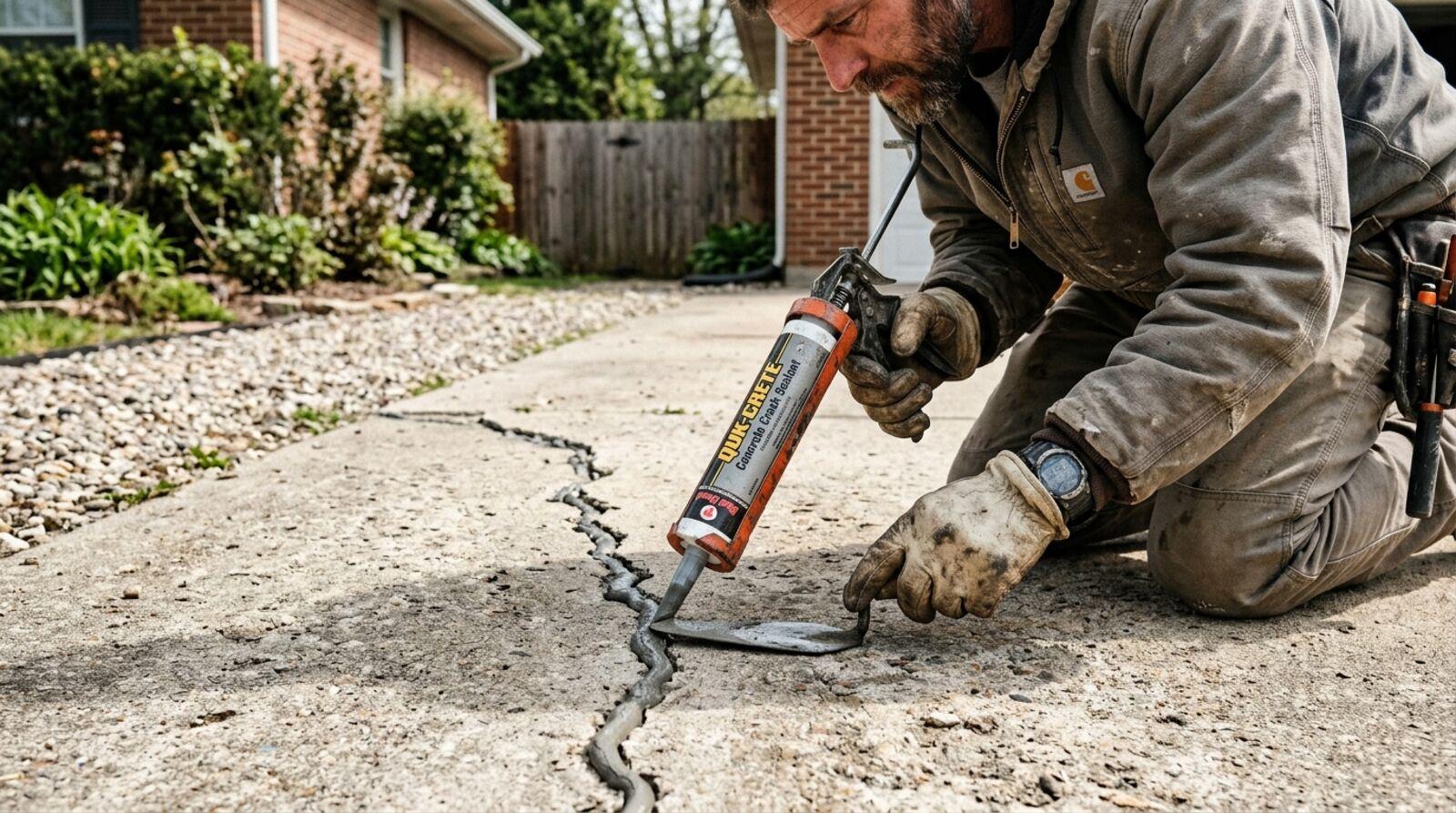
A single hairline crack in your driveway is not the problem. The problem is what that crack becomes 18 months later when water gets in, freezes, thaws, and turns a $50 fix into a $5,000 replacement. Driveway repair is the most cost-effective home maintenance task most homeowners ignore until it's too late.
The decision tree is simple: patch if the damage is cosmetic, resurface if it's widespread but shallow, and replace if the base has failed. The trick is knowing which category your driveway actually falls into — because the wrong repair on the right driveway wastes money, and the right repair on the wrong driveway wastes even more.
How to Diagnose Your Driveway Damage
Before you call a contractor or buy a bucket of filler, spend 10 minutes actually looking at your driveway. Not a glance from the car — a walk across the full surface with a tape measure and a garden hose.
Here's what to look for:
- Hairline cracks (under 1/4 inch wide) — cosmetic damage only. These are normal in concrete and asphalt after a few years. Seal them before winter and move on. - Spider web cracking (multiple interconnected cracks) — early sign of base problems or heavy load stress. Resurfacing usually handles this if the slab is still level. - Wide cracks (over 1/2 inch) — water is getting into the base. Fill and seal immediately, but watch for worsening. If they grow past 1 inch or show vertical displacement, you're headed toward replacement. - Potholes or depressions — the base material has eroded or compacted unevenly. Patching helps short-term; full replacement is usually inevitable. - Heaving or raised sections — tree roots, frost, or failed base. No surface repair fixes this. You need excavation and a new base. - Alligator cracking (asphalt) — the asphalt has reached end of life. An overlay might buy you 5-7 years, but only if the base is sound.
Run a garden hose across the surface and watch where water pools. Standing water accelerates every type of driveway damage. If water sits in the same spots every time, you may also need to read our driveway drainage solutions guide before spending money on surface repairs.
Driveway Repair by Material
Every driveway material fails differently, and the repair approach changes accordingly.
Concrete driveway repair is the most common. Hairline cracks get filled with concrete caulk or a polymer-modified repair compound — a 10-minute DIY job that costs $5-$15 per crack. Wider cracks (1/4 to 1/2 inch) need to be chased with a grinder, cleaned, and filled with a flexible sealant that accommodates seasonal movement. According to the Portland Cement Association, rigid fillers in concrete joints are the number one cause of repeat cracking because they don't flex with the slab.
Spalled concrete — where the surface flakes and pits — can be resurfaced with a polymer overlay for $3-$7 per square foot. This works if the slab underneath is structurally sound. If the slab has settled or cracked through its full depth, no overlay will hold.
Asphalt driveway repair is more forgiving in some ways and less in others. Cold-patch asphalt filler handles potholes up to 3-4 inches deep — you dump it in, tamp it down, and it bonds to the existing surface. Cost: $10-$20 per bag, and one bag fills roughly a 1 square foot, 2-inch deep hole. Hot-mix asphalt repair is more durable but requires professional application.
Asphalt crack sealing is critical maintenance. Unsealed cracks in asphalt let water into the aggregate base, which causes frost heaving in cold climates and base erosion everywhere else. A 5-gallon bucket of asphalt crack sealer costs $15-$25 and covers about 100 linear feet — cheap insurance. See our asphalt driveway sealing guide for the full maintenance schedule.
Paver driveway repair is the most straightforward because pavers are modular. A settled or cracked paver gets pulled up, the base re-compacted and re-leveled, and the paver (or a new one) goes back in. Cost: $5-$15 per square foot for professional repair, or essentially free if you DIY with a rubber mallet and some polymeric sand. Our paver driveway complete guide covers long-term maintenance in detail.
The catch with pavers: if settlement affects a large area (more than 10-15 square feet), the base itself has failed. Pulling up 200 pavers, regrading the base, and relaying them costs nearly as much as a new installation.
Gravel driveway repair is the simplest and cheapest. Add fresh gravel to thin spots, regrade the surface with a box blade or landscape rake, and compact. A cubic yard of gravel costs $30-$75 delivered, and covers about 100 square feet at 3 inches deep. The full rundown is in our gravel driveway guide.
Driveway Repair Cost Breakdown
Here's what you'll pay in 2026 for common driveway repairs, assuming a typical 600-square-foot driveway:
- Crack filling (DIY) — $15-$50 in materials. An afternoon of work. - Crack filling (professional) — $100-$400 depending on crack count and severity. - Pothole patching (DIY) — $20-$60 per pothole. - Pothole patching (professional) — $100-$300 per pothole. - Concrete resurfacing — $1,800-$4,200 ($3-$7/sq ft) for the full surface. - Asphalt overlay — $1,200-$3,000 ($2-$5/sq ft) over existing asphalt. - Full driveway replacement — $3,000-$15,000 depending on material. See our driveway replacement cost guide for detailed breakdowns.
The sweet spot is resurfacing: it costs 30-50% of full replacement and can add 8-15 years to a driveway that's structurally sound but cosmetically worn. If your contractor quotes resurfacing at more than 60% of replacement cost, you should probably just replace.
The Biggest Driveway Repair Mistake
Here it is: ignoring small cracks because they "don't look that bad." Every major driveway failure started as a minor crack that got water in it.
In freeze-thaw climates, water expands 9% when it freezes. That expansion turns a 1/8-inch crack into a 1/4-inch crack in one winter. By year three, you have a network of connected cracks. By year five, the slab has shifted and the base is compromised. A repair that would have cost $50 in year one now costs $5,000.
The fix is embarrassingly simple: walk your driveway once a year — ideally in early spring after frost cycles — and fill every crack wider than a pencil lead. Buy a case of concrete caulk or asphalt crack filler and spend one Saturday morning on it. This one habit can double the lifespan of your driveway.
Repairs You Can DIY vs. Repairs That Need a Pro
DIY-friendly repairs:
- Filling hairline cracks in concrete or asphalt - Patching small potholes in asphalt (under 2 square feet) - Releveling and resetting individual pavers - Adding and grading fresh gravel - Applying asphalt sealer (whole-surface maintenance) - Replacing polymeric sand in paver joints
Hire a professional for:
- Cracks wider than 1 inch with vertical displacement - Resurfacing concrete or asphalt (requires specialized equipment) - Any repair involving base excavation or regrading - Paver repairs affecting more than 15-20 square feet - Leveling a concrete slab with mudjacking or foam injection ($500-$1,500) - Any repair near the driveway apron — this section may involve municipal right-of-way rules. Our driveway apron guide explains who pays for what.
The general rule: if the damage is on the surface only, you can probably fix it yourself. If the damage involves the base layer or structural movement, you need someone with equipment and experience.
When Repair Stops Making Sense
There's a tipping point where repairing your driveway costs more than replacing it — and most homeowners cross it without realizing.
Replace instead of repair when:
- More than 25-30% of the surface has cracks, spalling, or settlement - The driveway has been patched multiple times and patches are failing - Water pools in multiple areas despite previous repairs - The driveway is over 25 years old (concrete) or 15-20 years (asphalt) - You're planning to sell within 2-3 years and the driveway hurts curb appeal
A patched-up driveway that looks like a quilt of different repairs does nothing for your home's value. A clean replacement — even in basic broom-finish concrete — adds curb appeal and eliminates the ongoing repair cycle.
If you're weighing materials for a replacement, our best driveway materials for curb appeal guide compares every option side by side, and our concrete vs. asphalt comparison covers the two most popular choices in detail.
Preview Your Repaired or Replaced Driveway Before Committing
Whether you're patching what you have or planning a full replacement, it helps to see the end result before writing a check. DrivewAI lets you upload a photo of your current driveway and preview what it would look like in any material — fresh concrete, new pavers, stamped concrete, or exposed aggregate. Your Every render is covered by a 24-hour refund guarantee, and a $9 4-pack unlocks enough room to compare several options before you call a contractor.
For more on planning a driveway project from start to finish, our driveway renovation planning guide walks through budgeting, contractor selection, and timeline management.
About the author
Noah James
Founder, DrivewAI
Noah James is the founder of DrivewAI, an AI home visualization platform that helps homeowners, contractors, and real estate agents preview renovations before committing. He built DrivewAI to close the gap between inspiration and execution in home improvement.
His writing focuses on practical renovation decision-making, material comparisons, and how AI visualization tools are changing the way people plan projects — from driveway replacements to full interior staging.
See your home transformed by AI
Upload a photo and get AI renderings across every style. Designs from $9 with a 24-hour refund guarantee.
Try DrivewAI Free