Driveway drainage solutions that actually work
By Noah James
• 9 min read • Founder, DrivewAI
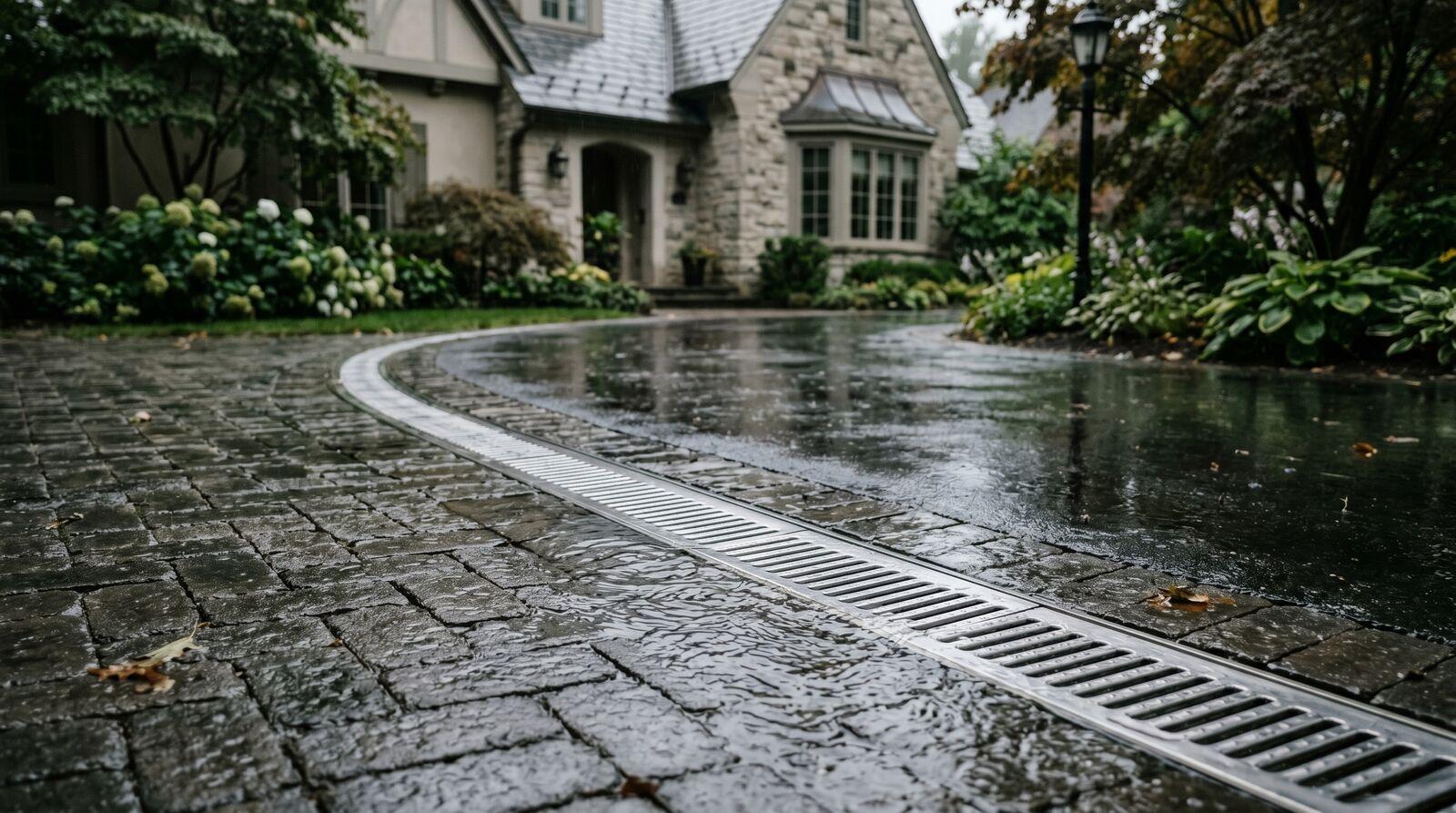
Standing water on your driveway is not a cosmetic issue. It's a ticking clock. Water sitting on concrete accelerates surface spalling. Water pooling on asphalt breaks down the binder that holds the aggregate together. Water collecting at the base of any driveway material erodes the compacted gravel underneath, leading to settling, cracking, and eventual structural failure. Bad driveway drainage shortens a driveway's lifespan by 30-50%.
The good news: most driveway drainage problems have straightforward solutions that cost $500-$5,000 — far less than the $3,000-$15,000 you'll spend on premature replacement. The bad news: diagnosing the actual problem matters more than picking a solution, and most homeowners skip that step entirely.
How to Diagnose Your Drainage Problem
Before you buy anything or call a contractor, you need to understand where the water comes from and where it's supposed to go. Grab a garden hose or wait for a moderate rainstorm and observe:
- Where does water pool? Mark the spots with chalk or spray paint. You're looking for puddles that persist more than 30 minutes after rain stops. - Where does water enter the driveway? From the street? The yard? The roof? The direction of flow determines which solution works. - Where should water go? Every driveway needs an exit route — a yard, a storm drain, a swale, or a dry well. If there's no exit, no drain design will help. - What's the slope? A properly graded driveway slopes at least 1/4 inch per foot (2% grade) away from the garage and toward the street or yard. Use a 4-foot level and measure. If your driveway is flat or slopes toward your garage, that's your primary problem.
The single most useful diagnostic tool is a $3 bottle of spray paint. Mark every low spot, every pooling area, and every place where water flows in from an adjacent surface. When a contractor arrives, you can show them what's happening instead of describing it from memory.
Solution 1: Fix the Grading First
Most driveway drainage problems are grading problems. The driveway doesn't slope enough, or it slopes in the wrong direction. Before installing any drain, verify that the surface grade is working with you, not against you.
For existing driveways, regrading the surface costs $1,000-$4,000 depending on material:
- Asphalt can be overlaid with a tapered layer that creates proper slope. This is the cheapest fix — $1,000-$2,500 for most residential driveways. - Concrete is harder to regrade because you can't easily add a thin layer. Mudjacking (pumping material under the slab to raise it) costs $500-$1,500 and can correct minor grade issues. Polyurethane foam injection is the modern alternative at $1,000-$2,500. - Pavers can be pulled up, the base regraded, and the pavers relaid. Labor-intensive but effective — $2,000-$4,000 for a full driveway. - Gravel is the simplest to regrade. Add material to low spots, use a landscape rake, and compact. DIY cost: $100-$300 in materials.
If your driveway is new construction, insist on a minimum 2% slope in the spec. This is the cheapest drainage solution because it costs nothing extra during installation and prevents 80% of future problems.
Solution 2: Channel Drains
Channel drains — also called trench drains or linear drains — are the workhorse of driveway drainage. They're a narrow trench (4-12 inches wide) cut across the driveway surface with a slotted grate on top. Water flows into the channel and is piped to a discharge point.
Where they work best:
- Across the bottom of a sloped driveway to catch water before it enters a garage - At the transition between the driveway and the street (the apron area — see our driveway apron guide for details) - Where water flows onto the driveway from an adjacent surface
Cost: $1,500-$4,000 installed for a single channel drain across a standard driveway. The drain body itself costs $10-$30 per linear foot; the grate costs $15-$50 per linear foot depending on material (plastic, galvanized steel, or stainless steel); and labor plus pipe routing adds $800-$2,000.
DIY feasibility: moderate. You need a concrete saw (rental: $75-$150/day), the drain body, connectors, grates, and a discharge pipe routed to a storm drain or dry well. It's a hard day of work but saves $1,000-$1,500 in labor.
The most common mistake with channel drains: installing one at the bottom of the driveway but not routing the discharge pipe properly. Water has to go somewhere. If the pipe dead-ends in your yard two feet from the drain, you've moved the puddle, not eliminated it.
Solution 3: French Drains
French drains are underground drainage systems — a perforated pipe wrapped in filter fabric, buried in a gravel-filled trench. Water seeps through the gravel, enters the pipe through perforations, and flows by gravity to a discharge point.
French drains work best for:
- Collecting groundwater that seeps up through or alongside the driveway - Intercepting yard runoff before it reaches the driveway - Draining water away from the driveway edge toward a lower area of the yard
They don't work well for surface water that pools in the middle of a driveway — that's a channel drain problem. French drains handle subsurface and edge-of-driveway water.
Cost: $1,000-$3,000 for a 30-50 foot run alongside or behind a driveway. Materials (pipe, fabric, gravel) cost $3-$8 per linear foot; labor adds $15-$30 per linear foot.
DIY feasibility: high if you own or rent a trencher ($200-$350/day rental). The digging is the hard part. Once the trench is open, laying filter fabric, placing the pipe, and backfilling is straightforward. Budget a full weekend.
One critical detail: French drain pipe must slope at least 1% (1/8 inch per foot) toward the discharge point. Use a string level during installation. A flat French drain is a buried puddle.
Solution 4: Permeable Pavers and Surfaces
Permeable driveway surfaces eliminate pooling by letting water pass through the surface and into the ground. Instead of fighting water with drains and grading, you let the driveway itself handle it.
Options include:
- Permeable pavers — specially designed with wider joints or porous material. Water drains through the gaps into a gravel reservoir base. Cost: $15-$30 per square foot installed, roughly 20-40% more than standard pavers. Our paver driveway complete guide covers the installation differences. - Permeable concrete (pervious concrete) — a mix with reduced fine aggregate that creates an open-pore structure. Water passes through the slab. Cost: $8-$15 per square foot, comparable to standard concrete. - Gravel or crushed stone — inherently permeable. The cheapest permeable option at $2-$5 per square foot. Details in our gravel driveway guide. - Grass pavers (grid systems) — plastic or concrete grids filled with soil and grass that support vehicle weight. Cost: $5-$12 per square foot.
Permeable surfaces are increasingly popular because many municipalities now regulate stormwater runoff from residential properties. The EPA's stormwater management resources detail how local regulations work, and some areas offer incentives or reduced stormwater fees for permeable installations.
The downside: permeable surfaces require specific base preparation (usually 12-18 inches of open-graded gravel reservoir) and periodic maintenance to prevent clogging. Pressure washing or vacuum sweeping once a year keeps pores open.
Municipal Requirements You Need to Know
Before installing any drainage system, check your local regulations. This step saves money, avoids fines, and occasionally unlocks rebates.
- Stormwater runoff rules: Many municipalities now limit how much runoff a property can add to the storm system. If your drainage solution just pipes water to the street faster, you may need a permit or may violate local ordinances. - Discharge restrictions: You typically can't discharge driveway drainage onto a neighbor's property or directly into a natural waterway without approval. - Right-of-way work: If your drainage problem involves the driveway apron (the section between your property line and the street), that's often in the public right-of-way. Repairs or modifications there may require a permit and municipal approval — and in some cases, the city handles it. - Impervious surface limits: Some jurisdictions limit the percentage of your lot that can be covered by impervious surfaces. Adding a larger driveway or patio might push you over that limit and require compensating drainage measures.
Call your local building department before starting. A 5-minute phone call is cheaper than a code violation.
Matching the Solution to the Problem
Not every driveway drainage problem needs the same fix. Here's the decision framework:
- Water pools in the middle of the driveway — grading problem. Fix the slope first. If the driveway can't be regraded, a channel drain across the low point is the fallback. - Water flows from the yard onto the driveway — French drain along the uphill edge of the driveway to intercept before it arrives. - Water accumulates at the bottom of a sloped driveway — channel drain at the base, piped to a storm drain or dry well. - Water enters the garage — channel drain across the garage threshold plus a check of the apron grade. - Water pools everywhere, no slope at all — consider replacing the surface with permeable pavers or regrading during a full replacement. If you're already considering replacement, check our driveway redesign ideas for inspiration. - Heavy clay soil, water has nowhere to go — dry well at the discharge point. A dry well is an underground chamber filled with gravel that slowly releases water into surrounding soil. Cost: $500-$2,000 installed.
The wrong diagnosis leads to the wrong solution, and the wrong solution means you spend $2,000-$4,000 and still have puddles. Take the time to observe water behavior during actual rainfall before committing.
How Drainage Affects Your Driveway's Lifespan — and What to Do Next
A well-drained driveway lasts dramatically longer than a poorly drained one. Concrete in good drainage conditions lasts 25-30 years. The same concrete with chronic standing water might crack and spall in 10-15. Asphalt with proper drainage gets 15-20 years; without it, 7-10. The Federal Highway Administration has documented for decades that water is the primary accelerant of pavement deterioration — and residential driveways follow the same physics.
If you're planning a driveway repair or replacement, solve the drainage problem first. Otherwise you're pouring new material over the same conditions that destroyed the old one. Our driveway repair guide covers when to repair versus replace, and our driveway renovation planning guide includes drainage in the project checklist.
If your drainage fix involves replacing or redesigning your driveway surface, DrivewAI lets you upload a photo and preview what permeable pavers, stamped concrete, gravel, or any other material would look like on your actual property. Your Every render is covered by a 24-hour refund guarantee, and a $9 4-pack unlocks enough room to compare multiple materials before deciding.
Good drainage isn't glamorous, but it's the difference between a driveway that lasts 25 years and one that needs replacing in 10. Fix the water first, then worry about aesthetics.
About the author
Noah James
Founder, DrivewAI
Noah James is the founder of DrivewAI, an AI home visualization platform that helps homeowners, contractors, and real estate agents preview renovations before committing. He built DrivewAI to close the gap between inspiration and execution in home improvement.
His writing focuses on practical renovation decision-making, material comparisons, and how AI visualization tools are changing the way people plan projects — from driveway replacements to full interior staging.
See your home transformed by AI
Upload a photo and get AI renderings across every style. Designs from $9 with a 24-hour refund guarantee.
Try DrivewAI Free