Gravel Driveways: The Honest Guide to Costs and Upkeep
By Noah James
• 9 min read • Founder, DrivewAI
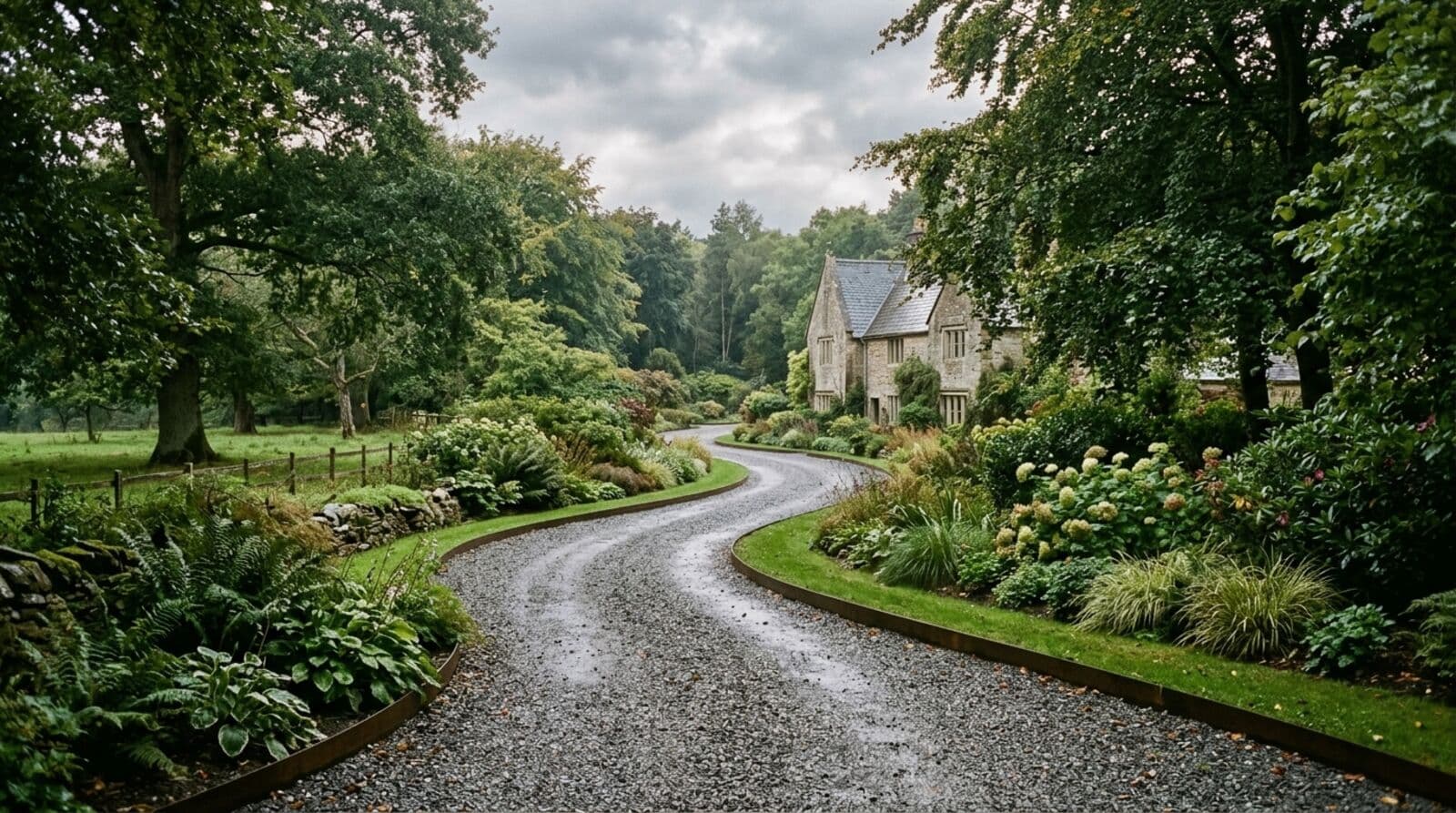
A gravel driveway is either the smartest landscaping decision you'll make or a maintenance headache you'll regret for years. The difference comes down to one thing most guides gloss over: the base. Get the base right and gravel is affordable, attractive, and practically maintenance-free. Skip the base layers and you'll be raking ruts every weekend and watching your gravel slowly sink into the mud.
At $1-$3 per square foot installed, gravel is the cheapest driveway surface by a wide margin. But cheap doesn't mean low-quality — some of the most beautiful properties I've seen use gravel intentionally, not as a budget compromise. The key is understanding which gravel type works for your situation, how to build it properly, and what the real ongoing maintenance looks like.
Types of Gravel for Driveways
Not all gravel works for driveways. This is the single biggest mistake homeowners make — buying the wrong stone.
Crushed stone (angular): This is what you want for a driveway surface. The irregular, angular edges lock together under traffic and create a stable surface. Crushed limestone, crushed granite, and crusher run (a mix of crushed stone and stone dust) are all excellent choices. Size #57 stone (3/4") is the standard top layer.
Pea gravel: Smooth, round, and terrible for driveways. Pea gravel rolls under tires, migrates off the edges, and never compacts into a stable surface. It looks pretty in a garden path. On a driveway, it's like driving on marbles. If someone recommends pea gravel for your driveway, find a different advisor.
River rock: Even worse than pea gravel for driveways. The large, smooth stones shift constantly and can damage vehicle undercarriages. River rock is decorative, not functional.
Crushed gravel/crusher run: A mix of crushed stone and fine particles (stone dust). The fines fill gaps between larger stones and create an incredibly solid surface when compacted. This is what the Penn State Extension recommends for high-traffic surfaces, and the same principles apply to driveways.
Recycled concrete: Crushed concrete from demolition sites. Usually free or very cheap. It compacts well and makes an excellent base layer, though it's not the most attractive top surface.
How Much a Gravel Driveway Actually Costs
Here's the honest pricing for a standard single-lane driveway (12' wide x 60' long = 720 sq ft):
DIY with delivered materials: - Base layer (6" of crusher run): 5-6 tons at $25-$45/ton = $125-$270 - Middle layer (4" of #57 stone): 3-4 tons at $30-$50/ton = $90-$200 - Top layer (2-3" of finish gravel): 2-3 tons at $35-$65/ton = $70-$195 - Delivery (usually 1-2 truckloads): $50-$150 - Equipment rental (plate compactor): $75-$150/day - DIY total: $410-$965
Professional installation: - $1.50-$3.50/sq ft including materials, grading, compaction, and basic edging - For our 720 sq ft driveway: $1,080-$2,520
Compare that to $4-$8/sq ft for basic concrete or $2-$5/sq ft for asphalt, and you see why gravel appeals to budget-conscious homeowners.
The catch: gravel needs topping off every 2-4 years. Budget $200-$500 per top-off. Over 20 years, the maintenance costs add up. But you're still ahead of concrete or asphalt on total lifetime cost for most driveway sizes.
Proper Gravel Driveway Installation: The Layers Matter
A gravel driveway is a layered system. Skipping layers is like building a house without a foundation.
Step 1: Excavation and grading. Remove topsoil and organic material. You need to get down to firm subsoil. Grade the surface with a 2-3% crown (highest in the center) so water flows to the edges. This step alone prevents 80% of gravel driveway problems.
Step 2: Geotextile fabric (optional but smart). Lay landscape fabric over the subgrade. This prevents the gravel from slowly mixing with the underlying soil. On clay soils, this is essential — without it, your gravel will disappear into the clay within a few years. Cost is minimal ($0.10-$0.25/sq ft).
Step 3: Base layer. 6-8 inches of large crushed stone (#3 or #4 stone, 1.5-2.5" diameter) or crusher run. Compact with a plate compactor or roller. This is your structural layer — it distributes vehicle weight and provides drainage.
Step 4: Middle layer. 3-4 inches of medium crushed stone (#57, approximately 3/4"). Compact again. This bridges the gap between the coarse base and fine top layer.
Step 5: Top layer. 2-3 inches of your finish stone. For most driveways, #8 or #9 crushed stone (3/8-1/2") provides a smooth driving surface while still locking together. Compact one final time.
Total depth: 12-15 inches. Yes, that's a lot of digging. But a driveway built this way will last decades with minimal maintenance.
Drainage: Gravel's Secret Superpower
Here's something that doesn't get enough attention: gravel driveways are superior for drainage. Water passes right through the surface and into the ground below. No puddles, no ice sheets, no runoff overwhelming your storm drains.
This matters enormously if you live in an area with stormwater management regulations. Some municipalities charge stormwater fees based on impervious surface area. A gravel driveway often doesn't count as impervious surface, potentially saving you $50-$200 per year in fees. It also means no need for the complex drainage solutions that concrete and asphalt driveways require.
For properties with high water tables, seasonal flooding, or heavy rainfall, gravel isn't just cheaper — it's functionally better than any hard surface.
Gravel Driveway Maintenance: The Reality
Let's be straight about what you're signing up for:
Raking and redistribution (2-4 times per year): Traffic pushes gravel to the sides and creates ruts in high-traffic areas. A landscape rake and 30 minutes fixes this. It's not hard work, but it is recurring work.
Topping off (every 2-4 years): You'll lose about 1/2 inch of surface gravel per year to compaction and migration. A delivery of 2-3 tons ($100-$250) every few years keeps the surface at the right depth.
Weed control: Weeds will find a way, especially at the edges. A pre-emergent herbicide in spring handles most of it. Alternatively, ensure your geotextile fabric extends past the gravel edges.
Snow removal: This is gravel's biggest maintenance drawback. You can't scrape a snowplow blade flat against gravel without removing half your driveway surface. Set the blade 1-2 inches above grade, or use a snow blower. Some homeowners switch to a V-plow angle that pushes snow sideways rather than scraping.
Dust control: In dry climates, gravel generates dust. Calcium chloride ($10-$20 per 50 lb bag) applied to the surface binds fine particles and reduces dust dramatically. You'll need 2-3 applications per summer.
When Gravel Is the Smart Choice
Gravel makes the most sense when:
- Your driveway is long. A 200-foot farm driveway in concrete would cost $15,000-$25,000. In gravel, $2,000-$4,000. - Drainage matters. Properties with poor drainage, high water tables, or stormwater fees benefit from gravel's permeability. - You live in a rural area. Gravel fits the aesthetic and meets the functional needs without overspending. - Your budget is tight but your timeline isn't. Gravel now with a plan to upgrade later is smarter than financing a concrete driveway at 8% interest. - The terrain is challenging. Steep grades, curves, and irregular shapes are much cheaper to build in gravel than poured concrete.
When Gravel Is a Mistake
Gravel is the wrong choice when:
- You live in a dense subdivision with paved streets. Your neighbors will hate you when your gravel migrates onto their property and into the storm drains. Some HOAs prohibit gravel entirely. - You need ADA accessibility. Wheelchairs and walkers don't work well on loose gravel. Stabilized gravel with grid systems can help, but adds significant cost. - You have a short, steep driveway. Gravel migrates downhill. On slopes over 8-10%, you'll constantly be moving stone back uphill. Consider other driveway materials for steep grades. - Resale is your priority. In suburban markets, a gravel driveway can reduce perceived home value. Buyers see future expense, not current savings. - Snowplow access is limited. If you rely on a plowing service and can't specify blade height, your gravel will end up in your lawn every winter.
Gravel Driveway Alternatives and Upgrades
If you like gravel's cost but want more stability, consider these hybrid approaches:
Grid stabilization systems: Plastic honeycomb grids laid on the base and filled with gravel. The grid prevents lateral migration and creates a surface that feels almost like pavement. Adds $1-$2/sq ft but dramatically reduces maintenance.
Tar and chip (chip seal): A layer of hot liquid asphalt topped with crushed stone. Costs $2-$5/sq ft — more than raw gravel but less than asphalt or concrete. Looks like gravel but doesn't require raking. Needs resealing every 5-7 years.
Resin-bound gravel: Gravel mixed with resin to create a solid, permeable surface. Beautiful but expensive ($8-$15/sq ft). More common in the UK than the US.
Making Your Decision
The right driveway surface depends on your property, your budget, and honestly, your tolerance for maintenance. Gravel demands a little ongoing attention in exchange for massive upfront savings and superior drainage.
Before you commit to any surface, try visualizing your options. Upload a photo of your current driveway to DrivewAI and see what gravel, concrete, pavers, or other finishes would actually look like on your property. Customized renders start at $9.00 each. If you're weighing gravel against paving, our driveway renovation planning guide walks through the full decision framework, and inexpensive driveway ideas covers other budget-friendly surfaces worth considering.
About the author
Noah James
Founder, DrivewAI
Noah James is the founder of DrivewAI, an AI home visualization platform that helps homeowners, contractors, and real estate agents preview renovations before committing. He built DrivewAI to close the gap between inspiration and execution in home improvement.
His writing focuses on practical renovation decision-making, material comparisons, and how AI visualization tools are changing the way people plan projects — from driveway replacements to full interior staging.
See your home transformed by AI
Upload a photo and get AI renderings across every style. Designs from $9 with a 24-hour refund guarantee.
Try DrivewAI Free