Cobblestone driveways: real costs and tradeoffs
By Noah James
• 9 min read • Founder, DrivewAI
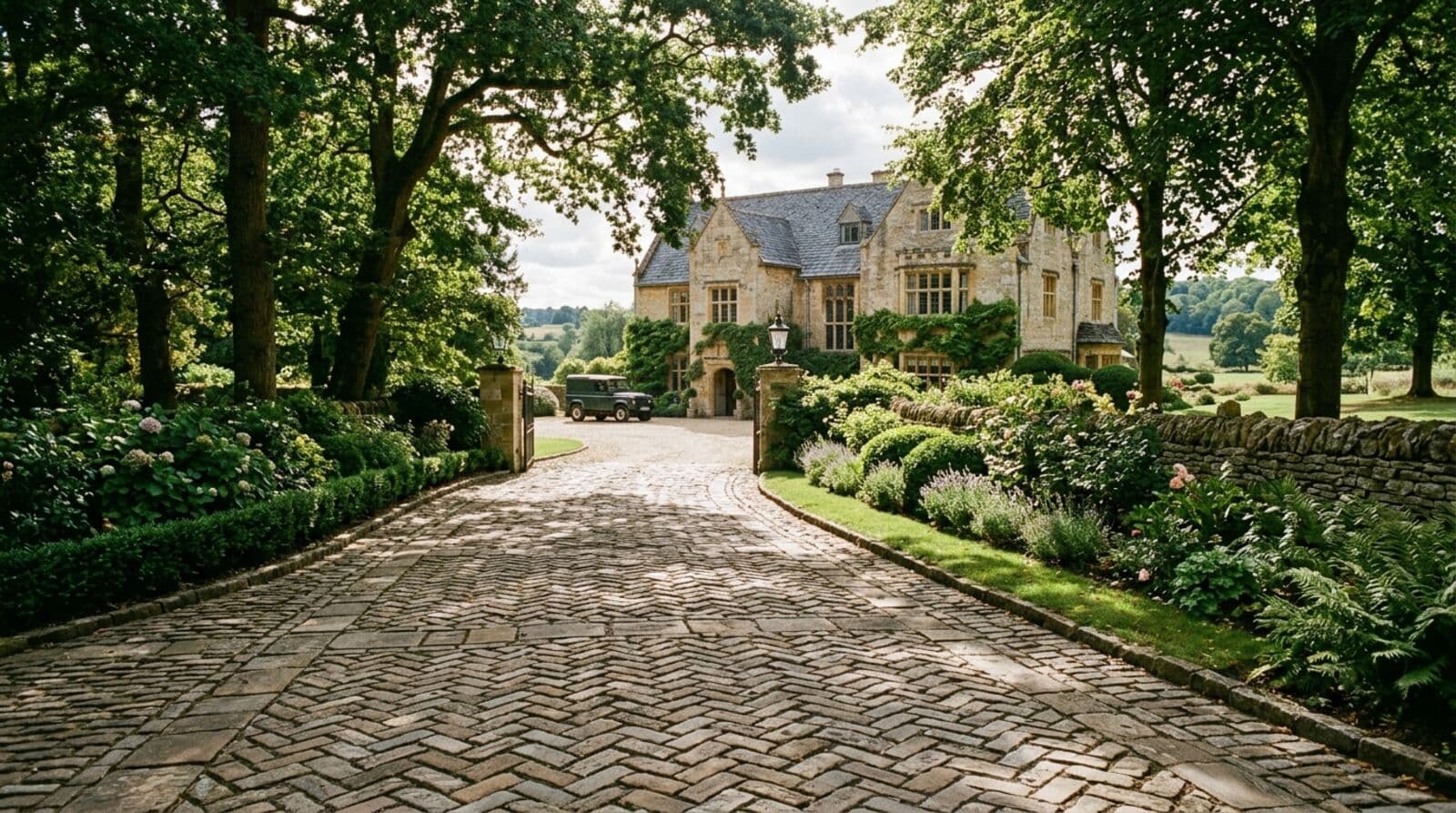
A cobblestone driveway is the single most requested driveway material on home design inspiration boards and the most regretted one in practice. The look is undeniable — that old-world, European charm that makes a suburban home look like it has a backstory. The cost, however, is $15-$40 per square foot installed, which puts a 600-square-foot cobblestone driveway at $9,000-$24,000. And the cost is only the beginning of what you need to know.
Real cobblestone and cobblestone-look pavers are two very different products with different price points, different installation requirements, and different long-term realities. Before you fall in love with the aesthetic, let's talk about what each option actually involves.
Real Cobblestone vs. Cobblestone-Look Pavers
Real cobblestone (also called setts or Belgian block) is natural stone — typically granite, basalt, or sandstone — cut or tumbled into roughly rectangular blocks, usually 4-6 inches square and 4-6 inches deep. Each stone weighs 3-8 pounds and is set individually by hand into a sand or morite bed.
Real cobblestone has been used for roads and driveways for centuries. The stones in many European city centers are hundreds of years old — they're essentially indestructible. That durability is a selling point, but it comes with 2-3 times the installation labor of standard pavers because each stone is irregular and must be fitted individually.
Cost: $20-$40 per square foot installed. The stone itself runs $8-$18 per square foot; labor adds $12-$25 per square foot because of the hand-setting process.
Cobblestone-look pavers (manufactured pavers designed to mimic cobblestone) are concrete or clay products machine-tumbled to create irregular edges and an aged appearance. They come in standard sizes with consistent thickness, which makes them dramatically faster to install.
These pavers capture about 70-80% of the cobblestone aesthetic at about half the price. A well-made cobblestone-look paver in a varied color blend, properly installed with a tight joint, is genuinely hard to distinguish from real cobblestone at car-passing distance.
Cost: $12-$25 per square foot installed. The pavers cost $4-$10 per square foot; standard paver installation labor adds $8-$15 per square foot.
The choice between real and faux cobblestone depends on your budget, your aesthetic standards, and honestly, how close people will be looking. For a driveway border or accent strip, real cobblestone is worth the premium. For a full 600-square-foot driveway, cobblestone-look pavers deliver 90% of the visual impact at 50-60% of the cost.
Why Cobblestone Installation Costs 2-3x More in Labor
Standard concrete pavers install at a rate of roughly 75-100 square feet per day per worker. Real cobblestone installs at 30-50 square feet per day per worker. That labor difference is the single biggest driver of the cost gap, and it comes from three factors:
Irregular stone sizes. Real cobblestones vary in width, length, and height. Each stone has to be selected, tested for fit, and sometimes trimmed with a chisel or masonry saw to work in the pattern. Standard pavers are uniform — pick one up, set it down, move to the next.
Deeper base requirements. Real cobblestone is typically set in a concrete setting bed or a thick mortar bed (2-3 inches) on top of a compacted gravel base (6-8 inches). The total base depth is 10-14 inches. Standard pavers use a 1-inch sand setting bed on 4-6 inches of gravel — total base depth of 5-7 inches. More excavation, more material, more labor.
Joint work. Real cobblestone joints are typically filled with mortar, polymer-modified sand, or stone dust. Each joint is irregular and needs individual attention. Standard pavers use polymeric sand swept into uniform joints — a fraction of the effort.
If a contractor quotes you real cobblestone at the same labor rate as standard pavers, they either don't have experience with cobblestone or they're planning to cut corners on the setting bed. Both are problems.
Cobblestone Driveway Patterns and Layouts
The pattern you choose affects both the look and the structural integrity of a cobblestone driveway:
- Running bond (offset rows) — the most common pattern. Each row is offset by half a stone from the row above. Structurally sound and visually balanced. Works with both real cobblestone and manufactured pavers. - Fan pattern (arcs radiating from a center point) — the classic European cobblestone look. Gorgeous but extremely labor-intensive. Add 30-50% to labor costs for a fan pattern in real cobblestone. The National Trust for Historic Preservation documents this pattern as historically significant in many American cities' original street designs. - Herringbone — sets stones at 45 or 90 degrees in an interlocking V pattern. Excellent for driveability because the interlocking pattern resists shifting under tire loads. Good choice for the main driveway surface. - Basket weave — pairs of stones set alternating horizontally and vertically. More decorative than structural. Better for walkways and borders than the main driving surface. - Random/irregular — uses varying stone sizes in a deliberately unstructured layout. Looks the most authentically old-world but requires the most skilled installation to avoid looking simply messy.
For most homeowners, running bond or herringbone in cobblestone-look pavers gives the best combination of aesthetics, structural performance, and reasonable cost.
Maintenance Reality
Let's be direct about cobblestone driveway maintenance because it's the part inspiration photos never show.
Real cobblestone is virtually maintenance-free in terms of the stones themselves — granite and basalt don't crack, fade, or wear out in a residential setting. The maintenance is all about the joints.
Mortar joints crack over time, especially in freeze-thaw climates. You'll need to repoint (remove and replace cracked mortar) every 5-10 years. Cost: $3-$8 per square foot for professional repointing. DIY is possible but tedious — it involves grinding out old mortar, cleaning the joints, and packing in new mortar one joint at a time.
Sand or stone-dust joints are easier to maintain but wash out faster. Annual topping-off with fresh joint material ($50-$100 in materials for a full driveway) keeps them tight.
Weed growth in joints is the constant battle with any cobblestone driveway. Wider joints and deeper texture provide more footholds for weeds than smooth, tight-jointed pavers. Pre-emergent herbicide applications in spring and fall keep this manageable, but it's an ongoing task.
Cobblestone-look pavers require the same maintenance as standard pavers — annual polymeric sand top-up, occasional pressure washing, and reapplication of sealer every 3-5 years. Our paver driveway complete guide covers the full maintenance schedule.
Snow removal on cobblestone is the hidden headache. The irregular surface catches plow blades and snow shovels. Metal plow blades can chip mortar joints and dislodge stones. Use a rubber-edged plow blade or a snow blower instead. If you're in a heavy-snow climate, seriously consider whether cobblestone is the right choice for your main driveway — it might make more sense as a border accent with a smoother material in the driving lanes.
Where Cobblestone Makes Sense (and Where It's Overkill)
Cobblestone driveways make financial and aesthetic sense in specific situations:
Good fit for cobblestone:
- Short driveways (under 300 square feet) — the per-square-foot premium is high, but the total cost stays under $10,000-$12,000 for real cobblestone and under $7,500 for manufactured. - Driveway borders and accents — a 12-18 inch cobblestone border around a concrete or asphalt driveway adds character at a fraction of the full-surface cost. A border on a 600-square-foot driveway might run $2,000-$4,000. - Historic homes — if your home has genuine architectural character from the early 1900s, cobblestone is contextually appropriate and adds to resale value in a way that standard pavers don't. - Properties where curb appeal is a priority — cobblestone creates an immediate first impression. If you're investing in front yard landscaping for curb appeal, a cobblestone driveway (or accent) ties the whole composition together.
Overkill for cobblestone:
- Large driveways (over 800 square feet) — a full cobblestone installation at $15-$40 per square foot on a 1,000-square-foot driveway costs $15,000-$40,000. That's kitchen renovation money. - Budget-constrained projects — if your total driveway budget is under $8,000, cobblestone-look pavers or stamped concrete with a cobblestone pattern give you a similar look for less. Our inexpensive driveway ideas guide covers additional alternatives. - Heavy-snow climates — the ongoing snow removal complications make cobblestone a high-maintenance choice in regions with 30+ inches of annual snowfall. An alternative: consider a heated driveway system under cobblestone pavers if the budget allows. - Driveways with drainage issues — cobblestone joints are more susceptible to washout from flowing water. Fix drainage problems before investing in cobblestone.
Cobblestone vs. Other Premium Driveway Materials
How does cobblestone stack up against other high-end options?
- Cobblestone vs. standard pavers: Cobblestone costs 1.5-2x more and delivers a more distinctive look. Standard pavers are more practical for most homeowners. See our paver driveway guide for a full comparison. - Cobblestone vs. stamped concrete: Stamped concrete can mimic a cobblestone pattern at $12-$25 per square foot — cheaper than real cobblestone but comparable to manufactured pavers. The trade-off: stamped concrete eventually cracks as a slab, while individual cobblestones or pavers can be repaired one at a time. Our exposed aggregate vs. stamped concrete guide covers the durability differences. - Cobblestone vs. brick: Similar price range ($15-$35 per square foot installed), similar old-world aesthetic, similar maintenance. Brick is easier to source in the US and offers more consistent sizing. Our brick driveway guide has the full breakdown. - Cobblestone vs. exposed aggregate: Exposed aggregate costs $10-$18 per square foot — significantly less than cobblestone — and offers a textured, high-end look with lower maintenance. It's the practical person's premium driveway.
Preview Cobblestone on Your Actual Driveway
The biggest risk with cobblestone is spending $10,000-$25,000 on a material that doesn't suit your home's architecture or your neighborhood's character. A Tudor revival surrounded by cobblestone looks intentional. A 1990s colonial with cobblestone can look like it's trying too hard.
DrivewAI lets you upload a photo of your current driveway and preview what cobblestone — real or manufactured — would look like on your specific property. Compare it to stamped concrete, standard pavers, or brick before committing. Your Every render is covered by a 24-hour refund guarantee, and a $9 4-pack unlocks enough room to test several directions.
For a full overview of material options and their impact on resale value, our best driveway materials for curb appeal guide compares everything side by side.
About the author
Noah James
Founder, DrivewAI
Noah James is the founder of DrivewAI, an AI home visualization platform that helps homeowners, contractors, and real estate agents preview renovations before committing. He built DrivewAI to close the gap between inspiration and execution in home improvement.
His writing focuses on practical renovation decision-making, material comparisons, and how AI visualization tools are changing the way people plan projects — from driveway replacements to full interior staging.
See your home transformed by AI
Upload a photo and get AI renderings across every style. Designs from $9 with a 24-hour refund guarantee.
Try DrivewAI Free