Inexpensive Driveway Ideas That Do Not Look Cheap
By Noah James
• 8 min read • Founder, DrivewAI
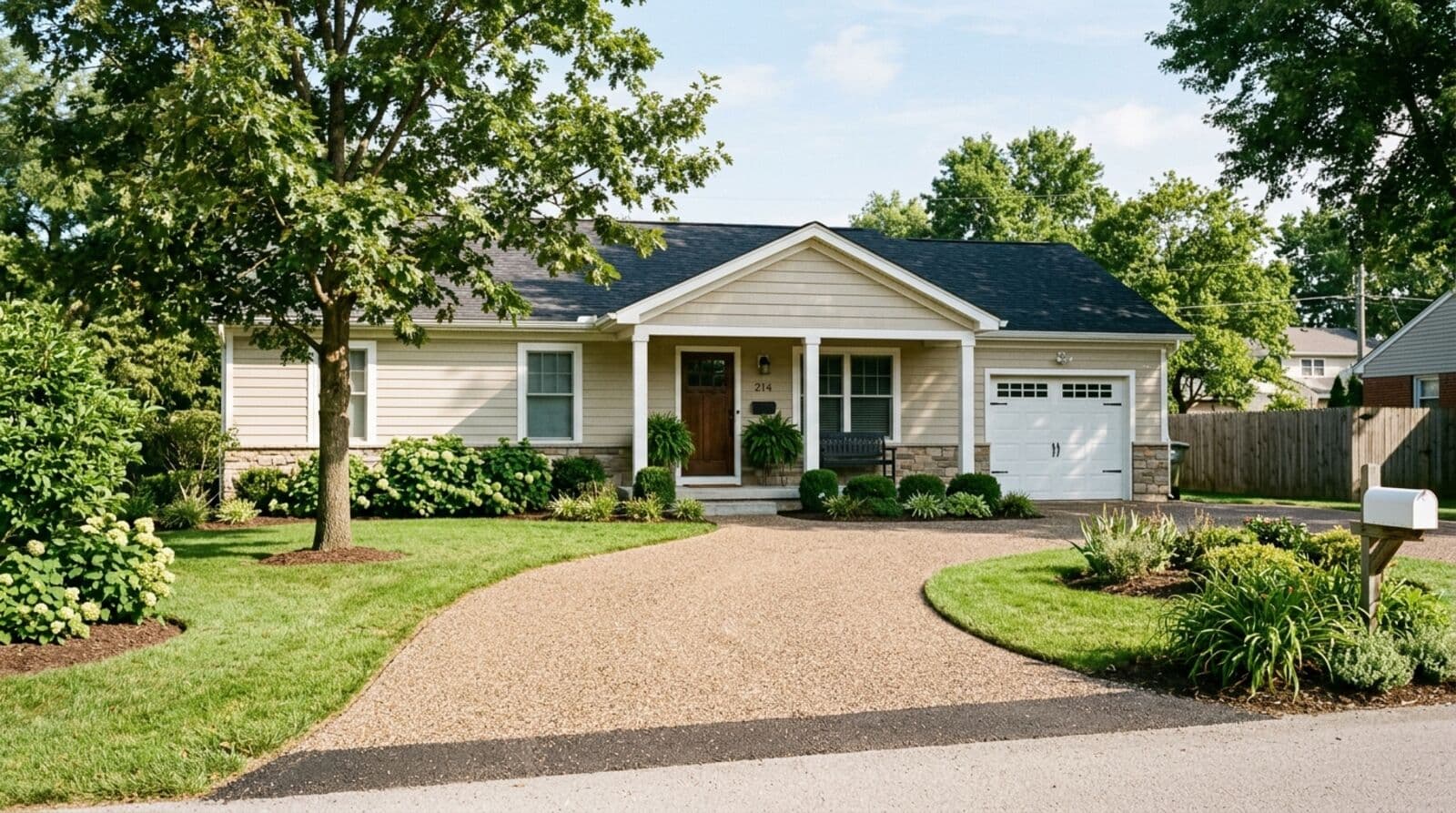
Most articles about inexpensive driveway ideas give you a list of materials sorted by price and call it a day. That approach misses the most important question: what is actually cheap over ten years? A driveway that costs $2 per square foot to install but needs $500 in annual maintenance and a full replacement at year eight is not cheap. It is a subscription you did not sign up for. This guide ranks budget driveway options by true long-term cost, tells you which ones look decent and which ones look like you ran out of money, and covers a resurfacing trick that can save thousands if your existing driveway still has structural integrity.
The Cheapest Options Ranked by Real Long-Term Cost
Before diving into specifics, here is the honest ranking from least expensive to most expensive over a 15-year ownership period, assuming a 600-square-foot driveway.
- Gravel: $1,200 to $3,000 upfront, plus $200 to $400 annually for regrading and top-up. 15-year cost: roughly $4,200 to $9,000. - Tar-and-chip: $1,800 to $4,200 upfront, minimal annual maintenance. 15-year cost: roughly $2,500 to $5,500 (may need a second application at year 10). - Recycled asphalt millings: $600 to $2,400 upfront, some annual maintenance. 15-year cost: roughly $2,000 to $5,000. - Basic poured concrete with broom finish: $4,800 to $7,200 upfront, almost no maintenance. 15-year cost: roughly $5,000 to $7,500. - Standard asphalt: $4,200 to $7,800 upfront, sealing every 2-3 years at $200 to $400. 15-year cost: roughly $5,400 to $10,200.
Notice that the cheapest upfront option (gravel) is not the cheapest over 15 years. That distinction likely goes to tar-and-chip or recycled asphalt millings, depending on your climate and how well the initial installation is done.
Gravel: The Universal Budget Driveway
Gravel driveways cost $2 to $5 per square foot installed, making them the most accessible option for almost any budget. A basic gravel driveway for two cars can be done for under $2,000 in many markets. According to the National Association of Home Builders, gravel remains one of the most common driveway surfaces in rural and semi-rural areas nationwide.
The key to a gravel driveway that does not look like a construction site is proper layering and edging. You want three layers: a 4-inch base of large crushed stone (typically #3 or #4), a middle layer of smaller stone (#57), and a top layer of fine angular gravel (#8 or crusher run) that compacts into a firm surface. Skip the base layers and your driveway will develop ruts within months.
Edging makes or breaks the appearance. Steel, aluminum, or stone edging that keeps the gravel contained creates clean lines and prevents migration into the lawn. Without edging, gravel creeps everywhere and looks neglected within a season.
The honest downsides: gravel driveways are noisy, can be difficult to shovel in winter, shed stones onto the street, and require periodic regrading with a box blade or heavy rake. They are also not great for high heels, wheelchairs, or strollers. If any of those matter to you, gravel probably is not your answer.
Tar-and-Chip: The Budget Option Nobody Talks About
Tar-and-chip (also called chip seal or macadam) costs $3 to $7 per square foot and looks significantly better than gravel. The process involves spraying hot liquid asphalt over a prepared base and immediately rolling crushed stone into the surface. The result is a textured, natural-looking surface that sheds water well and handles traffic without rutting.
Tar-and-chip is the sleeper pick of budget driveways. It provides a solid, low-maintenance surface at roughly half the cost of standard asphalt. It does not require sealing. The stone surface provides excellent traction in wet and icy conditions. And the natural stone color options — tan, gray, brown, blue-gray — blend beautifully with rural and suburban landscapes.
The downsides are real but manageable. Tar-and-chip is not as smooth as asphalt or concrete, so it is harder to shovel and can be rough on bare feet. Loose stones will shed from the surface for the first few months. Not every contractor offers tar-and-chip, so finding an experienced installer may take some calls. And the surface is not as durable as asphalt — high-traffic areas may wear down after 7 to 10 years and need a fresh application.
Recycled Asphalt Millings: Surprisingly Effective
When road crews resurface asphalt roads, they mill up the old surface. That ground-up asphalt — called millings or RAP (reclaimed asphalt pavement) — is available from paving companies and often costs very little. Installed, recycled asphalt millings run $1 to $4 per square foot, making them one of the cheapest solid-surface options available.
Here is the clever part: asphalt millings still contain residual asphalt binder. When you spread them, compact them, and let them bake in summer heat, the old binder softens and re-bonds. Over a season or two, millings can form a surprisingly hard, cohesive surface that looks and performs like a worn asphalt driveway.
Quality varies. Ask for millings from a reputable paving company and try to inspect the material before delivery. You want relatively uniform, small-particle millings without large chunks of concrete or other debris mixed in. Spread them 3 to 4 inches thick over a compacted gravel base and roll them with a heavy roller. Water them periodically during the first summer to help activate the binder.
The obvious downside is that recycled millings are not as uniform or finished-looking as fresh asphalt. They work well for longer rural driveways where a rustic appearance is acceptable. For a suburban home where curb appeal matters, millings alone might look too rough. Combining millings as a base with a tar-and-chip top coat gives you a budget-friendly driveway that actually looks intentional.
The Resurfacing Trick Most People Do Not Know About
If your existing asphalt or concrete driveway is structurally sound — meaning the base is stable, there is no significant heaving or settling, and the surface damage is limited to the top inch or so — you can often resurface rather than replace. This costs 30 to 50 percent less than a full tear-out and replacement.
Asphalt resurfacing (overlay) involves cleaning the existing surface, repairing major cracks, and paving a fresh 1.5 to 2-inch asphalt layer on top. Cost: $3 to $7 per square foot, compared to $7 to $13 for full removal and replacement. The new surface looks and performs like a brand-new driveway.
Concrete resurfacing applies a polymer-modified concrete overlay that bonds to the existing slab. These overlays can be stamped, stained, or textured to completely transform the appearance. Cost: $3 to $10 per square foot for the overlay, compared to $8 to $18 for full removal and new pour.
The catch is that resurfacing only works when the underlying structure is solid. If your driveway has significant cracks from a failed base, settling, or tree root damage, an overlay will crack in the same places within a year or two. Have a contractor evaluate the base before committing to an overlay.
Concrete on a Budget: The Broom Finish Secret
Standard poured concrete with a simple broom finish costs $6 to $10 per square foot — not the cheapest option, but it offers arguably the best value when you factor in longevity and near-zero maintenance. A plain concrete driveway lasts 30 to 40 years with minimal care.
The broom finish is key to keeping costs down. Exposed aggregate, stamped patterns, and colored concrete all add $3 to $10 per square foot in finishing costs. A clean broom finish with well-placed control joints and a nice edge profile looks perfectly respectable and costs nothing extra.
If you want some visual interest without the cost of stamping, consider a simple border treatment. A contrasting stamped or exposed aggregate border (12 to 18 inches wide) around the perimeter of a broom-finished field adds visual interest for a fraction of what full stamping would cost. The border-and-field approach saves 60 to 70 percent compared to stamping the entire surface.
Another budget concrete trick: integral color. Adding iron oxide pigment to the concrete mix costs $1 to $2 per square foot and produces a uniform, permanent color change. A warm tan or sandstone-colored concrete with a broom finish looks surprisingly upscale and costs far less than staining or stamping.
What Looks Cheap and What Does Not
Honesty matters here. Some budget options look great. Others look like budget options.
Looks good on a budget: tar-and-chip with natural stone color, clean gravel with proper edging and a defined border, broom-finished concrete with integral color, asphalt with crisp edges and a fresh seal coat.
Looks cheap: loose gravel without edging (stones everywhere, no definition), raw recycled millings on a suburban lot, cracked asphalt with patch repairs in different colors, concrete with misaligned control joints or uneven surfaces.
The common thread is not the material — it is the installation quality and the details. Edging, grading, clean borders, and uniform surfaces make inexpensive materials look intentional. Sloppy installation makes even expensive materials look bad.
Do Not Forget Drainage
Budget driveway projects often skip proper drainage planning, and it is the mistake that causes the most expensive problems down the road. Water that pools on or alongside your driveway will eventually undermine the base, cause frost heave in cold climates, and direct runoff toward your foundation.
Every driveway needs a minimum crown or cross-slope of 2 percent — about a quarter inch per foot — to direct water off the surface. For longer driveways, a swale or French drain along one or both sides prevents water from pooling against the edges.
Gravel driveways are actually excellent for drainage because water percolates through the surface. But even gravel needs to be graded so that surface water flows away from structures. Spending an extra $300 to $500 on proper grading during installation saves thousands in potential foundation or erosion problems later.
See What Your Budget Driveway Could Look Like
The hardest part of choosing a budget driveway material is imagining what it will look like on your specific property. Gravel looks amazing on some homes and terrible on others. Same with tar-and-chip, plain concrete, and asphalt. Upload a photo of your current driveway to DrivewAI and preview different materials at different price points before spending a dollar. You can compare how a $3-per-square-foot option stacks up visually against a $10 option and decide where the sweet spot is for your budget and curb appeal goals. Check out our full driveway materials comparison and driveway cost breakdown for more details, then try the free visualizer to see the options on your actual home.
About the author
Noah James
Founder, DrivewAI
Noah James is the founder of DrivewAI, an AI home visualization platform that helps homeowners, contractors, and real estate agents preview renovations before committing. He built DrivewAI to close the gap between inspiration and execution in home improvement.
His writing focuses on practical renovation decision-making, material comparisons, and how AI visualization tools are changing the way people plan projects — from driveway replacements to full interior staging.
See your home transformed by AI
Upload a photo and get AI renderings across every style. Designs from $9 with a 24-hour refund guarantee.
Try DrivewAI Free