Concrete Driveway Cost: Real Prices by Finish Type
By Noah James
• 9 min read • Founder, DrivewAI
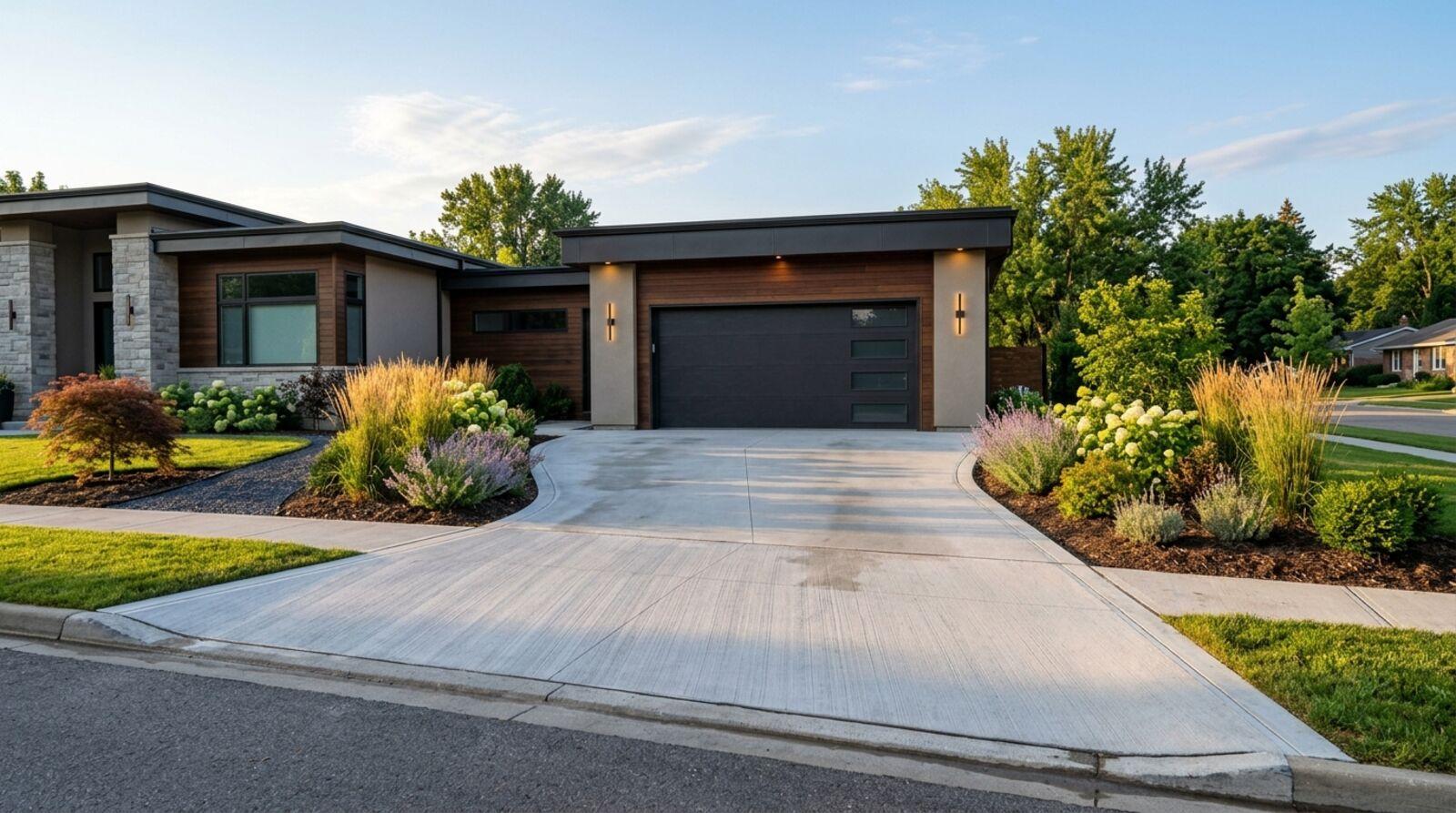
Understanding concrete driveway cost shouldn't require a contractor's visit and three weeks of phone tag. The honest range is $4-$18 per square foot installed, and the massive spread depends almost entirely on what finish you choose and what's already on the ground. A basic broom-finish slab for a two-car driveway runs $2,400-$4,800. A stamped and colored masterpiece hits $7,200-$10,800 for the same footprint. Let me break down exactly where your money goes.
Most online cost guides give you a single national average and call it a day. That's useless. Concrete costs vary 30-40% by region, and the finish type matters more than the square footage. Here's the real math.
Concrete Driveway Cost Per Square Foot by Finish
These are installed prices including labor, materials, and standard site prep for 2025-2026, cross-checked against HomeAdvisor's 2025 concrete driveway pricing and Concrete Network's national finish pricing. For a typical two-car driveway of 600 square feet:
| Finish | Cost / sq ft | 600 sq ft total | Notes |
|---|---|---|---|
| Broom finish (standard gray) | $4-$8 | $2,400-$4,800 | Baseline — functional, slip-resistant, plain |
| Colored (integral color) | $6-$10 | $3,600-$6,000 | Color mixed into the concrete; goes all the way through |
| Exposed aggregate | $7-$12 | $4,200-$7,200 | Top cement paste washed off to reveal stone |
| Stamped concrete | $8-$14 | $4,800-$8,400 | Pattern pressed in while wet; labor-intensive |
| Stamped + colored | $10-$18 | $6,000-$10,800 | The full treatment |
For a deeper dive on stamp patterns versus paver alternatives, check out stamped concrete vs pavers.
The Quick Mental Math Formula
Here's a shortcut contractors use for ballpark estimates:
Base cost = Square footage x $6. Then adjust: - Subtract 25% for basic broom finish in a low-cost market - Add 30% for stamping - Add 15% for integral color - Add 40% for both stamping and color - Add $1,000-$2,500 if the old driveway needs demolition and removal
So for a 600 sq ft stamped and colored driveway with demo: 600 x $6 = $3,600 base. Add 40% ($1,440) for stamping and color. Add $1,500 for demo. Rough total: $6,540. That will land you within 15-20% of most real quotes.
What Actually Drives Concrete Driveway Cost Up
Thickness matters more than you'd think. A standard residential driveway is 4 inches thick. If you have heavy vehicles (RVs, boats on trailers, work trucks), you need 5-6 inches. Going from 4" to 6" increases material costs by roughly 50% — that's an extra $1.50-$2.50 per square foot.
Rebar vs wire mesh. Wire mesh reinforcement is standard and adds minimal cost ($0.15-$0.30/sq ft). Rebar reinforcement (typically #4 rebar on 18" centers) adds $0.75-$1.50/sq ft but significantly reduces cracking, especially on expansive clay soils. If your area has clay soil, rebar is not optional — it's mandatory if you want the slab to last. The Portland Cement Association recommends reinforcement for all residential slabs.
Demolition and removal. If you're replacing an existing driveway, demo costs $2-$4 per square foot. A 600 sq ft concrete driveway produces roughly 12 tons of debris. Disposal fees vary wildly by location — some areas have free concrete recycling, others charge $50-$75 per ton. Always ask about disposal costs separately. Some contractors include it in their bid, others don't.
Subgrade preparation. On solid, well-draining soil, subgrade prep is minimal — grade the dirt, compact it, add 4" of gravel base, compact again. On poor soil (clay, organic material, or high water table), you might need to excavate deeper and add more base material. An extra 4" of crushed stone base adds $1-$2/sq ft.
Access and logistics. If the concrete truck can't back up to your driveway, the crew needs to wheelbarrow or pump the concrete. Concrete pumping adds $800-$1,500 to the job. Narrow side yards, steep lots, and long distances from street to pour site all increase cost.
Regional Price Variations for Concrete Driveways
Concrete driveway cost isn't uniform across the country. Labor rates published by the U.S. Bureau of Labor Statistics for cement masons (47-2051) vary by 60% across metros, and material availability creates further differences:
| Region | Markets | Adjustment vs. national avg | Why |
|---|---|---|---|
| West Coast | LA, San Francisco, Seattle | **+20% to +35%** | High labor, strict permits, expensive disposal |
| Northeast | Boston, NYC, Philadelphia | +15% to +25% | High labor; shorter pouring season |
| Midwest | Chicago, Minneapolis, Detroit | At national average | Competitive contractor market; short season |
| Southwest | Phoenix, Las Vegas, Albuquerque | -5% to -15% basic; +0-15% decorative | Cheap basic; high decorative demand |
| Southeast | Atlanta, Charlotte, Nashville | -5% to -10% | Lower labor; longer pouring season |
| Rural | Anywhere outside metros | -10% to -20% | Lower labor; less bid competition |
Always get at least three quotes. In my experience, the spread between the lowest and highest bid for the same job is usually 40-60%. The lowest bid isn't automatically the best — ask about their concrete mix design, reinforcement, and cure time before choosing.
Hidden Costs Most Homeowners Miss
Permits. Many jurisdictions require a permit for driveway work, typically $50-$200. Some require engineering for driveways over a certain size or on slopes.
Apron replacement. The apron is the section between your driveway and the street. Some municipalities require you to replace the apron when you redo the driveway. An apron replacement adds $500-$1,500 and may require a separate permit. Check out our driveway apron guide for more on this.
Cure time. You can't park on new concrete for 7 days minimum, and heavy vehicles should wait 28 days for full cure. If you have only one driveway and no street parking, you need to plan for a week of hauling groceries from down the block.
Sealing. New concrete should be sealed 28-30 days after pouring to protect against stains, moisture, and freeze-thaw. Add $0.50-$1.50/sq ft for professional sealing, or $0.15-$0.25/sq ft for DIY. Our driveway sealing guide covers the process in detail.
Expansion joints and control joints. These are cut into the concrete to control where cracking occurs. A good contractor includes these in the bid. A bad contractor skips them and your slab cracks randomly. Make sure joints are specified in your contract.
Concrete vs Other Driveway Materials: Cost Comparison
How does concrete stack up against the alternatives? Lifespan figures below are from the National Association of Realtors' driveway-material lifespan summary and Concrete Network; pricing reflects 2025-2026 installed costs.
| Material | Installed cost / sq ft | Typical lifespan | Maintenance cadence |
|---|---|---|---|
| Gravel | $1-$3 | 10-20 yrs | Top-off every 2-4 yrs |
| Asphalt | $2-$5 | 15-20 yrs | Seal every 3-5 yrs |
| Concrete (broom) | $4-$8 | 25-30+ yrs | Seal every 5-7 yrs |
| Concrete (stamped) | $8-$14 | 25-30+ yrs | Seal every 3-5 yrs |
| Pavers | $10-$25 | 30-50 yrs | Re-sand joints every 5-10 yrs |
Read the deeper guides: concrete vs asphalt, paver driveway guide, and gravel driveway guide.
How to Get the Best Price on Your Concrete Driveway
Time your project for the shoulder season. Concrete contractors are slammed from May through September. Schedule for October or March and you might save 10-15% — they'd rather keep crews busy at a discount than lay them off.
Bundle with neighbors. If your neighbor also needs driveway work, approach contractors together. A concrete truck carries 10 cubic yards — enough for about 800 sq ft at 4" thickness. If your driveway uses 7 yards, the remaining 3 would go to waste. A neighbor's small patio or walkway fills that truck and saves both of you money.
Don't cheap out on thickness or reinforcement. A driveway that cracks in year three because you saved $400 on rebar is not a savings. It's a $5,000 mistake.
Ask about the concrete mix. Standard residential is 3,000-4,000 PSI. For driveways in freeze-thaw climates, 4,000 PSI with air entrainment is the minimum. Some contractors cut costs by using lower-strength mixes — this is not where you want savings.
Figuring Out What Your Driveway Could Look Like
Numbers on a page only get you so far. The biggest decision isn't just cost — it's what finish will look right with your house. A stamped ashlar slate pattern that looks incredible on a craftsman home can look ridiculous on a mid-century ranch.
Before you commit to a specific finish, try uploading a photo of your current driveway to DrivewAI to preview different concrete finishes on your actual home. Customized renders start at $9.00 each. Seeing a stamped, colored, or exposed aggregate finish overlaid on your real property takes the guesswork out of a decision you'll live with for decades. And for more design inspiration, browse our driveway redesign ideas collection.
About the author
Noah James
Founder, DrivewAI
Noah James is the founder of DrivewAI, an AI home visualization platform that helps homeowners, contractors, and real estate agents preview renovations before committing. He built DrivewAI to close the gap between inspiration and execution in home improvement.
His writing focuses on practical renovation decision-making, material comparisons, and how AI visualization tools are changing the way people plan projects — from driveway replacements to full interior staging.
See your home transformed by AI
Upload a photo and get AI renderings across every style. Designs from $9 with a 24-hour refund guarantee.
Try DrivewAI Free