Deck Ideas That Make Your Backyard Feel Twice as Big
By Noah James
• 8 min read • Founder, DrivewAI
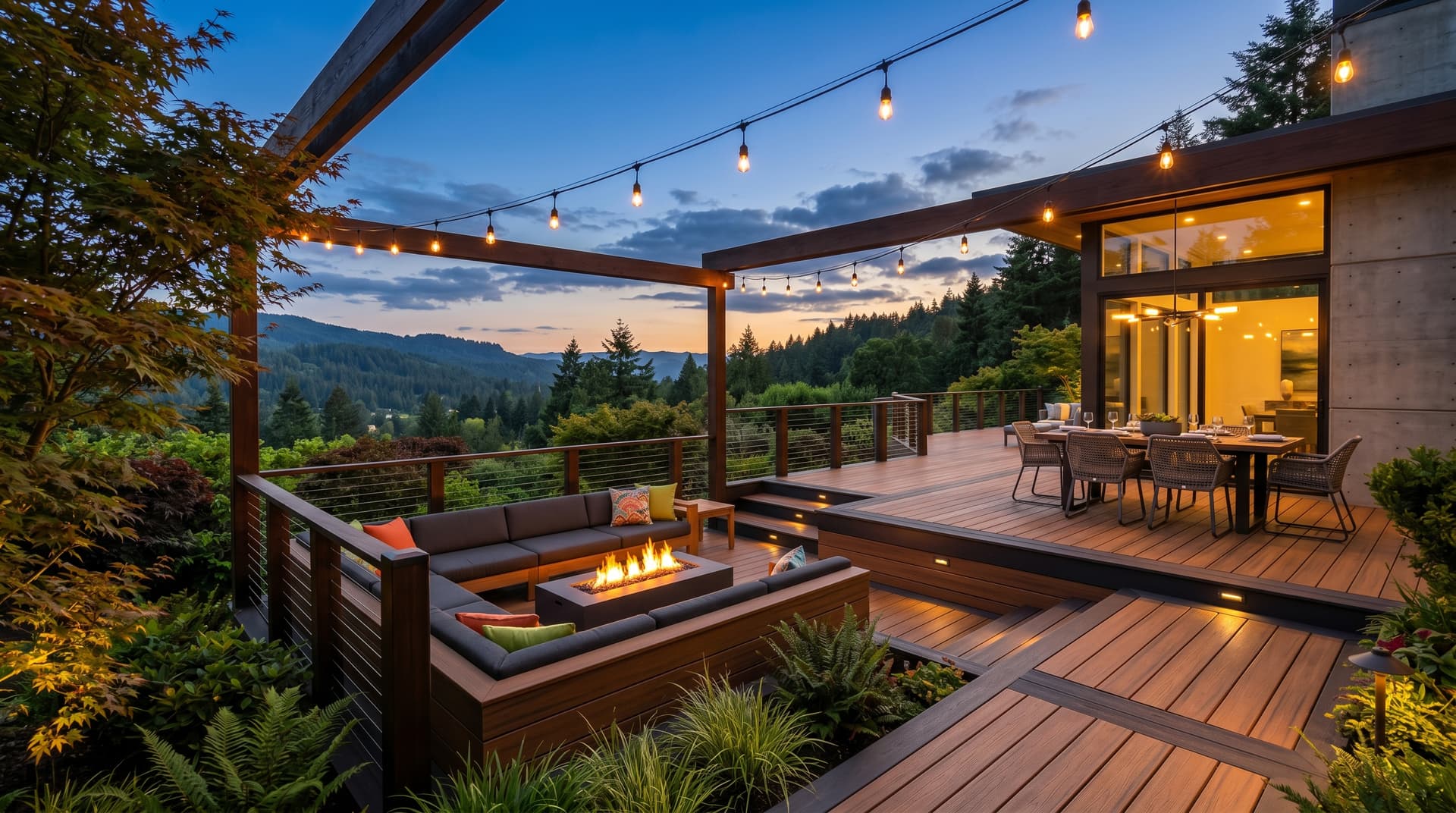
The right deck ideas don't just add square footage to your backyard — they change how you use the entire space. A well-designed deck turns a door that leads "outside" into a door that leads to a room. The wrong deck is a flat rectangle of boards that nobody sits on because it's too hot, too exposed, or too disconnected from everything else.
Most deck projects cost between $15,000 and $35,000 for a mid-range build with composite decking, and the decisions you make before construction — layout, material, railing, level changes — determine whether that investment creates a space you actually use or one you walk past. Here's what's worth building in 2026.
Wood vs. Composite Decking — the Real Tradeoff
Every deck project starts with the material question, and in 2026 the answer has shifted decisively toward composite for most homeowners. But the tradeoff isn't as simple as "composite is better."
Pressure-treated wood: - Cost: $8-$14 per square foot (materials only) - Lifespan: 10-15 years with annual maintenance - Pros: lowest upfront cost, easy to cut and modify, natural appearance - Cons: annual staining/sealing required, splinters, warping, fading
Composite decking (Trex, TimberTech, Fiberon): - Cost: $20-$40 per square foot (materials only) - Lifespan: 25-50 years with minimal maintenance - Pros: no staining or sealing, won't splinter or warp, fade-resistant, consistent color - Cons: higher upfront cost, retains more heat in direct sun, can't be refinished
Hardwood (ipe, cumaru, tigerwood): - Cost: $25-$45 per square foot (materials only) - Pros: stunning natural grain, extremely durable (25+ years), hardest decking surface available - Cons: expensive, requires specialized fasteners, needs annual oiling, heavy
The math: a 300-square-foot deck in pressure-treated wood costs roughly $4,500 in materials and needs $200-$400 in annual maintenance. Over 15 years, that's $7,500-$10,500 total. The same deck in composite costs $9,000 upfront with near-zero maintenance. Over 25 years, composite costs less per year of use — and you never spend a weekend sanding and staining.
Deck Layout Ideas That Actually Work
The layout matters more than the material. A beautiful deck in the wrong configuration feels awkward. The layouts that consistently work:
Multi-level deck: Two or more platforms connected by a few steps. The level change naturally creates zones — upper level for dining, lower level for lounging. Best for sloped yards where a single flat platform would require excessive framing. Cost premium: 20-30% over a single-level deck of the same total area.
Wraparound deck: L-shaped or U-shaped, wrapping around a corner of the house. Creates multiple outdoor "rooms" accessible from different interior rooms. Works well when you want the kitchen door to access a dining area and the living room door to access a lounging area.
Floating deck (ground-level): Not attached to the house, sitting on its own footings at or near grade. No ledger board, no flashing concerns, simpler permitting in many jurisdictions. Best for flat yards where you want a defined outdoor surface without the height and railing of an elevated deck.
Platform with built-in seating: A single-level deck with integrated bench seating along the perimeter. Eliminates the need for outdoor furniture along the edges, maximizes usable floor space, and creates a clean, architectural look. The built-in benches can include storage underneath.
Before committing to a layout, preview how it looks against your house. DrivewAI's landscape visualization lets you upload a photo of your backyard and test different deck configurations in your actual space — seeing scale, proportion, and how the deck relates to your existing landscape.
Railing Options That Change the Whole Look
Railing is the most visible element of an elevated deck, and the wrong choice can make a $30,000 deck look like a $5,000 one. Options ranked by visual impact:
- Cable railing ($60-$120 per linear foot) — horizontal stainless steel cables between metal or wood posts. Minimalist, modern, and almost invisible from a distance. Preserves views. The most popular choice for contemporary deck designs. - Glass panel railing ($80-$150 per linear foot) — tempered glass panels in aluminum frames. Maximum view preservation. Premium look but shows fingerprints and water spots. - Horizontal metal bar ($50-$100 per linear foot) — thin horizontal bars instead of cables. Similar aesthetic to cable rail but no tension adjustment needed. Clean lines. - Traditional wood baluster ($30-$60 per linear foot) — vertical wood spindles. Classic look that works on traditional homes. Can feel heavy or dated on modern designs. - Composite baluster ($40-$80 per linear foot) — maintenance-free alternative to wood balusters. Available in square and round profiles. Consistent color but less character than real wood.
The International Residential Code requires railings on any deck surface 30 inches or more above grade, with a minimum height of 36 inches (42 inches in some jurisdictions). Baluster spacing must not exceed 4 inches. Check local codes before choosing a style — some municipalities have additional requirements for cable and glass railings.
How to Make a Small Deck Feel Larger
Small decks — under 200 square feet — need different design strategies than large ones. The goal isn't to cram everything onto the platform. It's to make the deck feel like part of a larger outdoor space.
Strategies that work:
- Run deck boards in the long direction — this simple trick makes the eye travel the full length of the deck, making it feel longer. Diagonal board patterns also work but cost more in labor and waste. - Use a single decking color — multiple colors or borders create visual boundaries that shrink the perceived space. One consistent tone reads as one continuous surface. - Match the deck height to the yard — a ground-level deck that flows seamlessly into the lawn feels larger than an elevated deck with stairs. If your lot is flat, consider a floating deck at grade. - Extend the hardscape — a gravel or paver pad adjacent to the deck creates a larger combined outdoor area. The transition from deck to paver to lawn reads as one extended space, not a small platform surrounded by grass. - Minimize railing bulk — cable or glass railing on a small deck preserves sightlines. Wood balusters on a 12x12 deck can feel like sitting inside a fence.
Deck Lighting That Extends the Evening
A deck without lighting is unusable after dark for half the year. Three lighting layers that transform evening use:
Step and riser lights — small LED fixtures recessed into stair risers or the face of level changes. Primarily functional (safety on stairs) but also creates a beautiful glow along the deck's edges. $5-$15 per fixture, and most composite decking systems include compatible options.
Post cap lights — LED fixtures that replace the flat caps on railing posts. Provide ambient downlight along the deck perimeter without visible fixtures during the day. $20-$50 per cap. Solar-powered options work well since post caps get direct sun.
Overhead string lights — warm white bulbs strung between the house and a post, tree, or pergola. The single most effective deck lighting upgrade for ambiance. $30-$80 for a quality commercial-grade strand. Hang them 8-10 feet above the deck surface for the best effect.
For more lighting strategies that work across the whole yard, check out our driveway lighting ideas guide — the same principles of layered, warm-toned lighting apply to decks.
What a Deck Costs in 2026
Full deck costs — including materials, labor, railing, and stairs — vary widely by size, material, and complexity:
- Basic pressure-treated deck (200 sq ft): $6,000-$10,000 - Mid-range composite deck (300 sq ft): $15,000-$25,000 - Premium composite with cable rail (400 sq ft): $25,000-$40,000 - Multi-level hardwood deck (500+ sq ft): $40,000-$70,000 - Covered deck with roof structure: add $8,000-$20,000
Labor typically accounts for 50-60% of the total cost. DIY-ing a ground-level floating deck can cut costs by half, but elevated decks with ledger boards, footings, and railings should be professionally built — structural failure is a real safety risk, and most jurisdictions require permits and inspections for elevated deck construction.
The National Association of Home Builders reports that a wood deck addition recoups roughly 65% of its cost at resale, while a composite deck recoups about 60%. The lower recoup percentage for composite is misleading — the total dollar amount recovered is often higher because the deck is in better condition at sale time.
Preview Your Deck Before You Build
A deck is a permanent structural addition to your house. The footings are concrete. The ledger is bolted to your framing. The layout you choose is the layout you live with for decades. Unlike paint or furniture, you can't return a deck that doesn't feel right.
DrivewAI lets you upload a photo of your backyard and preview how different deck styles, sizes, and configurations look against your actual house — before you hire a contractor or pull a permit. See whether a wraparound or floating layout works better with your yard. Test how composite tones look against your siding. Preview the proportions before committing to a design you'll see every day.
One rendering is free each month, and the Customized renders start at $9.00 each. covers enough to compare multiple directions before you break ground.
For more outdoor planning, check out our guides on patio ideas, outdoor kitchen ideas, and backyard landscaping ideas — all of which pair naturally with a new deck project.
About the author
Noah James
Founder, DrivewAI
Noah James is the founder of DrivewAI, an AI home visualization platform that helps homeowners, contractors, and real estate agents preview renovations before committing. He built DrivewAI to close the gap between inspiration and execution in home improvement.
His writing focuses on practical renovation decision-making, material comparisons, and how AI visualization tools are changing the way people plan projects — from driveway replacements to full interior staging.
See your home transformed by AI
Upload a photo and get AI renderings across every style. Designs from $9 with a 24-hour refund guarantee.
Try DrivewAI Free