Backyard Landscaping Ideas Worth Testing Before You Dig
By Noah James
• 8 min read • Founder, DrivewAI
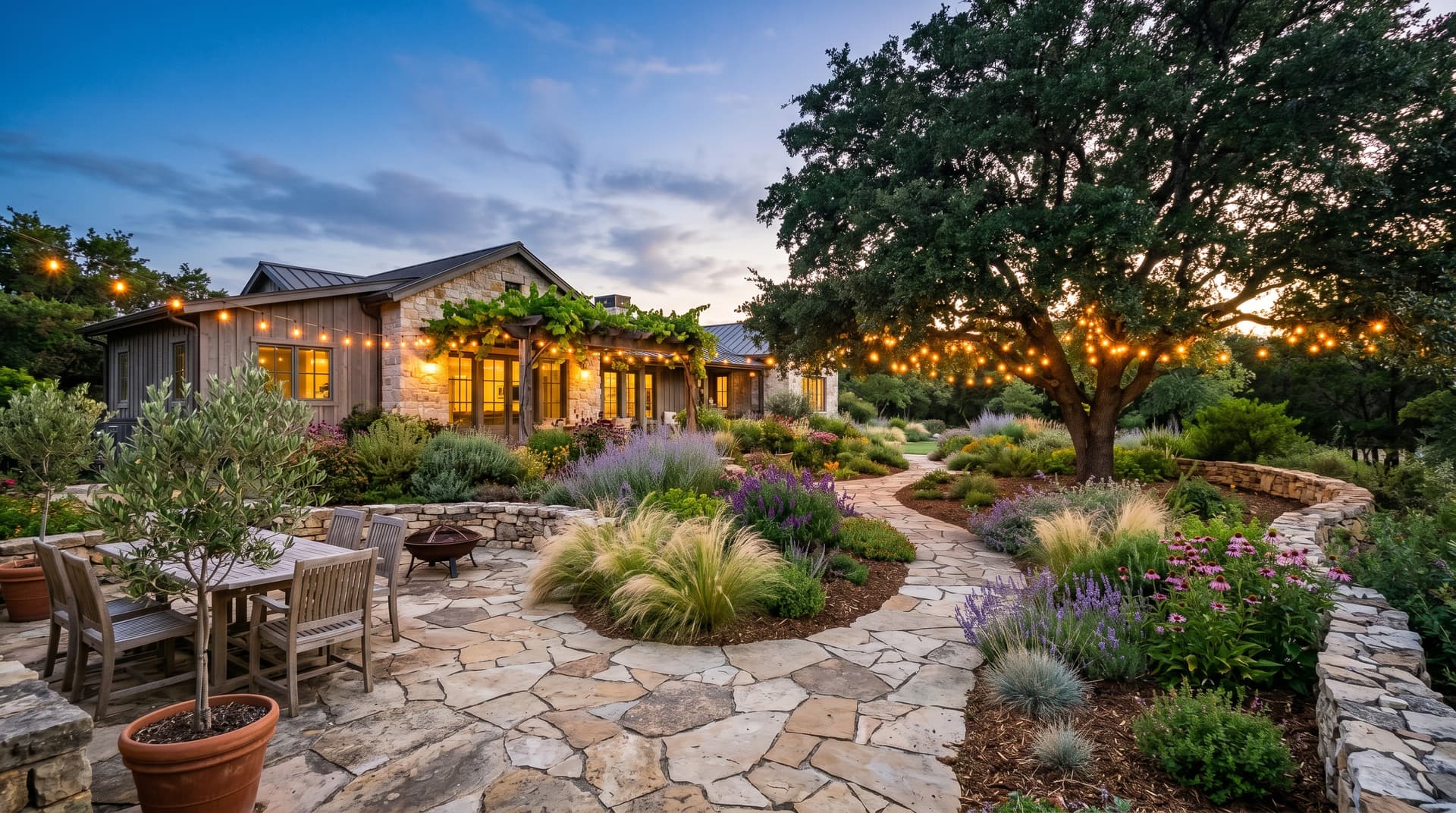
Backyard landscaping ideas are easy to find and hard to execute. Every homeowner has a Pinterest board full of fire pits, pergolas, and lush garden borders — and a backyard that looks nothing like any of them. The gap isn't ambition. It's that most people skip the planning step where you figure out what actually works in your specific space, with your specific soil, sun exposure, and budget.
The fix: preview before you plant. AI landscape visualization tools let you upload a photo of your backyard and test design directions in under a minute. No sod commitment, no $6,000 patio you regret by October. Here are the backyard landscaping ideas worth testing first.
Start With Zones, Not Plants
The biggest backyard landscaping mistake is jumping straight to plant selection. Before you pick a single shrub, divide your yard into functional zones:
- Entertainment zone — patio, deck, or gravel pad with seating for guests - Transition zone — planted borders that separate the entertaining area from the rest of the yard - Active zone — open lawn or play area (if you need one) - Garden zone — dedicated beds for ornamentals, edibles, or both - Utility zone — storage, compost, trash cans, AC unit screening
Most backyards try to be everything at once and end up being nothing. Zoning forces decisions. A 1,200 square foot backyard that commits to a generous patio and two deep planting beds will always look better than one that spreads a thin layer of everything across the entire space.
Build the Patio First — Everything Else Follows
Hardscaping is the backbone of backyard landscaping. Get the patio or deck right and the rest of the design organizes itself around it. Get it wrong and no amount of planting fixes the proportions.
Material options ranked by cost and longevity:
- Poured concrete — $8-$15 per square foot installed. Clean, modern, permanent. Can be stained, stamped, or left natural. - Pavers — $12-$25 per square foot installed. More visual interest than concrete. Repairable — you can replace individual pavers without tearing up the whole surface. Our paver driveway guide covers patterns and installation details that apply to patios too. - Natural flagstone — $15-$30 per square foot. Organic, high-end look. Best for irregular, naturalistic layouts. - Pea gravel — $2-$5 per square foot. The budget option that actually looks intentional if edged properly with steel or stone borders.
Size matters more than material. A 200 square foot patio in pea gravel beats a 100 square foot patio in travertine. You need room for a table, chairs, a grill, and circulation space — most homeowners undersize by 30-40%.
Layer Plantings Around the Perimeter
The area where your yard meets the fence line is the highest-impact planting zone. Most backyards leave this as bare fence or a single row of identical shrubs. The fix is layering — the same principle that works in front yard landscaping:
- Back row (along fence, 4-8 feet tall) — screening plants, ornamental trees, or tall grasses like miscanthus or bamboo muhly. These hide the fence and create a green backdrop. - Middle row (2-4 feet) — flowering shrubs, medium grasses, or evergreen structure plants. Boxwood, lavender, Russian sage, and dwarf fountain grass all work here. - Front row (under 2 feet) — groundcovers, low perennials, or trailing plants that soften the bed edge. Creeping thyme, sedum, or dwarf mondo grass.
This three-layer approach creates depth that makes even a small backyard feel larger. The eye travels through the layers instead of stopping at a flat fence line.
Add One Water Feature — Not Three
Water features are the most over-recommended backyard landscaping idea on the internet. Every listicle suggests a pond, a fountain, and a waterfall. In practice, one modest water feature is perfect. Two is redundant. Three is a maintenance nightmare.
The best backyard water features are ones you can hear from the patio:
- Bubbling rock — a drilled boulder with a recirculating pump. Subtle, low-maintenance, and surprisingly affordable ($200-$500 DIY). - Wall-mounted spout — water flowing from a spout into a trough or basin. Works well mounted on a privacy wall or fence. - Simple basin fountain — a single stone or concrete bowl with a recirculating pump. No plumbing, no pond liner, no mosquito habitat.
Skip the koi pond unless you genuinely want a second hobby. The upkeep is real — filtration, algae management, seasonal draining, and predator protection. A bubbling rock gives you 90% of the sensory benefit at 5% of the maintenance.
Design for Evening Use
Most backyard time happens after work — which means after sunset for half the year. Backyards designed only for daylight look flat and uninviting at night. Three lighting moves that fix this:
- String lights strung across the patio at 8-10 foot height — the single most cost-effective backyard upgrade. Warm white bulbs, not cool white. Budget: $30-$80. - Uplighting on one or two trees — a $20 LED spotlight at the base of a mature tree creates drama that makes the whole yard feel designed. The USDA Forest Service research on trees and property value shows mature trees add 3-15% to home value — lighting them up makes that investment visible at night. - Path lights from the back door to the patio — functional and inviting. Solar-powered options work fine for ambient lighting.
Total cost for all three: $100-$300 DIY. The backyard goes from "dark rectangle behind the house" to "place you actually want to sit after dinner."
Think About Privacy Before Aesthetics
The most beautiful backyard in the world feels unusable if your neighbors can see everything. Privacy screening should be one of your first decisions, not an afterthought:
- Fast-growing hedges — privet, arborvitae, or clumping bamboo can create a dense screen in 2-3 seasons. Cost: $15-$40 per plant, planted 3-4 feet apart. - Fence-mounted planters — vertical greenery on an existing fence adds privacy without taking up ground space. - Privacy sail or pergola — overhead coverage blocks sightlines from second-story windows, which hedges and fences can't do. - Strategic tree placement — one well-placed ornamental tree (Japanese maple, crepe myrtle, olive) can block a specific sightline without screening the entire yard.
Preview different screening options before planting. A row of arborvitae looks great in a nursery photo but can feel like a green wall prison in a narrow yard. DrivewAI's landscape tool lets you test how different plantings look in your actual space before committing to 20 trees.
Create a Focal Point That Draws You Outside
Every well-designed backyard has something that pulls your eye — and your feet — toward the far end. Without a focal point, the yard reads as a flat expanse of "stuff near the house, nothing out there."
Focal point ideas by budget:
- Fire pit ($150-$500 DIY, $2,000-$5,000 built-in) — the most universally useful backyard focal point. Extends the usable season by months. - Specimen tree ($200-$800 installed) — a single Japanese maple, magnolia, or multi-trunk crepe myrtle placed off-center in the yard - Garden sculpture or large pot ($50-$300) — one oversized planter with a seasonal planting at the end of a path - Pergola or arbor ($500-$3,000) — creates a destination at the back of the yard, especially when planted with climbing vines
The focal point should be visible from the patio and the back windows of the house. That sightline is what makes the backyard feel like an extension of your living space rather than leftover land behind the building.
Skip the Full Lawn
A full grass lawn in the backyard made sense when the primary use was kids and dogs. For everyone else, it's a maintenance obligation that returns very little visual or functional value.
Better alternatives for part or all of the lawn:
- Gravel courtyard with container plantings — low-maintenance, stylish, and functional as an entertainment space - Groundcover meadow — creeping thyme, clover, or native sedges that stay low without mowing - Raised planting beds — more visual interest than turf, productive if you grow herbs or vegetables - Artificial turf for a small play area — if you need a soft surface for kids, a 10x15 patch of quality artificial turf beats maintaining 2,000 square feet of real grass
Keep real grass only where you actively use it. A 200 square foot patch of well-maintained lawn surrounded by planted beds looks more intentional than 2,000 square feet of half-brown turf.
Preview Before You Commit
Backyard landscaping projects average $5,000-$15,000 for a full redesign, and even modest improvements run $1,000-$3,000. That's a lot of money to spend based on a Pinterest mood board and a hope that it'll look the same in your yard.
DrivewAI lets you upload a photo of your backyard and preview different landscaping styles before breaking ground. See how a patio looks with your fence line. Test whether ornamental grasses work with your house style. Preview the difference between a gravel courtyard and a flagstone patio.
Your Every render is covered by a 24-hour refund guarantee, and a $9 4-pack unlocks enough room to compare several design directions before you call a landscaper.
For more on how AI landscape design works, check out our complete guide to AI landscape visualization. And if the front yard needs attention too, our front yard landscaping ideas guide covers curb appeal strategies that complement a backyard redesign.
About the author
Noah James
Founder, DrivewAI
Noah James is the founder of DrivewAI, an AI home visualization platform that helps homeowners, contractors, and real estate agents preview renovations before committing. He built DrivewAI to close the gap between inspiration and execution in home improvement.
His writing focuses on practical renovation decision-making, material comparisons, and how AI visualization tools are changing the way people plan projects — from driveway replacements to full interior staging.
See your home transformed by AI
Upload a photo and get AI renderings across every style. Designs from $9 with a 24-hour refund guarantee.
Try DrivewAI Free