Driveway lighting ideas that look good and stay on
By Noah James
• 8 min read • Founder, DrivewAI
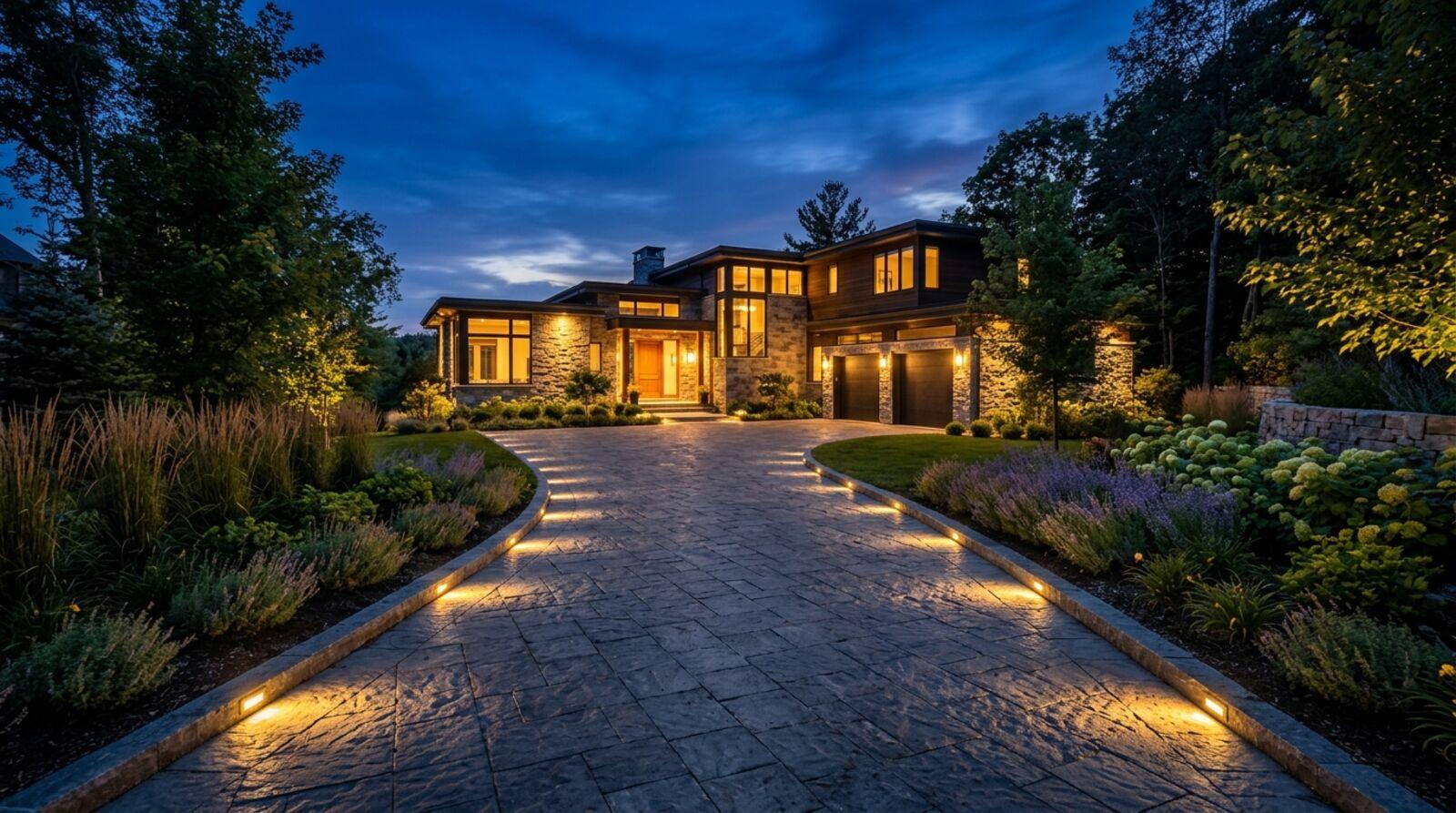
Most driveway lighting looks terrible, and the reason is always the same: too many lights, too bright, spaced too evenly, all the same height. It looks like a runway, not a home. Good driveway lighting does three things — makes the driveway safe to walk and drive on after dark, defines the edges so you don't back over the lawn, and quietly improves curb appeal without turning your front yard into a car dealership.
The cost ranges from $200 for a basic solar path light set to $3,000-$5,000 for a professionally installed low-voltage system with transformers and controllers. Where you land on that spectrum depends on how much you care about reliability, aesthetics, and long-term maintenance.
Safety First, Aesthetics Second
Driveway lighting has a job before it has a look. That job is preventing someone from tripping on a step, missing the edge of the driveway in the dark, or backing into a landscaping feature they couldn't see.
The minimum safety requirements:
- Illuminate changes in elevation — where the driveway meets the street, where it meets the garage, any steps or grade changes along the path. Falls happen at transitions, not on flat stretches. - Define driveway edges — especially if the driveway curves or borders a garden bed, retaining wall, or drop-off. Drivers and pedestrians need to see where the surface ends. - Light the approach to the front door — if your driveway doubles as your walkway to the entry, the path needs continuous low-level lighting.
Here's what safety lighting doesn't require: flooding the entire driveway with 5,000-lumen floodlights. That creates glare, kills night vision, and makes your home look like it's under surveillance. The International Dark-Sky Association recommends shielded, warm-toned fixtures aimed downward — and their guidelines produce better-looking results than most landscape designers' instincts.
Solar vs. Low-Voltage Wired vs. LED Bollards
The fixture type determines cost, reliability, brightness, and maintenance. Here's an honest comparison.
Solar path lights cost $5-$30 per fixture and install in minutes — push the stake into the ground and you're done. No wiring, no electrician, no transformer. Sounds perfect, and for some situations it is.
The problem: solar driveway lights are inconsistent. After a cloudy day, they're dim. After two cloudy days, some don't turn on at all. The rechargeable batteries degrade over 2-3 years, dropping brightness significantly. And cheap solar fixtures have short LED lifespans that result in a yellow, sickly glow by year two.
Solar works when: you need temporary or seasonal lighting, you're renting, or you want to test placement before committing to wired fixtures. It does not work when: you need reliable illumination every night, you live somewhere with frequent overcast weather, or you care about consistent light color.
Low-voltage landscape lighting (12V) is the gold standard for residential driveway lighting. A transformer (usually 150-600 watts) plugs into an outdoor outlet, steps household current down to a safe 12 volts, and sends power through direct-burial cable to fixtures along the driveway.
Cost per fixture: $30-$150 for quality brass or copper path lights that last 15-20 years. Transformer: $80-$300. Cable and connectors: $50-$150 total. Professional installation: $1,500-$4,000 for a typical 8-12 fixture system, or $300-$600 in materials if you DIY.
Low-voltage systems are reliable, dimmable, and produce consistent warm light every night. The initial investment is higher, but the 15-20 year lifespan of quality fixtures makes the per-year cost lower than replacing solar lights every 3 years.
LED bollards are vertical fixtures (typically 24-36 inches tall) that produce a wider spread of light than stake-mounted path lights. They're common in commercial settings and increasingly popular for residential driveways, especially wider ones where path lights on the edges don't cast enough light to the center.
Cost: $80-$300 per bollard for residential-grade models. They typically run on low-voltage systems, so add transformer and wiring costs. Bollards make sense for driveways wider than 16-18 feet, circular driveways, or driveways with turnaround areas where path lights alone leave dark zones in the middle.
Placement Strategy That Actually Works
Here's where most homeowners go wrong: they buy a box of 10 path lights and space them evenly along both sides of the driveway, 4 feet apart, like airport taxiway lights. The result is visually overwhelming, wastes fixtures, and lights areas that don't need it while potentially leaving critical transitions dark.
Better approach — place lights where they're needed, not in a uniform grid:
- At the street entrance — one light on each side of where the driveway meets the street, marking the turn-in. These are the most important two lights in the system. - At curves — the outside edge of any curve needs a light so drivers see where the driveway bends. The inside of the curve usually doesn't. - At grade changes — every step, slope transition, or elevation change gets a light. Non-negotiable for safety. - At the garage or parking area — one or two lights near where you park, positioned to illuminate the path to the front door. - One side only (for straight driveways) — a straight, narrow driveway often looks better with lights on one side only, staggered every 8-10 feet. Both sides creates the runway effect.
The goal is 6-10 fixtures for a typical 40-60 foot driveway, not 20. Fewer fixtures, thoughtfully placed, always looks better than more fixtures uniformly spaced.
The One Lighting Mistake Every Homeowner Makes
Too bright. Always too bright.
Residential driveway lighting should be subtle — enough to see the surface and edges, not enough to read a newspaper at the curb. The target illumination level for a residential driveway is 0.5-2 foot-candles. For reference, a full moon provides about 0.01 foot-candles. A parking garage is 10-50. Your driveway should be somewhere between moonlight and your living room, closer to the moonlight end.
Warm color temperature matters too. Aim for 2700K-3000K (warm white). Cool white (4000K+) looks institutional and harsh against residential architecture. It also disrupts sleep patterns for you and your neighbors and creates more light pollution.
If you've already installed lights that are too bright, try a lower-wattage bulb before ripping out fixtures. A 3-watt LED path light produces plenty of illumination for edge definition. You don't need the 7-watt version.
Integration With Landscape Lighting
Driveway lighting shouldn't exist in isolation. It's part of a larger outdoor lighting scheme that includes the front entry, landscaping, and architectural features. The best driveway lighting systems share a transformer and controller with the broader landscape lighting, allowing you to coordinate timing, brightness, and zones.
Design principles for integration:
- Match color temperature — every outdoor fixture should be the same Kelvin rating. Mixing 2700K path lights with a 4000K porch light looks disjointed. - Layer light levels — the front entry should be the brightest zone (3-5 foot-candles), landscape accents next (1-3 foot-candles), and driveway lighting the subtlest (0.5-2 foot-candles). This hierarchy draws the eye toward the house, not down the driveway. - Use one transformer — most residential 600-watt transformers can power 20-30 LED fixtures across the entire property. One transformer is simpler to maintain than three. - Add a timer or photocell — lights that turn on at dusk and off at a set time (11 PM, midnight) save energy and prevent the all-night-blazing look.
If your front yard landscaping plan includes lighting, our front yard landscaping ideas guide covers plant and hardscape choices that work well with integrated lighting design.
Cost Summary for Driveway Lighting
Here's what a complete driveway lighting system costs in 2026 for a standard 40-60 foot residential driveway:
- Budget solar path lights (8-10 fixtures) — $40-$200 total. No installation cost. Replace every 2-3 years. - Mid-range low-voltage system (8-12 fixtures, DIY install) — $400-$900 in materials. Requires an outdoor outlet near the driveway. - Professional low-voltage system (8-12 fixtures) — $1,500-$4,000 installed, including transformer, wiring, fixtures, and labor. - High-end system with bollards and smart controls — $3,000-$6,000 installed. Includes brass or copper fixtures, Wi-Fi controller, and integration with landscape lighting.
The professional install premium ($1,000-$2,500 over DIY) buys you proper wire burial depth, waterproof connections, correct voltage drop calculations for long runs, and a warranty. If you're running more than 6-8 fixtures on runs longer than 50 feet, voltage drop becomes a real issue — the last fixtures on the line will be noticeably dimmer without proper wire gauge selection.
Preview Driveway Lighting With Your Actual Home
Picking fixtures from a catalog tells you very little about how they'll look installed on your specific driveway and against your home's architecture. DrivewAI lets you upload a photo of your driveway and preview different design approaches — including how materials and lighting interact at different times of day. Your Every render is covered by a 24-hour refund guarantee, and a $9 4-pack unlocks enough room to test several looks.
For broader driveway design ideas beyond lighting, check our driveway redesign ideas guide and our best driveway materials for curb appeal.
About the author
Noah James
Founder, DrivewAI
Noah James is the founder of DrivewAI, an AI home visualization platform that helps homeowners, contractors, and real estate agents preview renovations before committing. He built DrivewAI to close the gap between inspiration and execution in home improvement.
His writing focuses on practical renovation decision-making, material comparisons, and how AI visualization tools are changing the way people plan projects — from driveway replacements to full interior staging.
See your home transformed by AI
Upload a photo and get AI renderings across every style. Designs from $9 with a 24-hour refund guarantee.
Try DrivewAI Free