Flooring Ideas by Room: How to Pick the Right Floor
By Noah James
• 8 min read • Founder, DrivewAI
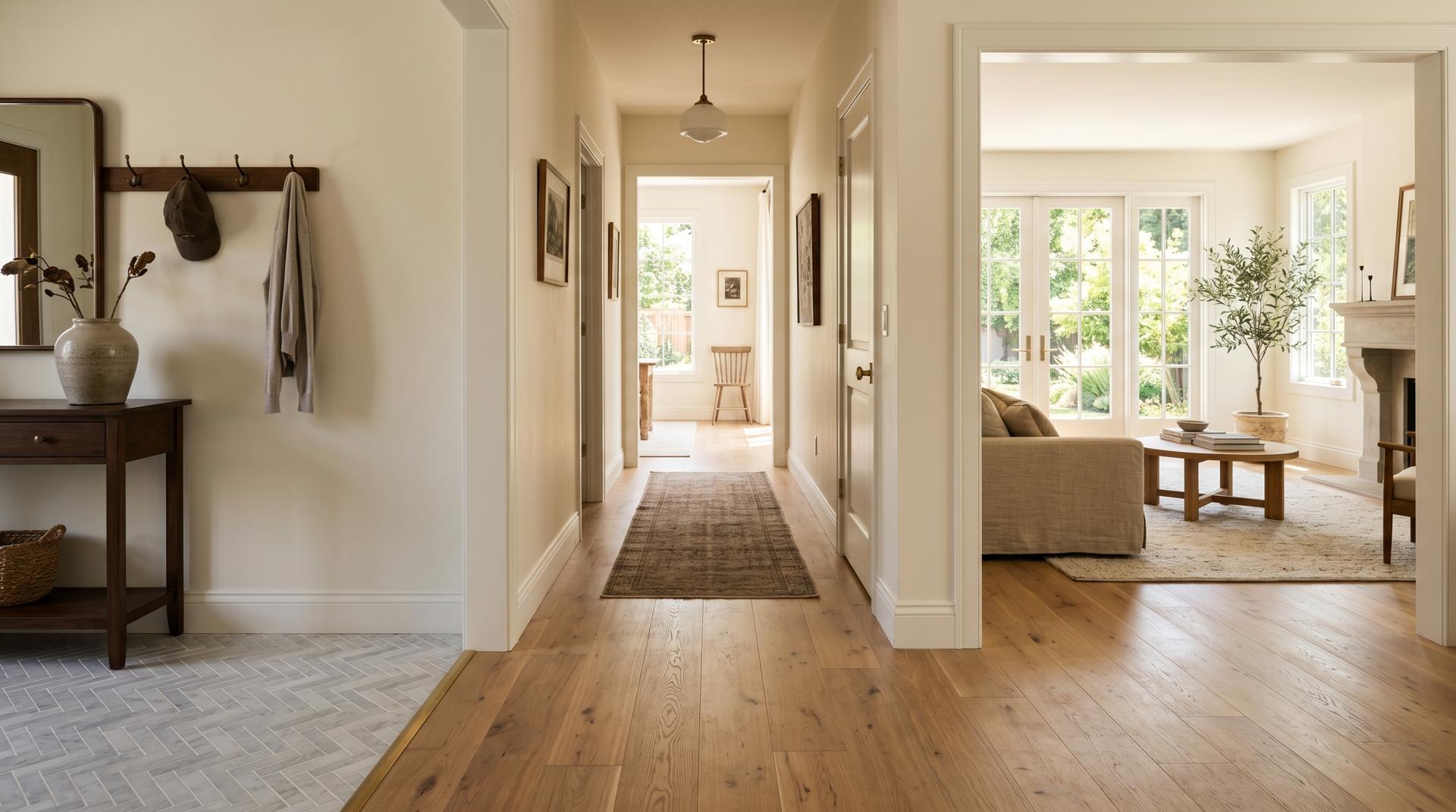
Flooring ideas are easy to browse and brutal to get wrong. You pick a sample at the showroom under fluorescent lights, it looks completely different installed in your living room, and now you're living with 800 square feet of a color you hate for the next 15 years. New flooring costs $6-$12 per square foot installed for mid-range materials — that's $6,000-$12,000 for a typical main floor. The stakes are too high to guess.
The right flooring depends on the room. What works in a kitchen fails in a bedroom. What looks great in a living room cracks in a bathroom. Here's what actually holds up in each space — with real costs and the tradeoffs nobody at the flooring store tells you.
Hardwood Flooring — Where It Works and Where It Doesn't
Solid hardwood remains the gold standard for living rooms, dining rooms, and bedrooms. It's warm underfoot, ages beautifully, and adds 3-5% to home resale value according to the National Association of Realtors. But it's not right for every room.
Where hardwood works: - Living rooms and dining rooms — the warm tones and natural grain create the foundation for every other design decision in the room. White oak is the dominant species in 2026, with wide planks (5-7 inches) and matte or wire-brushed finishes replacing the glossy red oak of previous decades. - Bedrooms — hardwood feels premium underfoot in the morning, and an area rug adds warmth where you need it. Medium-toned wood (honey, natural oak) pairs with almost any bedroom makeover style. - Hallways — continuous hardwood from room to room creates flow and makes a home feel larger.
Where hardwood fails: - Bathrooms — moisture warps and buckles solid wood. Period. - Kitchens — debatable. Hardwood works in kitchens if you're diligent about wiping spills, but a dropped pot of water left for an hour will leave a mark. - Basements — below-grade moisture makes solid hardwood a bad bet regardless of what the installer says.
Cost: $8-$15 per square foot installed for domestic species (oak, maple, hickory). Exotic hardwoods (walnut, acacia) run $12-$20+.
Luxury Vinyl Plank — the Practical Choice That Looks Better Than It Should
Luxury vinyl plank (LVP) is the flooring story of the last five years, and for good reason. Modern LVP with a rigid core and realistic wood-grain embossing is nearly indistinguishable from hardwood in photos — which is exactly why it works so well for virtual staging and AI room visualization.
Where LVP excels: - Kitchens — 100% waterproof, handles dropped pots and spilled liquids without damage. The single best kitchen flooring for durability per dollar. - Bathrooms — waterproof core means no warping, no swelling, no mold under the surface. - Basements — handles moisture and temperature swings that destroy hardwood and laminate. - Rentals and high-traffic homes — scratch-resistant wear layers handle kids, dogs, and furniture dragging without showing damage.
Where LVP falls short: - Resale perception — despite looking good, some buyers still perceive vinyl as "cheaper" than hardwood. This gap is closing but hasn't disappeared. - Feel underfoot — warmer than tile but cooler and harder than real wood. On cold mornings, you notice the difference. - Repair — individual planks can be replaced, but finding an exact color match years later is difficult as manufacturers rotate collections.
Cost: $4-$8 per square foot installed. Premium brands (COREtec, Shaw Floorte) run $6-$10.
Tile Flooring — Best for Wet and High-Traffic Areas
Porcelain and ceramic tile remain unbeatable in spaces that deal with water, heat, or heavy foot traffic. The options have expanded dramatically beyond the white subway tile of the last decade.
Best tile flooring ideas by room: - Bathrooms — large-format porcelain (24x24 or 12x24) with minimal grout lines creates a clean, spa-like feel. Matte finishes hide water spots better than polished. - Kitchen floors — porcelain tile handles spills, heat, and dropped cookware. Wood-look porcelain gives you the appearance of hardwood with the durability of tile — ideal for kitchens that connect to tile-floored bathrooms. - Entryways and mudrooms — slate, travertine, or textured porcelain handles dirt, wet shoes, and heavy traffic. These are the rooms where tile earns its cost in longevity. - [Outdoor kitchens](/blog/outdoor-kitchen-ideas) — porcelain pavers or frost-rated tile handle temperature extremes and rain.
Where tile doesn't work: - Bedrooms — too cold and hard underfoot unless you install radiant heating underneath ($8-$15 per square foot to add). - Living rooms — tile reads as cold and institutional in spaces meant for comfort, unless you're in a warm climate where cool floors are a feature.
Cost: $6-$15 per square foot installed for porcelain. Natural stone (marble, slate, travertine) runs $15-$30+.
Engineered Hardwood — the Compromise That Actually Works
Engineered hardwood sits between solid hardwood and LVP — a real wood veneer over a plywood or HDF core. It looks and feels like solid wood but handles moisture and temperature swings better.
Where engineered hardwood wins: - Open-concept main floors — one material running continuously from living room through dining room to kitchen. The real wood surface looks authentic because it is. - Over concrete slabs — can be floated or glued directly to concrete, which solid hardwood can't. - Over radiant heat — the layered construction resists the expansion and contraction that cracks solid wood over heated subfloors.
The catch: The wood veneer on engineered hardwood ranges from 1mm to 6mm thick. Thinner veneers can only be refinished once or not at all. If you're paying for engineered, get at least a 3mm wear layer so you have the option to sand and refinish in 10-15 years.
Cost: $6-$12 per square foot installed. Slightly less than solid hardwood for comparable species.
How to Choose Flooring for an Open Floor Plan
Open floor plans are the trickiest flooring decision because one material has to work across the living room, dining area, kitchen, and sometimes a hallway — all visible at once.
Three approaches that work:
One material throughout: Wide-plank engineered hardwood or premium LVP running wall to wall. Creates seamless flow and makes the space feel larger. The simplest solution and the best for resale. Choose a mid-toned neutral (natural oak, greige) that works with both kitchen cabinetry and living room furniture.
Two materials with a clean transition: Hardwood in living and dining areas, tile in the kitchen and entry. Use a flat metal transition strip — not a T-molding — to keep the line clean. The materials should share a color temperature (both warm or both cool) even if they're different species.
Zone with area rugs: If the floor is continuous but you want visual separation between living and dining zones, large area rugs define each space without breaking the floor line. The rug should be large enough that all furniture legs sit on it — undersized rugs make a room feel smaller.
Preview New Floors Before Ripping Up the Old Ones
Flooring is permanent in a way that paint and furniture aren't. Once it's installed, you're living with it until you're willing to spend $6,000+ to rip it out and start over. And flooring samples are notoriously misleading — a 6-inch square of white oak looks completely different when it covers 400 square feet under your specific lighting.
DrivewAI lets you upload a photo of any room and preview how different flooring styles look in your actual space — your walls, your lighting, your furniture. Test whether light oak or dark walnut works better with your kitchen cabinets. See how herringbone compares to straight plank in your entryway. Preview the full room before committing to a material you'll walk on every day.
Try every render risk-free with a 24-hour refund guarantee. Customized renders start at $9.00 each. That's enough to test multiple rooms and styles before you visit a single showroom.
For more room-specific design, check out our guides on kitchen remodel cost, living room redesign ideas, and bathroom remodel ideas.
About the author
Noah James
Founder, DrivewAI
Noah James is the founder of DrivewAI, an AI home visualization platform that helps homeowners, contractors, and real estate agents preview renovations before committing. He built DrivewAI to close the gap between inspiration and execution in home improvement.
His writing focuses on practical renovation decision-making, material comparisons, and how AI visualization tools are changing the way people plan projects — from driveway replacements to full interior staging.
See your home transformed by AI
Upload a photo and get AI renderings across every style. Designs from $9 with a 24-hour refund guarantee.
Try DrivewAI Free