Curb Appeal Ideas Ranked by ROI and Effort
By Noah James
• 8 min read • Founder, DrivewAI
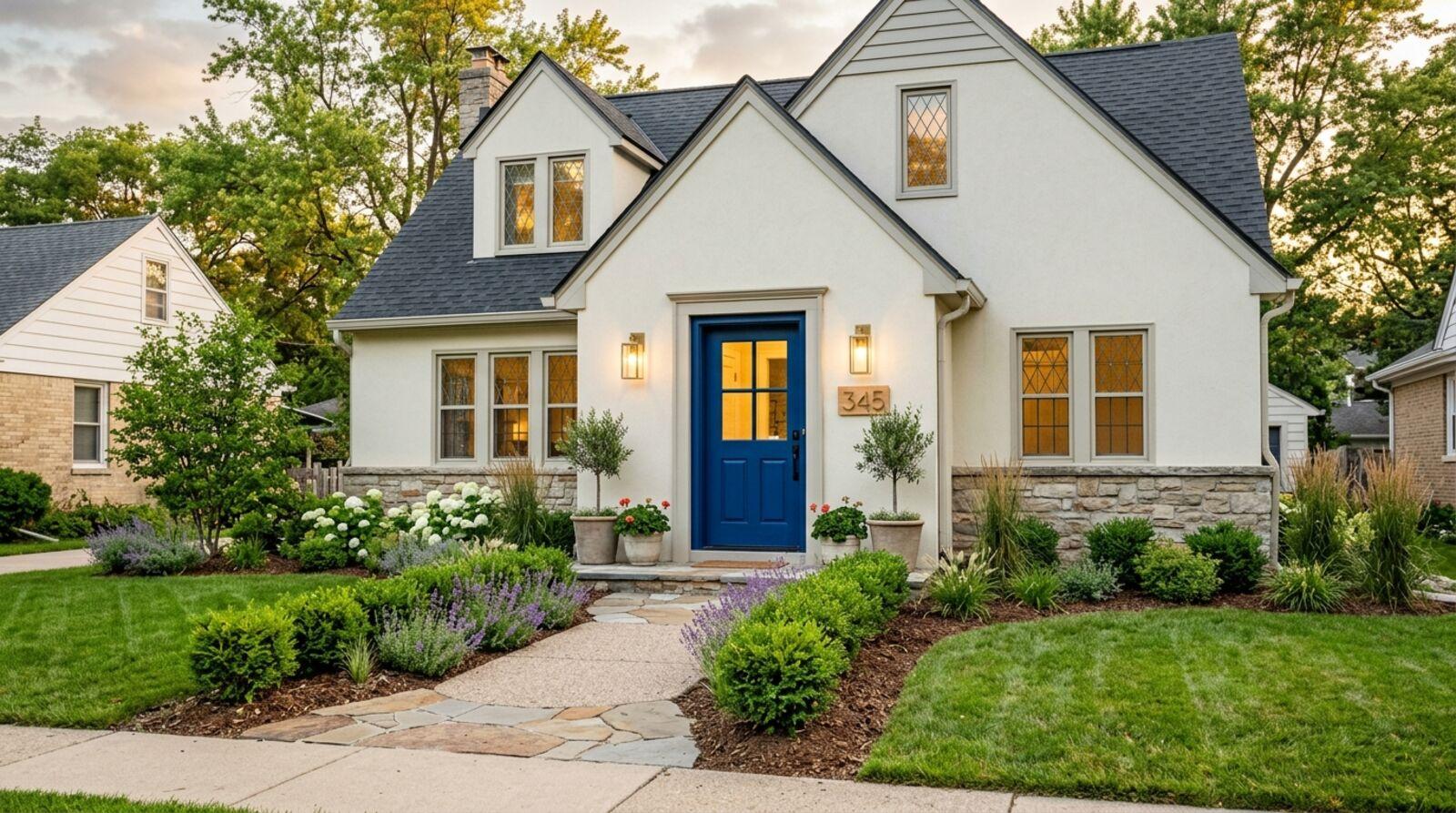
The 7-Second Rule of First Impressions
Here's a number that should influence how you spend your home improvement budget: buyers form an opinion about a house within 7 seconds of seeing it. Seven seconds. That's before they notice the renovated kitchen, the new bathroom tile, or the refinished hardwood floors. Their gut reaction — "I like this place" or "next" — happens at the curb.
This is why curb appeal ideas aren't just vanity projects. They're strategic investments that affect how people perceive your home's value, whether you're selling next month or just want to stop cringing at your own house when you pull into the driveway.
The good news is that the highest-impact curb appeal upgrades are usually the cheapest ones. You don't need a $50,000 exterior renovation. You need the right $200-$2,000 projects done well. Here are ten of them, ranked roughly by the ratio of impact to effort and cost.
New Front Door: The Single Highest-ROI Upgrade
If you can only do one curb appeal project, replace or refresh your front door. According to Remodeling Magazine's Cost vs. Value Report, a new steel entry door consistently delivers over 100% return on investment at resale. No other exterior project matches that ROI.
Cost range: $200-$1,000 for a new door (not including professional installation). A basic steel door with a fresh coat of paint runs $200-$400. A fiberglass door with decorative glass panels costs $500-$1,000. High-end solid wood doors can exceed $2,000, but the ROI diminishes as the price climbs.
If you're not replacing the door, just paint it. A bold, saturated front door color — deep red, navy, forest green, black, even bright yellow on the right house — transforms a facade for the cost of a quart of exterior paint ($15-$30). New hardware (handle set and deadbolt) adds another $50-$150 and makes a dated door look current.
The front door is the focal point of your entire home exterior. It's where every visitor's eye lands first. A door that's peeling, faded, or builder-beige is telling the world you've given up. A freshly painted door in a confident color says the opposite.
Landscape Lighting: Cheap Magic After Dark
Your house goes invisible after sunset unless you light it. Landscape lighting solves this problem for surprisingly little money and makes your home look like it belongs in a real estate listing at every hour of the day.
Cost range: $100-$500 for a DIY low-voltage lighting kit. A basic kit with 6-8 path lights and 2-4 spotlights runs $100-$200. Higher-quality brass or copper fixtures cost $30-$60 each, pushing a full installation toward $300-$500. Professional installation runs $1,500-$4,000 but is often unnecessary — most low-voltage landscape lighting is genuinely DIY-friendly.
Where to place lights for maximum impact:
- Uplights on the facade — Two or three ground-mounted spotlights aimed up at the front of your house create drama and architectural interest. Position them 12-18 inches from the foundation, angled upward. - Path lights along the walkway — Every 6-8 feet, alternating sides. They guide visitors to the front door and add a sense of arrival. - Accent lights on specimen trees or landscaping features — One or two uplights on a large tree creates a beautiful canopy effect after dark.
Use warm white LED bulbs (2700K). Cool white landscape lighting makes a home look like a security compound. Warm light makes it look inviting.
Pressure Washing: Free Curb Appeal
Your house, driveway, walkways, and porch accumulate years of grime, mildew, and algae that you stop noticing because it happens gradually. Pressure washing removes all of it and can make a 20-year-old house look 10 years younger in an afternoon.
Cost: $40-$80 per day for a rental pressure washer, or free if you borrow one from a neighbor. Professional pressure washing services charge $200-$500 for a full house exterior and driveway.
What to wash:
- Siding (reduces that greenish tint on north-facing walls) - Concrete driveway and walkways (removes oil stains and darkening) - Front porch and steps - Fence (if you have one) - Retaining walls and hardscape
Caution: Pressure washers can damage wood siding, strip paint, and etch soft stone if used at too high a pressure or too close a distance. Use a wide fan tip (25 or 40 degree), keep the nozzle at least 12 inches from the surface, and test an inconspicuous area first. On wood surfaces, a lower-pressure soft wash with cleaning solution is safer than blasting with high pressure.
The visual impact of pressure washing is absurd relative to the cost. It's one of those projects where neighbors stop and ask what you did to your house.
House Numbers and Mailbox: The Details That Signal Care
These are tiny, cheap upgrades that communicate attention to detail. Outdated, crooked, or missing house numbers make a home look neglected. A rusty or dented mailbox says "I don't notice things."
Modern house numbers: $5-$20 per digit. Floating mount numbers in brushed nickel, matte black, or brass are the current standard. Size matters — go with 5-6 inch tall numbers minimum for visibility from the street. Mount them on a contrasting surface so they're easy to read.
New mailbox: $20-$150. A simple black post-mounted mailbox costs $20-$40. A more substantial mailbox on a decorative post runs $80-$150. If your mailbox is leaning, rusty, or has its door held on with wire, replacing it is a 30-minute project with outsized visual impact.
These are the kinds of projects that individually seem too small to matter but collectively create a sense of care and intentionality that visitors and buyers register subconsciously.
Fresh Mulch and Bed Edging: Instant Landscape Upgrade
You can spend thousands on new plants, or you can spend $100-$200 on fresh mulch and clean bed edges and get 80% of the visual upgrade.
Mulch costs $25-$40 per cubic yard in bulk. Most front yard beds need 2-4 cubic yards. Dark brown or black mulch creates the strongest contrast against green plants and makes the bed look freshly maintained.
Edging creates a clean line between beds and lawn that reads as "professionally maintained" even if you did it yourself with a $30 half-moon edger. That crisp edge is what separates a garden bed that looks designed from one that looks like plants wandered into the lawn.
Spread mulch 3 inches deep, keep it 2-3 inches away from plant stems and tree trunks, and refresh it annually. This is a Saturday morning project with week-long visual payoff.
Shutters: The Upgrade People Forget About
If your house has shutters, look at them honestly. Are they faded? Cracked? Obviously too narrow for the windows they're supposed to "shut"? Shutters are one of those features that either enhance a house or detract from it — there's no neutral.
Painting existing shutters: $30-$50 in paint (exterior satin or semi-gloss). Remove them from the house, clean them, paint them on sawhorses, and reinstall. A fresh coat of paint on shutters, especially in a color that contrasts with the body color, sharpens the entire facade.
Replacing shutters: $40-$100 per pair for vinyl, $80-$200 per pair for composite or wood. If your shutters are the wrong size (a depressingly common builder shortcut), replacing them with properly sized shutters — ones that would actually cover the window if closed — makes a noticeable difference.
Not every house needs shutters. Modern and contemporary homes usually look better without them. If your house doesn't have shutters and looks fine, don't add them just because you think you should.
Garage Door Refresh
The garage door is often the single largest visual element on a home's front face. A faded, dented, or dated garage door drags down every other curb appeal improvement you make.
Full replacement: $800-$2,500 for a standard two-car garage door installed. Carriage-house style doors with decorative hardware and window panels represent the biggest curb appeal upgrade in this price range.
Budget refresh: $50-$200. Paint the existing door (use a paint rated for metal if it's steel). Add decorative hardware — magnetic or bolt-on hinges and handles that give a plain panel door a carriage-house look for $30-$60. Add window inserts (snap-in or magnetic) for $50-$100.
A garage door upgrade is particularly high-impact if your garage faces the street directly. On homes where the garage dominates the facade, it might be the most important curb appeal investment you make.
Window Boxes and Planters
Window boxes add color, depth, and character to a facade without any structural changes. They work on virtually every home style and create visual interest on otherwise flat wall surfaces.
Cost: $15-$60 per window box plus plants and soil. Wood and PVC boxes are the most common. Metal or copper boxes are more expensive but develop a beautiful patina over time. Fill them with seasonal plants — petunias and geraniums in summer, mums in fall, evergreen boughs in winter.
Large planters flanking the front door create a sense of entry and formality. Two matching planters with symmetrical plantings frame the door and make the approach feel intentional. Use planters that are proportional to the door — 18-24 inch diameter pots work for most standard front doors. Tiny pots on a big porch look like an afterthought.
What Realtors Actually Recommend vs What Homeowners Think Matters
There's a persistent gap between what homeowners think improves curb appeal and what real estate professionals say actually matters to buyers. Having talked with multiple realtors and studied buyer behavior research, the disconnect is interesting.
What homeowners overvalue:
- Elaborate landscaping. Homeowners spend thousands on exotic plants and complex garden designs. Buyers appreciate clean, maintained landscaping — they don't pay premiums for rare specimen plants they can't identify. - Decorative flags and seasonal decor. Homeowners love them. Buyers are neutral at best, distracted at worst. They want to picture their own taste, not yours. - Trendy exterior elements. That accent wall of reclaimed barn wood might thrill you but confuse buyers who just see maintenance.
What realtors say actually moves the needle:
- Cleanliness. A clean house, clean driveway, clean walkways, and clean landscaping beds. This is the foundation of curb appeal and it costs almost nothing. - A well-maintained lawn (or deliberately designed alternative). Brown patches, bare spots, and dandelion colonies signal neglect to buyers. The lawn doesn't need to be golf-course perfect — just green and mowed. - Fresh paint where needed. Touch up trim, repaint the front door, hit any visible peeling or fading spots. You don't need to repaint the entire house — just the parts people can see from the street. - Symmetry and order. Matching planters, evenly spaced path lights, centered house numbers. Human brains are wired to find symmetry attractive.
The theme is consistent: curb appeal comes from maintenance, cleanliness, and small intentional upgrades — not from expensive additions.
Seeing the Full Picture Before You Start
The challenge with curb appeal is that individual projects are easy to picture but the cumulative effect is hard to visualize. A new front door plus landscape lighting plus fresh mulch plus new house numbers — what does all of that look like together on your specific house?
Upload a photo of your home's exterior to DrivewAI and preview multiple curb appeal changes at once. Customized renders start at $9.00 each. It's a useful way to prioritize your project list. Maybe you'll discover that painting the front door navy and adding path lights delivers 90% of the transformation you're after, and the more expensive projects can wait.
Curb appeal isn't about spending the most money. It's about spending strategically on the projects that create the strongest first impression. Start with the quick wins — clean everything, paint the door, add lighting — and work up from there. Your house already has good bones. It just needs you to show them off.
For more exterior upgrade inspiration, explore our guides to front porch ideas, exterior house colors, and front yard landscaping ideas.
About the author
Noah James
Founder, DrivewAI
Noah James is the founder of DrivewAI, an AI home visualization platform that helps homeowners, contractors, and real estate agents preview renovations before committing. He built DrivewAI to close the gap between inspiration and execution in home improvement.
His writing focuses on practical renovation decision-making, material comparisons, and how AI visualization tools are changing the way people plan projects — from driveway replacements to full interior staging.
See your home transformed by AI
Upload a photo and get AI renderings across every style. Designs from $9 with a 24-hour refund guarantee.
Try DrivewAI Free