Modern Kitchen Ideas That Won't Look Dated in 5 Years
By Noah James
• 8 min read • Founder, DrivewAI
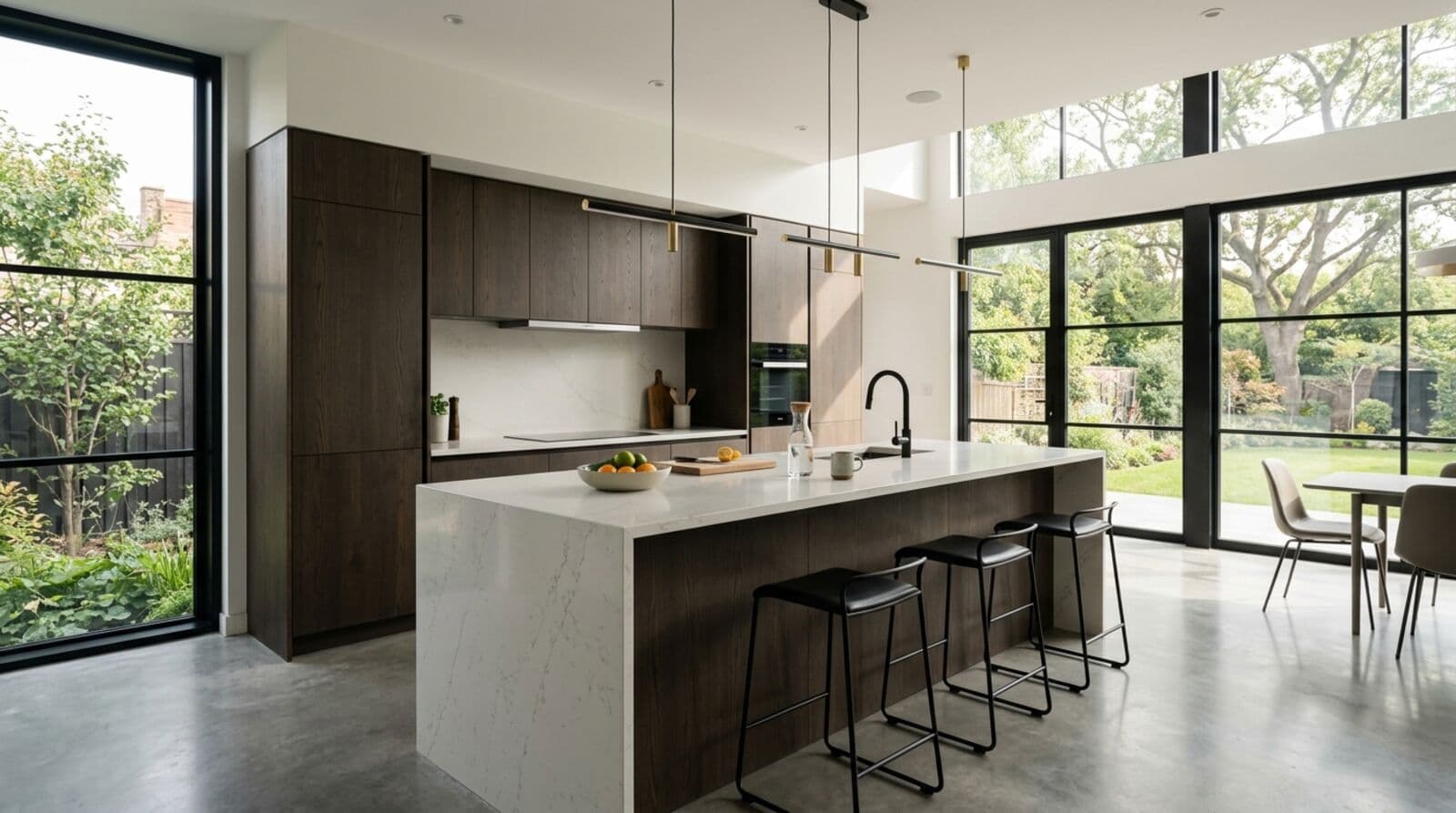
If you search for modern kitchen ideas right now, you'll get a wall of all-white kitchens with waterfall islands and brass hardware. Half of those kitchens were designed in 2019. The other half are renders that nobody actually built. The real shift happening in 2026 is subtler and, frankly, more interesting than "paint everything white and add a statement light fixture."
Modern doesn't mean minimalist-to-the-point-of-sterile anymore. It means intentional. It means choosing materials and layouts that work for how you actually use your kitchen, not how it photographs for a listing. And it means accepting that some "modern" trends from five years ago already look like a time capsule.
What "Modern Kitchen" Actually Means Now
The word "modern" in kitchen design has been abused beyond recognition. Technically, modern refers to mid-century modern — clean lines, organic shapes, function-first design from roughly 1940 to 1970. What most people mean when they say modern is "contemporary," which just means "current."
In 2026, contemporary kitchen design has landed somewhere between the cold minimalism of the 2010s and the cluttered warmth of the pandemic-era "cozy kitchen" trend. You're seeing warm wood tones mixed with matte black or dark green. Integrated appliances that disappear into cabinetry. Textured surfaces instead of everything being glossy and flat.
The National Kitchen & Bath Association's 2026 design trends report confirms what designers have been saying for two years: the all-white kitchen is no longer the default. It's still an option, but it's not the safe choice it used to be.
Flat-Panel vs Shaker Cabinets for a Modern Look
This is the first decision that sets the tone for your entire kitchen, and people agonize over it for good reason.
Flat-panel (slab) doors are the more "modern" choice on paper. No frame, no detail, just a clean surface. They look incredible in high-gloss or matte finishes and pair well with handleless designs where you push to open. The catch: they show every fingerprint, every smudge, and every slight imperfection in alignment. If your walls aren't perfectly plumb — and older homes almost never are — flat-panel doors will telegraph that fact.
Shaker cabinets have been the default for so long that calling them "modern" feels wrong. But a shaker door in a dark color with minimal hardware reads completely differently than the white-shaker-with-brushed-nickel combo that dominated the last decade. Shaker doors are more forgiving with alignment, hide wear better, and cost less to replace if one gets damaged.
The genuinely modern move in 2026 is mixing both. Flat-panel uppers with shaker lowers, or flat-panel on the island with shaker on the perimeter. It creates visual interest without looking busy. You can preview different cabinet styles with our staging tool before committing to either direction.
Hardware Choices That Make or Break the Design
Cabinet hardware is the jewelry of your kitchen, and right now the market is split between two camps: go minimal or go bold.
Minimal hardware means finger pulls, integrated channels routed into the door edge, or push-to-open mechanisms. This creates the cleanest look but has practical downsides — push-to-open latches can fail, finger pulls collect grime in the channel, and some people just find handleless cabinets annoying to use with wet or greasy hands.
Bold hardware means oversized pulls in matte black, unlacquered brass, or textured bronze. These make a statement and are easy to swap if trends shift, since hardware is relatively cheap. A full set of quality pulls runs $200 to $600 for an average kitchen.
What's actually dated: the tiny brushed-nickel knob on white shaker cabinets. If you have this combo and want a quick modern update, swapping hardware is the single highest-impact, lowest-cost change you can make. Budget about $5 to $15 per pull, and you can transform the entire feel of the room in an afternoon.
Lighting That Doesn't Try Too Hard
The oversized globe pendant over the island had its moment. So did the industrial cage light, the sputnik chandelier, and the linear LED bar. Every era of "modern" kitchen design has its signature light fixture, and every one of them eventually becomes a timestamp.
Recessed lighting is the backbone of any modern kitchen, and it's unglamorous for a reason — it just works. Properly spaced recessed cans (every 4 to 5 feet in a grid pattern, about 24 inches from the wall for perimeter lighting) give you even, functional light without visual clutter. The key is using 3000K to 3500K color temperature — warm enough to not feel clinical, cool enough to see what you're cooking.
Under-cabinet lighting is the single most underrated upgrade in kitchen design. LED strips or puck lights under your uppers eliminate shadows on your countertop where you actually prep food. Cost is typically $200 to $500 for the whole kitchen if you're handy, or $500 to $1,200 installed.
Pendant lights still have a place, but the trend is toward smaller, simpler shapes. Think cylindrical or conical pendants in matte finishes, hung in groups of two or three over an island. The days of the single oversized statement pendant are winding down.
Open Shelving vs Closed Storage — The Honest Answer
Open shelving photographs beautifully. Living with it is a different story.
The case for open shelving: it makes a small kitchen feel larger, it forces you to edit your possessions, and it gives you a place to display pieces you actually like looking at. The case against: dust, grease film from cooking, the pressure to keep everything perfectly arranged, and the loss of storage for ugly-but-necessary items like food processor attachments.
The compromise that actually works is one or two sections of open shelving flanking a window or in a corner, with the rest of your storage behind closed doors. This gives you the visual lightness without the full commitment. Another option gaining traction is glass-front uppers — you get the depth and interest of visible contents without the dust and grease.
If your kitchen is your main cooking space and you use it daily, more closed storage is the practical modern choice. If you mostly eat out and your kitchen is more about aesthetics, open shelving can work. Be honest with yourself about which camp you're in.
Color Trends With Actual Staying Power
White kitchens aren't going anywhere, but they're no longer the only "safe" option. Here's what has legs:
- Warm whites and off-whites instead of bright white. Think Benjamin Moore White Dove or Swiss Coffee. They feel less stark and don't show yellowing from cooking oils as quickly. - Dark green cabinets, particularly on lowers or islands. Forest green, hunter green, and sage have all shown multi-year staying power. Green works because it's a neutral in nature — it pairs with wood, stone, and metal without clashing. - Warm wood tones as a primary material, not just an accent. White oak, walnut, and rift-cut oak are showing up as full cabinet runs, not just floating shelves. This is the biggest shift from five years ago. - Matte black as an accent, not a primary. Black faucets, black hardware, black range hoods — used sparingly, these ground a kitchen. An all-black kitchen, on the other hand, is already starting to feel like a 2022 time capsule.
Colors to approach with caution: navy blue (oversaturated in the market), millennial pink (aging fast), and any cabinet color that requires a specific countertop to work. The more dependent your color scheme is on one trendy element, the faster it will date.
Modern Kitchen Mistakes That Already Look Dated
Some "modern" choices from recent years are aging poorly. Knowing what to avoid is as valuable as knowing what to choose.
Floating shelves as your only upper storage. Unless you have a butler's pantry or separate storage room, you'll run out of space within months. The Instagram version of this kitchen always conveniently crops out the cluttered countertops.
Matching everything to one finish. All-brass hardware, brass faucet, brass light fixtures, brass cabinet pulls — it looks coordinated in a showroom and monotonous in real life. Mix two metal finishes for depth.
Oversized subway tile backsplash. The 4x12 or 4x16 elongated subway tile was the "modern update" to classic 3x6 subway tile. It's fine, but it's everywhere now. Zellige tile, vertical stack-bond patterns, or full-slab backsplashes read as more current.
Open floor plan with zero definition. Knocking out every wall between kitchen and living area was the move for a decade. Now people are adding back elements that create separation without closing things off — half walls, columns, ceiling beams, or changes in flooring material.
Preview Before You Commit to Anything
The challenge with modern kitchen ideas is that "modern" is a moving target. What reads as fresh today might feel dated in three years. The best hedge against that is seeing your specific choices in your specific space before any demolition happens.
Upload a photo of your current kitchen to our AI staging tool and test different cabinet styles, colors, and layouts. It's a faster way to rule out options than pinning 200 images and hoping your contractor interprets your mood board correctly. You can also explore kitchen remodel cost breakdowns or browse backsplash ideas to keep narrowing your plan. Customized renders start at $9.00 each.
About the author
Noah James
Founder, DrivewAI
Noah James is the founder of DrivewAI, an AI home visualization platform that helps homeowners, contractors, and real estate agents preview renovations before committing. He built DrivewAI to close the gap between inspiration and execution in home improvement.
His writing focuses on practical renovation decision-making, material comparisons, and how AI visualization tools are changing the way people plan projects — from driveway replacements to full interior staging.
See your kitchen restyled by AI
Upload a photo and get AI renderings across every style. Designs from $9 with a 24-hour refund guarantee.
Try DrivewAI Free