Low Maintenance Landscaping Ideas That Actually Work
By Noah James
• 8 min read • Founder, DrivewAI
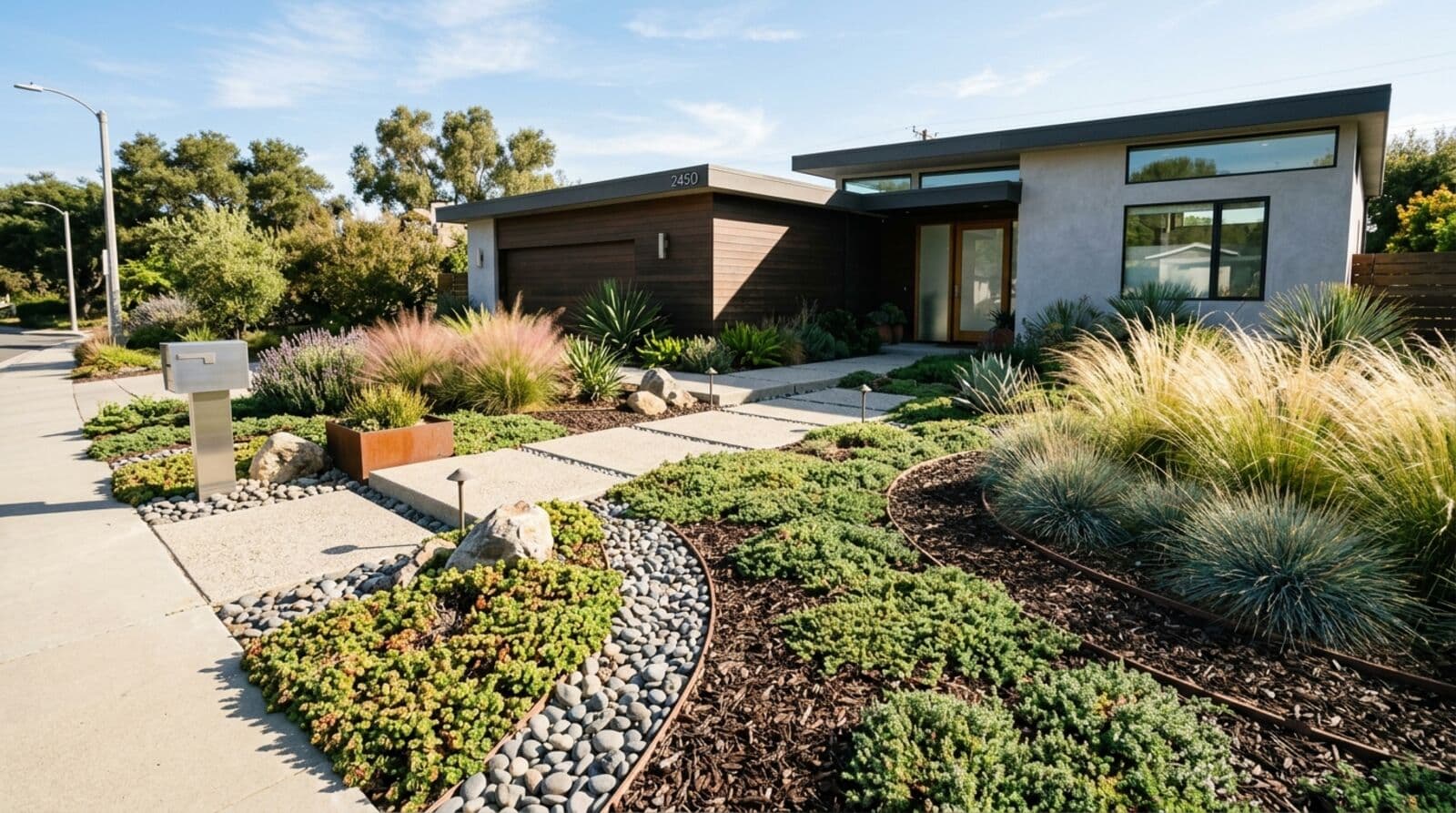
What "Low Maintenance" Actually Means
Let's get something out of the way: low maintenance landscaping ideas don't mean zero maintenance. Every yard needs some attention. The difference is whether you spend your Saturdays wrestling with a leaf blower or sipping coffee on the patio while your landscape mostly takes care of itself.
True low maintenance means designing a yard that works with your climate instead of against it, choosing plants that don't need constant babying, and replacing high-effort features with ones that age gracefully on their own. It means fewer inputs — less water, less fertilizer, less pruning, less of you muttering at dandelions.
The goal isn't a yard made of concrete and fake turf. It's a landscape that looks intentional and alive without demanding your entire weekend.
Native Plants by Region That Thrive on Neglect
The single best decision you can make for a low maintenance yard is choosing plants native to your region. These species evolved over thousands of years to handle your local soil, rainfall, and temperature swings. They don't need supplemental watering once established, they resist local pests, and they support pollinators — which is a nice bonus for feeling good about your yard.
Northeast and Mid-Atlantic: Black-eyed Susans, Eastern red columbine, switchgrass, and New England aster. These handle freeze-thaw cycles and clay soil without complaint.
Southeast: Muhly grass, coreopsis, beautyberry, and coral honeysuckle. Heat and humidity are their natural habitat, not a stress test.
Midwest: Prairie dropseed, purple coneflower, little bluestem, and wild bergamot. These plants literally evolved on prairies — they can handle whatever your suburb throws at them.
Southwest and West: Desert marigold, red yucca, penstemon, and California poppies. Drought tolerance isn't a feature for these plants; it's their default setting.
Pacific Northwest: Sword fern, Oregon grape, salal, and red flowering currant. They thrive in the rain and don't mind the gray skies.
The USDA Plant Hardiness Zone Map is your starting point for figuring out what grows in your area. Find your zone, then search for native species within it. Your local cooperative extension office usually has free plant lists too.
The 60/40 Hardscape-to-Softscape Ratio
Here's a ratio that landscape designers use but rarely share with homeowners: aim for roughly 60% hardscape and 40% softscape in a low maintenance yard. Hardscape includes patios, walkways, gravel beds, retaining walls, and any non-living surface. Softscape is your plants, trees, and ground cover.
This might sound like a lot of hard surface, but it works. A gravel pathway flanked by native grasses looks intentional. A stone patio surrounded by drought-tolerant perennials looks designed. Compare that to a massive lawn dotted with a few shrubs that need constant trimming.
The math is simple: hardscape needs almost no maintenance beyond occasional sweeping or pressure washing. Every square foot of hardscape replaces a square foot of something that needs mowing, watering, weeding, or feeding.
That said, don't go full concrete jungle. The 40% softscape provides shade, color, seasonal interest, and keeps your yard from looking like a parking lot. The trick is making that 40% work hard with low-effort plants.
Groundcovers That Replace Your Lawn
Lawns are the highest-maintenance feature in most yards. The average American spends 70 hours per year on lawn care. That's almost two full work weeks of mowing, edging, fertilizing, and watering something that provides zero food, minimal habitat, and questionable aesthetic value.
You don't have to rip out every blade of grass, but reducing your lawn footprint is the single biggest time-saver in landscaping. Here's what to plant instead:
- Creeping thyme — Handles foot traffic, smells amazing when stepped on, blooms purple in spring. Grows 2-4 inches tall. Needs almost no water once established. - Clover — Fixes nitrogen in the soil (free fertilizer), stays green in drought, and the white flowers attract bees. Seed is cheap at about $4 per thousand square feet. - Sedum (stonecrop) — Succulent ground cover that thrives in poor soil and full sun. Basically indestructible. - Creeping Jenny — Golden-green foliage that fills in fast. Works well in partial shade where grass struggles anyway. - Native sedges — Look like ornamental grass but only grow 6-12 inches tall. No mowing required. Period.
Start small. Convert a 10x10 section of lawn to ground cover and see how it goes. Most homeowners end up converting more once they realize how much less work it creates.
Automated Irrigation Changes Everything
If you take one piece of advice from this entire article, make it this: install a drip irrigation system with a smart timer. This is the $200-$500 investment that transforms a yard from high maintenance to practically self-sustaining.
Drip irrigation delivers water directly to plant roots through small emitters. No sprinkler overspray. No water on sidewalks and driveways. No fungal issues from wet foliage. Plants get exactly what they need, and you use 30-50% less water than traditional sprinklers.
A basic drip system for a medium yard costs around $200-$300 in materials if you DIY it. Add a smart controller like the Rachio or B-Hyve for another $100-$200. These controllers adjust watering schedules based on local weather data — they skip watering when rain is forecast and increase it during heat waves.
The installation is genuinely DIY-friendly. You're running flexible tubing along garden beds and pushing in small emitter stakes near each plant. No trenching, no plumbing skills, no permits. Most homeowners can set up a full system in a weekend.
Once it's running, you basically forget about watering. The controller handles scheduling, rain delays, and seasonal adjustments. Your plants stay healthy, your water bill drops, and you never drag a hose around again.
The Mulch Secret for Weed Suppression
Mulch is boring to talk about and transformative to use. A 3-4 inch layer of organic mulch in your garden beds does three things simultaneously: suppresses weeds, retains soil moisture, and breaks down slowly to feed your plants.
The key number is three inches. Less than that and weed seeds still germinate. More than four inches and you risk suffocating plant roots and creating moisture problems. Three to four inches is the sweet spot that blocks light from reaching weed seeds while still allowing air and water to penetrate.
Hardwood mulch lasts the longest — roughly 2-3 years before it needs refreshing. Pine bark breaks down faster but acidifies the soil slightly, which is great for azaleas and blueberries. Cedar mulch has natural insect-repelling properties. Avoid dyed mulch (the red and black stuff); it's often made from recycled construction lumber that may contain chemicals.
Here's the weed suppression math: a well-mulched bed requires about 80% less weeding than a bare-soil bed. If you're currently spending two hours a week pulling weeds from May through September, mulch cuts that to roughly 25 minutes. Over a season, you're saving 35+ hours.
Buy mulch in bulk from a local landscape supply yard, not bagged from the hardware store. Bulk mulch costs $25-$40 per cubic yard delivered. Bagged mulch from a big box store works out to $80-$120 per cubic yard. For a 500-square-foot bed at 3 inches deep, you need about 4.5 cubic yards. That's $180 in bulk versus $500+ in bags.
Design Principles That Reduce Long-Term Work
Beyond plant selection and irrigation, a few design decisions up front save you years of frustration down the road.
Group plants by water needs. This is called hydrozoning, and it means putting thirsty plants together and drought-tolerant plants together. When everything in a bed has similar water needs, you either water that zone or you don't. No more hand-watering individual plants because the salvia is drowning while the daylily is dying of thirst.
Use defined bed edges. A steel or aluminum landscape edging strip ($1-$3 per linear foot) creates a clean boundary between beds and pathways. Without it, grass creeps into beds, mulch migrates onto sidewalks, and everything looks sloppy within one season. Edging takes an afternoon to install and saves you from re-edging every month.
Plant in masses, not singles. Three of the same plant grouped together looks intentional. One plant of twelve different species looks like a plant adoption center. Mass plantings are also easier to maintain because you're dealing with one set of care requirements per group.
Pick plants that mature at the right size. This is the pruning trap. People buy a shrub that grows to 8 feet tall and plant it under a 4-foot window, then spend years fighting it with hedge trimmers. Read the plant tag. If it says it matures at 6 feet, it's going to grow to 6 feet. Buy a 3-foot variety instead.
Seeing Your Low Maintenance Yard Before You Commit
The hardest part of transitioning to a low maintenance landscape is visualizing the result. Will that gravel path look clean or barren? Will those native grasses read as intentional or weedy? Will the reduced lawn feel like a design choice or a lazy shortcut?
This is where technology genuinely helps. You can upload a photo of your yard to DrivewAI's landscaping tool and preview different low maintenance designs before you buy a single plant or bag of mulch. Swap lawn for ground cover, add gravel pathways, try different native plant groupings — all on your actual yard, not a generic template.
Customized renders start at $9.00 each. It's a cheap way to test whether the low maintenance look you're imagining actually works on your specific property before you commit to ripping out the lawn.
The transition from high maintenance to low maintenance doesn't have to happen all at once. Start with one bed, one section of lawn, or one new pathway. As you see the time savings stack up, you'll find yourself converting more of the yard each season. Within two or three years, you'll be the neighbor who actually enjoys their yard instead of resenting it.
For more ideas on transforming your outdoor space, check out our guides on patio ideas and xeriscaping — both pair perfectly with a low maintenance approach.
About the author
Noah James
Founder, DrivewAI
Noah James is the founder of DrivewAI, an AI home visualization platform that helps homeowners, contractors, and real estate agents preview renovations before committing. He built DrivewAI to close the gap between inspiration and execution in home improvement.
His writing focuses on practical renovation decision-making, material comparisons, and how AI visualization tools are changing the way people plan projects — from driveway replacements to full interior staging.
See your home transformed by AI
Upload a photo and get AI renderings across every style. Designs from $9 with a 24-hour refund guarantee.
Try DrivewAI Free