Kitchen Layout Ideas: Picking the Right Shape for Your Space
By Noah James
• 8 min read • Founder, DrivewAI
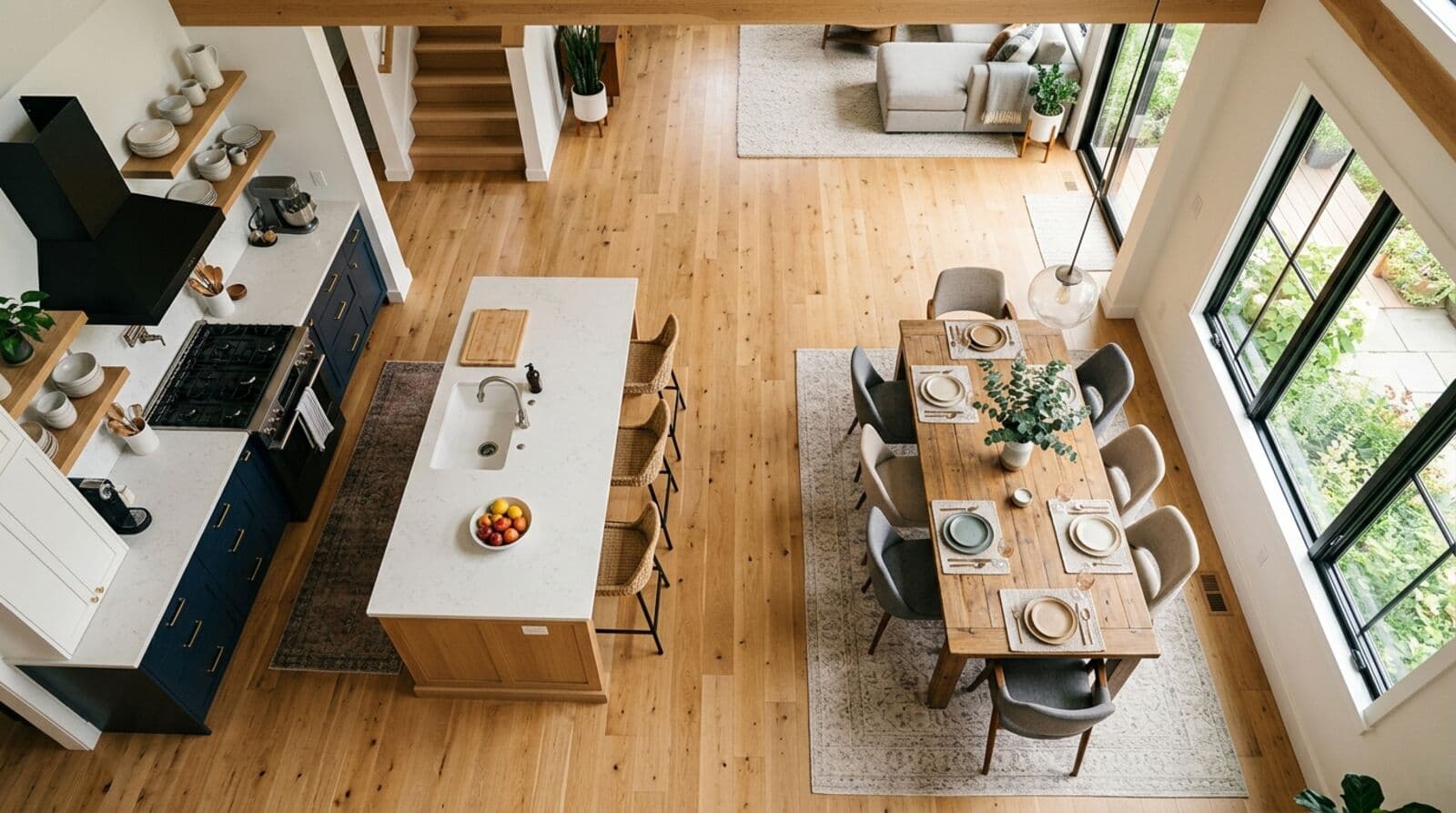
Most kitchen layout ideas articles give you five pretty floor plans and tell you to "choose the one that fits your lifestyle." That's not advice. That's a horoscope. Your layout is dictated by your room dimensions, where the plumbing enters the slab or subfloor, how many walls have windows, and whether you're willing to spend $8,000 moving a gas line. Lifestyle is a factor, but it's not the first one.
The layout you pick determines everything downstream — cabinet count, counter space, traffic flow, and ultimately how much the project costs. Moving a sink two feet in any direction can add $2,000 to $5,000 depending on your plumbing situation. So before you fall in love with a layout from Pinterest, let's talk about what each one actually requires and where each one falls short.
The Work Triangle Is a 1940s Relic
Every kitchen design resource still references the "work triangle" — the idea that your sink, stove, and refrigerator should form a triangle with sides between 4 and 9 feet, totaling no more than 26 feet. This concept was developed by the University of Illinois School of Architecture in the 1940s, when kitchens had one cook, no dishwashers, and no islands.
Modern kitchens have multiple cooks, prep zones, coffee stations, and islands that break the triangle into fragments. The NKBA planning guidelines have largely moved away from the rigid triangle toward a "work zone" approach — separate zones for prep, cooking, cleaning, and storage that each have their own logic.
The useful takeaway from the triangle isn't the measurements. It's the principle: don't put your three most-used stations too far apart or too close together. If you have to walk 15 feet from the fridge to the stove, that's a problem. If your stove is 18 inches from your fridge, that's also a problem — the heat will make your fridge work harder, and you'll have no landing space for hot pans.
L-Shaped Kitchen: The Safe Bet
The L-shaped layout uses two perpendicular walls and leaves the other two open. It's the most common layout in American homes for good reason — it works in almost any room size and accommodates an island or dining table in the open space.
Minimum dimensions: You need at least 10 feet on each leg to have functional counter and cabinet space. The legs don't have to be equal — a 12x8 L-shape works fine.
Pros: Flexible, allows an island, keeps traffic out of the cooking zone, works for one or two cooks, and leaves room for a table if you skip the island.
Cons: Corner cabinets are the bane of L-shaped kitchens. That dead corner where the two legs meet wastes space unless you install a lazy Susan, pull-out tray, or blind corner cabinet — all of which cost more than standard cabinets. You also get less total counter space than a U-shape.
Best for: Medium to large rooms where you want an open feel. If your kitchen opens to a dining or living area, the L-shape is usually the natural choice.
Galley Kitchen: Underrated and Efficient
Two parallel walls of cabinets and counters with a walkway between them. Galley kitchens get dismissed as cramped and outdated, but professional chefs prefer them for a reason — everything is within two steps.
Minimum dimensions: The walkway between counters needs to be at least 42 inches for one cook, 48 inches if two people will be in the kitchen simultaneously. Each counter run should be at least 8 feet to be functional. So your room needs to be roughly 8 feet wide minimum (with 24-inch-deep counters on each side and a 48-inch aisle).
Pros: Extremely efficient workflow. No wasted corner cabinets. Maximum counter and storage space relative to room size. Everything is close, so you're never walking far.
Cons: No room for an island. Can feel enclosed, especially with upper cabinets on both walls. If it's a pass-through (open at both ends), foot traffic cuts through your cooking zone. Only comfortable for one or two people max.
Best for: Narrow rooms, apartments, or anyone who prioritizes cooking efficiency over entertaining space. If you cook seriously and don't need the kitchen to double as a hangout zone, the galley is honestly the best layout. A lot of kitchen layout ideas dismiss it too quickly.
U-Shaped Kitchen: Maximum Counter Space
Three walls of cabinets and counters, with one side open for entry. The U-shape gives you the most storage and counter space of any layout, but it demands a larger room.
Minimum dimensions: Each leg needs at least 8 feet, and the opening between the two parallel legs should be at least 5 feet (42 to 48 inches clear after accounting for counter depth). In practice, you want a room that's at least 10x10 to make a U-shape work without feeling like a hallway.
Pros: Tons of counter space and storage. Keeps the cook in a defined zone. Works well for serious cooks who need multiple prep areas. Can accommodate two cooks more comfortably than a galley since there's more elbow room.
Cons: Two dead corners instead of one, doubling the wasted space problem. Can feel closed off and dark, especially with upper cabinets on all three walls. Harder to add an island — you typically need the room to be at least 12x12 to fit one.
Best for: Dedicated kitchen rooms (not open plan) where cooking is the priority. Empty nesters and serious home cooks love this layout because it puts everything within reach.
One-Wall Kitchen: When Space Is Tight
Everything on a single wall — fridge, sink, stove, and all your cabinets in a row. This is common in studios, loft conversions, and small apartments, but it also shows up in open-plan homes where the kitchen is part of a great room.
Minimum dimensions: You need at least 12 feet of linear wall space to fit a full kitchen. Under 10 feet and you'll be sacrificing something — usually counter space. The wall needs to be unbroken by doors or windows for the full run, which limits your options in most rooms.
Pros: Maximizes open floor space. Clean, simple look. No corner cabinets. Works well in open plans where you don't want the kitchen to dominate visually.
Cons: Very limited counter space. No natural separation between prep, cooking, and cleaning zones — everything is shoulder to shoulder. With only one wall, you'll likely need a pantry cabinet eating into your already limited run. Only works for one cook unless you add an island.
Best for: Small spaces, studio apartments, or open-plan great rooms where the kitchen is secondary to the living space. If you're the kind of person who cooks elaborate meals nightly, this layout will frustrate you.
Open Plan: The Default That Deserves More Scrutiny
Knocking out the wall between kitchen and living room has been the default renovation move for 15 years. It's so standard that questioning it feels contrarian. But it deserves questioning.
The case for open plan: Better sight lines to kids or guests. More natural light. Feels bigger. Good for entertaining.
The case against: Cooking smells travel everywhere. Noise from the kitchen (dishwasher, vent hood, conversation) bleeds into the living area. You can never hide a mess. The kitchen becomes the visual centerpiece of your home, which means every design choice has to be "nice enough" for public display — no ugly-but-functional shortcuts.
The compromise: A lot of 2026 kitchen layout ideas involve semi-open plans. A half wall, a wide cased opening, or a counter peninsula that defines the kitchen zone without fully enclosing it. This gives you sight lines and light while containing some of the noise and mess. It also gives you more wall space for upper cabinets, which full open plans sacrifice.
The Island Question: When It Helps and When It Blocks Traffic
Kitchen islands have become so standard that people add them even when the room can't support one. Here's the honest test:
Minimum room size for an island: Your kitchen needs at least 12 feet by 12 feet total to accommodate an island with 36 to 42 inches of clearance on all working sides. That 36-inch clearance is non-negotiable for code compliance with appliances and is the practical minimum for opening dishwashers and ovens.
When an island helps: You have the space, you need more counter area, you want casual seating, or you need to create a visual boundary in an open plan. Islands with sinks or cooktops can genuinely improve workflow by creating a second work zone.
When an island hurts: The room is under 12x12, traffic has to squeeze around it, there's no clearance to open the dishwasher, or it blocks the natural path from the door to the rest of the house. A bad island turns a functional kitchen into an obstacle course.
If you're on the fence, a movable butcher block cart ($200 to $600) lets you test the concept before committing to a permanent island that requires electrical, plumbing, and structural work.
Minimum Clearances That Actually Matter
Forget the "work triangle" measurements. These are the clearances that determine whether your layout is livable:
- Between parallel counters or counter and island: 42 inches minimum for one cook, 48 inches for two cooks. Under 42 inches and you can't open the dishwasher while someone walks behind you. - In front of the sink: 36 inches clear. You'll stand here more than anywhere else. - In front of the stove/range: 36 inches minimum, 48 inches preferred. You need room to step back from splatter and to open the oven door fully. - Between the refrigerator and the nearest wall or cabinet: The fridge door needs to open at least 90 degrees. Measure your fridge door and add 2 inches. - Between the island and perimeter cabinets: 42 inches on the working side (where the sink or stove is), 36 inches minimum on passage sides.
These numbers aren't suggestions. Go below them and you'll feel it every single day.
Test Your Layout Before Tearing Anything Out
The most expensive part of changing a kitchen layout isn't the cabinets or countertops — it's moving the plumbing and electrical. A sink relocation runs $1,500 to $5,000 depending on distance. Moving a gas line can cost $500 to $2,000. Adding a new electrical circuit for an island is $500 to $1,500.
Before you commit to a layout change, upload a photo of your current kitchen to our AI staging tool and see how different configurations look in your actual space. It won't replace a contractor's site visit, but it's a fast way to rule out ideas that won't work and narrow your options before spending money on design consultations. For budgeting, check our kitchen remodel cost guide, and if you're weighing island designs, our kitchen island with seating guide covers dimensions and costs. Customized renders start at $9.00 each.
About the author
Noah James
Founder, DrivewAI
Noah James is the founder of DrivewAI, an AI home visualization platform that helps homeowners, contractors, and real estate agents preview renovations before committing. He built DrivewAI to close the gap between inspiration and execution in home improvement.
His writing focuses on practical renovation decision-making, material comparisons, and how AI visualization tools are changing the way people plan projects — from driveway replacements to full interior staging.
See your kitchen restyled by AI
Upload a photo and get AI renderings across every style. Designs from $9 with a 24-hour refund guarantee.
Try DrivewAI Free