Kitchen Countertop Types Compared: Cost, Durability, Maintenance
By Noah James
• 9 min read • Founder, DrivewAI
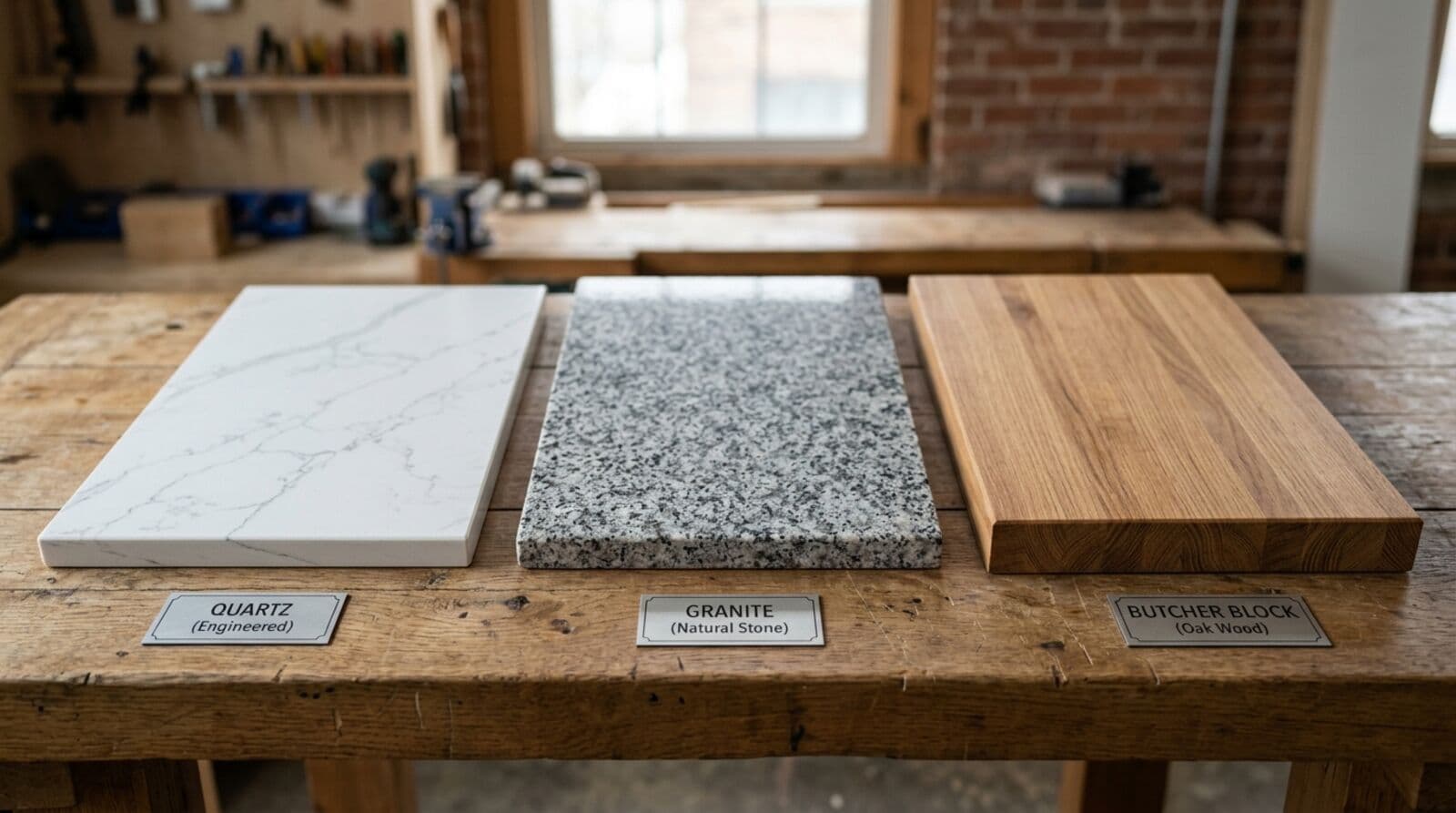
Choosing between kitchen countertops types is one of those decisions where marketing has completely overtaken reality. Every material has a trade association spending millions to convince you it's the best choice. Granite dealers will tell you granite is indestructible. Quartz manufacturers will tell you quartz is maintenance-free. Marble suppliers will tell you marble "develops character" over time — which is a poetic way of saying it stains permanently.
Here's what I want you to walk away with: there is no perfect countertop material. Every option involves a tradeoff between cost, durability, appearance, and maintenance. The right choice depends on how you actually use your kitchen, not which material is trending on design blogs. Let's go through each one honestly.
Quartz: The Current Default (and Why It Earned That Spot)
Engineered quartz (Silestone, Caesarstone, Cambria, and dozens of others) is crushed natural quartz bound with resin. It's been the top-selling countertop material since roughly 2020, and its dominance isn't an accident.
Cost installed: $50 to $120 per square foot, with most kitchens landing around $65 to $85. A typical kitchen with 40 to 50 square feet of counter space runs $2,600 to $5,000 installed.
Durability: Excellent for daily use. It won't scratch from normal kitchen activities (cutting directly on it will dull your knives before it scratches the quartz). It doesn't need sealing, ever. It resists stains from coffee, wine, and most foods.
The catch: Quartz is not heat-resistant. Set a hot pan directly on it and you can crack or discolor the resin. This is the single most common quartz countertop complaint, and it's entirely preventable with a trivet. Also, direct sunlight can cause some quartz colors (especially whites) to yellow over time, which matters if your counters are near large windows.
Verdict: Quartz is the Honda Civic of countertops — reliable, sensible, and a little boring. It's the right choice for most people, and there's no shame in that.
Granite: Still Good, No Longer Special
Granite dominated the kitchen upgrade market from the late 1990s through the 2010s. It's a natural stone, quarried in slabs, and every piece is unique. That uniqueness used to be a selling point. Now, with better engineered alternatives, granite occupies an awkward middle ground — more expensive than laminate, comparable to quartz, but requiring more maintenance.
Cost installed: $45 to $100 per square foot. Exotic colors and patterns cost more, but common granites (Santa Cecilia, Giallo Ornamental, Ubatuba) are often cheaper than mid-range quartz.
Durability: Very hard, excellent scratch resistance. It can handle hot pans better than quartz — granite won't crack from heat. However, it's a porous stone that requires sealing once or twice a year. Skip the sealing and it will absorb liquids and stain.
The catch: Seams are more visible than with quartz, especially on large islands. The natural variation means your installed slab might not look exactly like the sample at the showroom — always pick your specific slab at the yard if you go this route. Granite can also chip at edges, and repairs are noticeable.
Verdict: Granite is a perfectly fine choice that's lost its prestige factor. If you find a slab you love at a good price, there's no reason to avoid it. Just commit to the annual sealing.
Butcher Block: Warm, Affordable, and High-Maintenance
Butcher block is solid wood (usually maple, walnut, or oak) laminated into thick slabs. It brings warmth to a kitchen like no other material, and it's one of the few countertops you can install yourself.
Cost installed: $30 to $80 per square foot. IKEA sells butcher block counters starting around $25 per linear foot unfinished, making it the most affordable real-wood option. Professional installation adds $20 to $40 per square foot.
Durability: This is where butcher block gets complicated. It scratches easily — that's by design if you use it as a cutting surface, and a nightmare if you want it to look pristine. It dents from heavy impacts. Water is the real enemy: standing water causes warping, staining, and eventually rot. Around the sink is the highest-risk zone.
The catch: Butcher block needs oiling every 2 to 4 weeks with food-safe mineral oil to stay sealed and looking good. Skip the oiling and the wood dries out, cracks, and absorbs stains. Many people love the patina butcher block develops over time. Many other people see a beat-up surface and wish they'd picked quartz.
Verdict: Best as an accent — an island top or a dedicated prep section — rather than your entire kitchen. If you do use it everywhere, accept that it will show its age and require regular care.
Laminate: Better Than You Think
Laminate countertops have a reputation problem. People associate them with the cheap, peeling, obviously-fake surfaces from the 1980s. Modern laminate is a completely different product, and dismissing it outright is a mistake. Consumer Reports has rated several laminate brands competitively with stone in durability testing.
Cost installed: $15 to $45 per square foot. This makes laminate the most budget-friendly option by a wide margin. A full kitchen can cost $600 to $2,000 installed.
Durability: Modern laminate resists scratches, stains, and moisture far better than older versions. It won't chip like stone. The weak points are seams (water can infiltrate and cause swelling in the particleboard substrate) and heat — setting a hot pan on laminate will scorch it permanently.
The catch: It still looks like laminate. The best modern laminates are convincing at a distance, but up close or at the edges, you can tell it's not stone. Edge profiles are limited compared to stone, and you can't do an undermount sink with most laminate counters (though some newer products support it). Laminate also can't be repaired — a deep scratch or burn means replacing the section.
Verdict: If you're renovating on a budget or planning to sell in a few years, modern laminate is a genuinely smart choice. Spend the savings on better cabinets or appliances, which have more impact on daily life.
Marble: Beautiful, Expensive, and Brutally High-Maintenance
Marble is the aspirational kitchen countertops type that design magazines love to feature. Carrara, Calacatta, Statuario — these names carry a certain weight. But marble in a kitchen is a commitment that most people aren't prepared for.
Cost installed: $75 to $200 per square foot. Calacatta Gold, the most sought-after variety, can exceed $250 per square foot for premium slabs. A full marble kitchen easily costs $5,000 to $12,000 in countertops alone.
Durability: Marble is softer than granite and quartz on the Mohs hardness scale. It scratches more easily and can chip. But the real issue is porosity — marble absorbs liquids fast. Lemon juice, red wine, tomato sauce, and vinegar will etch the surface within minutes, leaving dull spots that no amount of sealing fully prevents.
The catch: Sealing helps but doesn't make marble stain-proof. It makes marble stain-resistant for a window of time — maybe 15 to 30 minutes before a spill penetrates. You'll need to reseal every 6 to 12 months. The "patina" that marble develops is real and some people genuinely love it, but you need to go in with open eyes. If a water ring from a glass will bother you, marble will drive you crazy.
Verdict: Marble is for people who love the material enough to accept its flaws. Use it on a baking station or island where you control what touches it, and pair it with a more durable material (quartz, granite) around the sink and stove.
Concrete: The Wild Card
Poured concrete countertops are custom by definition. They're formed in molds on-site or in a shop, sealed, and installed. The look ranges from industrial to refined depending on the finish and pigment.
Cost installed: $70 to $150 per square foot. The cost is almost entirely labor — the raw material is cheap, but the skill required for a quality pour is specialized.
Durability: Concrete is hard and heat-resistant, but it's also porous and prone to hairline cracking. Sealing is mandatory and needs to be redone annually. Cracks can develop over time due to settling or substrate movement, and while they're structural (not functional), they bother some people.
The catch: Concrete is heavy. Like, very heavy. Your cabinets may need reinforcement to support the weight. Color consistency across a large pour is difficult — there can be visible variation in tone. And if you don't like the finished product, there's no returning it. It's a permanent, custom material.
Verdict: Concrete is for people with a specific aesthetic vision and the budget to execute it with a skilled fabricator. It's not a good "safe choice."
How to Compare Durability Honestly
Here's a blunt ranking for the properties that matter most in a working kitchen:
Scratch resistance (best to worst): Quartz, granite, concrete, marble, laminate, butcher block.
Heat resistance (best to worst): Granite, concrete, marble, butcher block (with damage), quartz, laminate.
Stain resistance (best to worst): Quartz, laminate, granite (sealed), concrete (sealed), marble (sealed), butcher block.
Maintenance required (least to most): Quartz, laminate, granite, concrete, marble, butcher block.
No material wins every category. Quartz leads in three of four, which is why it outsells everything else. But if heat resistance matters most to you — maybe you bake a lot and want to set hot sheets directly down — granite is the better pick.
See Your Countertop Choice in Your Kitchen First
The biggest risk with countertop selection isn't picking a bad material — it's picking the wrong color or pattern for your specific kitchen. A marble that looks stunning in a bright showroom can look gray and flat in a north-facing kitchen with limited natural light.
Upload a photo of your kitchen to our AI staging tool and preview different countertop materials and colors in your actual space. It takes the guesswork out of coordinating counters with your cabinet design and backsplash. For a full budget picture, check our kitchen remodel cost breakdown. Customized renders start at $9.00 each.
About the author
Noah James
Founder, DrivewAI
Noah James is the founder of DrivewAI, an AI home visualization platform that helps homeowners, contractors, and real estate agents preview renovations before committing. He built DrivewAI to close the gap between inspiration and execution in home improvement.
His writing focuses on practical renovation decision-making, material comparisons, and how AI visualization tools are changing the way people plan projects — from driveway replacements to full interior staging.
See your kitchen restyled by AI
Upload a photo and get AI renderings across every style. Designs from $9 with a 24-hour refund guarantee.
Try DrivewAI Free