House Exterior Design: Styles, Siding, and Smart Updates
By Noah James
• 9 min read • Founder, DrivewAI
Your Home Has a Style Whether You Chose It or Not
Every house exterior design tells a story, and most of those stories are "the builder picked whatever was cheapest in 1987." If your home feels architecturally confused — a little bit Colonial, a little bit ranch, a lot of beige — you are not alone. Most American homes are a mashup of styles accumulated over decades of previous owners adding a dormer here, vinyl siding there, and shutters that do not actually shut anything.
The good news is that house exterior design can be dramatically transformed without tearing anything down. Strategic siding changes, paint choices, window trim updates, and a few well-placed architectural details can shift a home from one style to another. The key is understanding what style you are actually going for, then being disciplined enough to commit to it.
Major Exterior Styles and What Defines Them
Craftsman
Craftsman homes are defined by low-pitched roofs, wide front porches with tapered columns, exposed rafter tails, and mixed materials (stone base, wood or shingle siding above). The color palette leans earthy — olive greens, warm browns, deep reds, mustard yellows. If your home has a prominent front porch and you want it to feel handmade and grounded, Craftsman is the direction. Key detail: Craftsman homes use natural materials or materials that look natural. Vinyl siding on a Craftsman is like putting a bumper sticker on a Steinway.
Modern Farmhouse
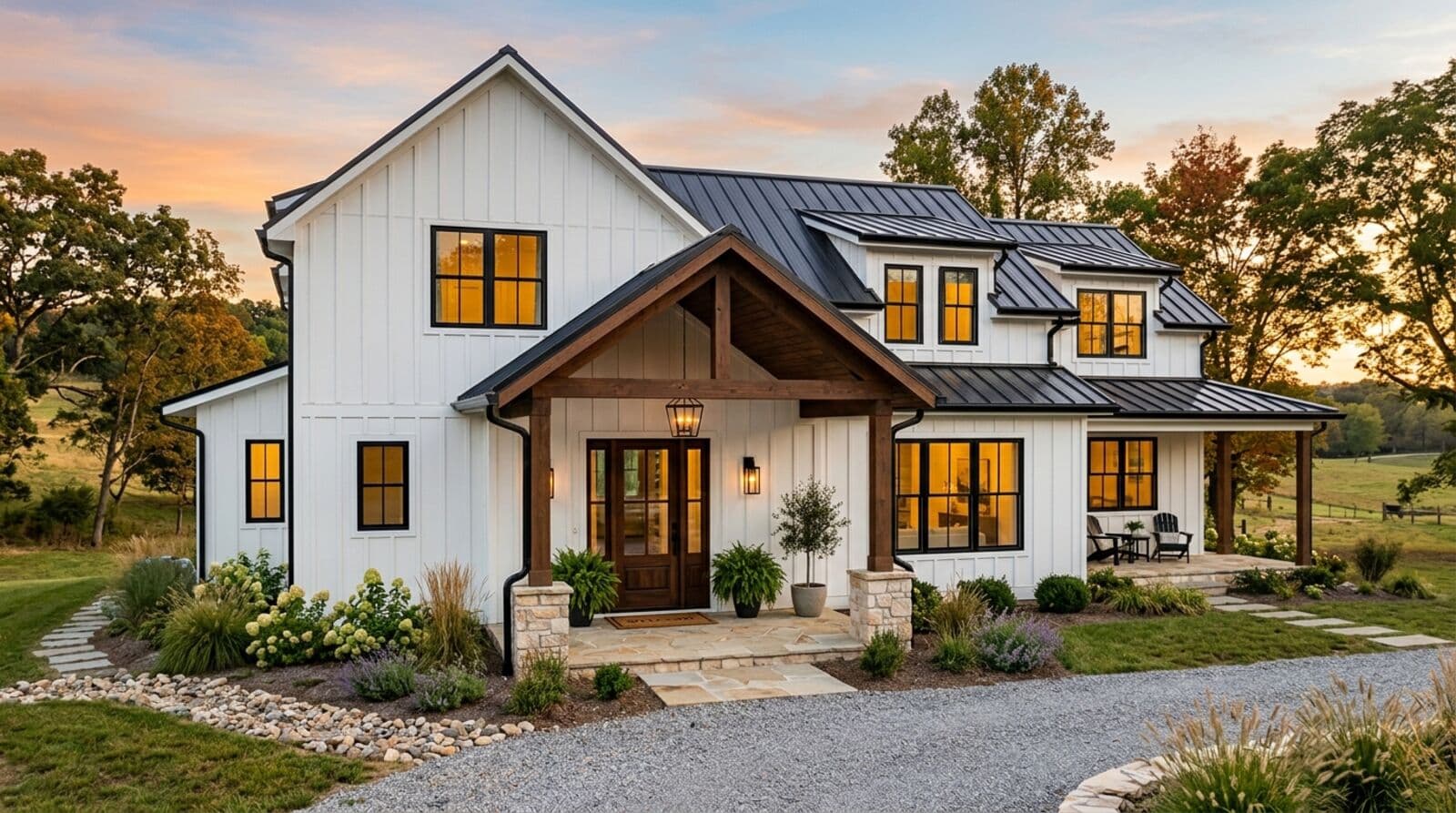
Modern farmhouse exploded around 2016 and has not gone away despite predictions. The formula is simple: white or light siding, black-framed windows, board-and-batten accents, metal roofing accents, and a covered front porch. It works because the contrast is high and the palette is limited. The style is forgiving on different house shapes, which is why builders love it. Warning: the all-white-everything version is already showing its age. Adding warm wood tones (a cedar accent wall, natural wood front door) keeps it from looking like a 2019 time capsule.
Contemporary
Contemporary means "current," so it shifts over time. Right now, contemporary exteriors feature flat or low-slope roofs, large windows, mixed materials (metal panels, wood, concrete), and asymmetric facades. The color palette is restrained — charcoal, white, natural wood, with maybe one accent color. Contemporary homes emphasize horizontal lines and clean geometry. This style is harder to retrofit onto a traditional home because the roof pitch usually gives it away.
Colonial
Colonial homes are symmetrical, with a centered front door, evenly spaced windows, and a side-gabled roof. The style is formal without being fussy. Color palettes are traditional — white, cream, navy, brick red, forest green. Shutters on Colonial homes should be functional-width (meaning they would actually cover the window if closed). Half-width decorative shutters on a Colonial look cheap, and everyone subconsciously notices even if they cannot articulate why.
Mid-Century Modern
Mid-Century homes (1945-1975) feature flat or butterfly roofs, large glass walls, post-and-beam construction, and integration with the landscape. These homes are increasingly sought after, and the worst thing you can do to one is "update" it with traditional details. If you have a Mid-Century home, lean into the style — replace small windows with larger ones, expose structural elements, and keep the palette minimal.
How to Update Your Home's Style Without a Full Renovation
You do not need to demolish and rebuild to change your home's exterior personality. Here are the highest-impact changes ranked by cost-effectiveness.
Paint (cost: $3,000-$8,000 for a full exterior). Paint is the least permanent and most transformative change. A brown ranch becomes a modern farmhouse with white paint and black trim. A beige Colonial becomes stately with a deep navy body and white trim. Paint is where you should start because it is reversible.
Window trim and shutters (cost: $1,000-$4,000). Adding or removing window trim changes how windows read from the street. Wide trim with a header detail says Craftsman. Minimal trim says Contemporary. Shutters that are properly sized add formality. Removing mismatched shutters often looks better than keeping them.
Front porch modifications (cost: $2,000-$15,000). Wrapping porch columns with tapered trim turns a plain porch into a Craftsman feature. Adding a metal roof over a porch adds farmhouse character. Removing a dated wrought iron railing and replacing it with cable rail or horizontal wood slats modernizes instantly.
Accent siding (cost: $3,000-$10,000). You do not need to re-side the entire house. Adding board-and-batten to a gable end, or stone veneer to the base of the front facade, creates a style anchor point that changes the entire composition.
Before making any of these changes, preview them with DrivewAI by uploading a current photo of your home. Seeing a realistic rendering of your home with new paint colors or siding styles beats guessing, and it costs far less than buying materials you end up returning.
Siding Options: What Actually Lasts and What Does Not
Vinyl ($3-$8 per square foot installed)
Vinyl is cheap and requires almost no maintenance. The downsides are that it looks like vinyl (the shadow lines and texture are never quite convincing), it can crack in extreme cold, and it melts if your neighbor's grill gets too close. For rental properties or budget-conscious updates, vinyl is fine. For a home you want to look its best, it is a compromise.
Fiber cement ($6-$13 per square foot installed)
Fiber cement (James Hardie being the dominant brand) is the current sweet spot. It looks like painted wood, resists rot and insects, handles fire well, and lasts 30-50 years. The main drawback is weight — it is heavier than vinyl and requires more labor to install. Fiber cement can be factory-painted (ColorPlus from Hardie is good) or field-painted. Factory paint holds up better.
Wood ($8-$15 per square foot installed)
Real wood siding — clapboard, shingle, board-and-batten — looks the best and requires the most maintenance. You will repaint or restain every 5-7 years, and you need to watch for rot and insects. Cedar and redwood are naturally resistant but expensive. Pine is cheap but demanding. Wood siding on a historic home is worth preserving. Wood siding on a new build is a lifestyle commitment.
Stone veneer ($15-$30 per square foot installed)
Manufactured stone veneer adds weight and texture to a facade. It works best as an accent — a wainscot on the lower third of the front face, around a fireplace chimney, or on porch columns. Full stone facades are expensive and can look heavy-handed on smaller homes. The key is restraint: stone on 20% of the front face looks intentional, stone on 80% looks like a castle.
The Biggest House Exterior Design Mistake
The number one mistake in house exterior design is mixing too many materials and colors. Three materials is the maximum for a cohesive exterior: a primary siding, a secondary accent material, and trim. A house with vinyl siding, stone veneer, brick, cedar shakes, and board-and-batten on the same front face is not interesting — it is chaotic.
The same rule applies to color. Two or three colors (body, trim, accent) is the formula. Body color covers 60-70% of the surface. Trim is 20-30%. Accent (front door, shutters) is 10% or less. When every element is a different color, the eye has nowhere to rest and the house reads as smaller because it is visually fragmented.
This mistake is most common on homes that have been updated piecemeal over the years. The original owner put up vinyl siding, the second owner added stone veneer to the front, the third owner replaced the porch with a different material, and now the home looks like a materials showroom. Sometimes the best update is to subtract — remove one material and let the remaining ones breathe.
Before and After: What Changes the Entire Feel
Real transformations rarely involve structural changes. Here is what the most dramatic before-and-after exterior redesigns have in common.
Unified color scheme. Going from four or five colors to two or three creates immediate cohesion. The house looks bigger, cleaner, and more intentional.
Simplified material palette. Removing one material (usually mismatched stone or outdated brick facing) and extending the primary siding to cover that area.
Updated windows or trim. Black window frames on a white house is the most copied exterior trend of the last decade, and it works because the contrast creates definition. Older homes with white-on-white windows can look flat.
Front door and hardware upgrade. As we covered in our front door ideas guide, the door is the focal point. A bold door color on a neutral house grounds the whole composition.
Landscaping integration. Exterior design does not stop at the siding. Foundation plantings that complement the house color, a walkway that matches the home's style, and properly scaled lighting tie the architecture to the site. Our front yard landscaping guide covers this in detail.
How Architectural Trends Age
Here is a contrarian take: do not chase the trend, chase the style that matches your home's bones. Modern farmhouse looks great on homes with gabled roofs and simple forms. It looks forced on a hip-roofed ranch. Contemporary updates work on mid-century homes. They fight with Colonial proportions.
The American Institute of Architects surveys home design trends annually, and the through-line is that homes trend toward simplicity over time. The McMansion era of the early 2000s — with its competing rooflines and decorative foam columns — has given way to cleaner forms and more honest materials. This is good news for homeowners updating older homes because subtraction (removing dated details) is cheaper than addition.
Visualize Your Exterior Redesign Before You Commit
Changing your house exterior design is expensive when done wrong and deeply satisfying when done right. The difference between those outcomes is usually planning — specifically, seeing what the changes will actually look like on your home before materials are ordered and contractors are hired.
DrivewAI lets you upload a photo of your home and generate AI-powered redesigns showing different styles, colors, and material combinations. DrivewAI plans start at just $9.00, which is a rounding error compared to the cost of a siding project you end up regretting. Try a few style directions, compare them side by side, and then go talk to contractors with a clear vision.
For more exterior inspiration, explore our guides on driveway redesign ideas and best driveway materials to make sure the rest of the property keeps up with your new facade.
About the author
Noah James
Founder, DrivewAI
Noah James is the founder of DrivewAI, an AI home visualization platform that helps homeowners, contractors, and real estate agents preview renovations before committing. He built DrivewAI to close the gap between inspiration and execution in home improvement.
His writing focuses on practical renovation decision-making, material comparisons, and how AI visualization tools are changing the way people plan projects — from driveway replacements to full interior staging.
See your home transformed by AI
Upload a photo and get AI renderings across every style. Designs from $9 with a 24-hour refund guarantee.
Try DrivewAI Free