Covered Patio Ideas: Pergola vs Solid Roof vs Shade Sails
By Noah James
• 8 min read • Founder, DrivewAI
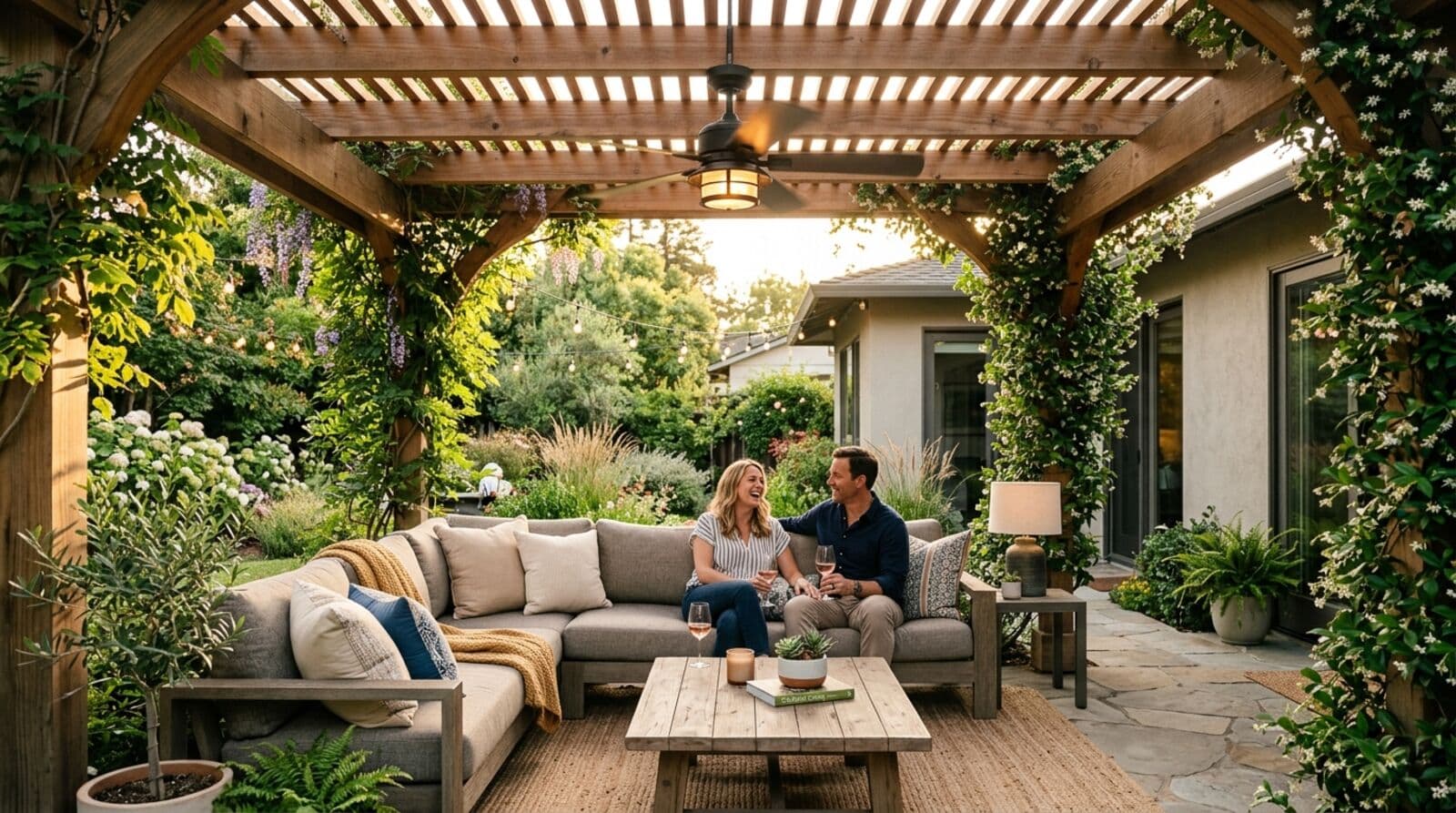
Covered patio ideas flood Pinterest and Instagram with gorgeous outdoor rooms that cost more than some people's kitchens. What those photos don't tell you is whether you need a permit, whether the cover will actually keep rain off your head, and why a $3,000 pergola and a $15,000 solid roof serve completely different purposes. This guide puts real numbers and honest tradeoffs on every option so you can pick the one that actually makes sense for your climate, budget, and lifestyle.
The Four Types of Patio Covers
Every covered patio falls into one of four categories, and each has fundamentally different performance characteristics.
Pergolas are open-framework structures with rafters or slats on top. They create filtered shade — typically blocking 50-70% of direct sunlight depending on rafter spacing and orientation. They do not block rain. Let me repeat that, because it's the single most common misunderstanding in outdoor design: pergolas do not keep you dry. They're architectural features that define space and filter light. They're beautiful. They're also decorative, not functional, when it comes to weather protection.
Solid roof structures are exactly what they sound like — a permanent roof extension with proper framing, roofing material, and often integrated gutters. They block sun and rain completely. They're also the most expensive option and almost always require a building permit because they're classified as permanent structures.
Shade sails are tensioned fabric panels anchored to posts or building attachment points. They block sun effectively (90-95% UV blockage for quality fabrics) and shed light rain, but they're not waterproof and they can't handle snow loads. They're the most affordable option and the easiest to install, but they have a lifespan of 5-8 years before UV degradation weakens the fabric.
Retractable awnings extend and retract on a mechanical or motorized frame. They give you the option to have full sun or full shade on demand. Motorized units with wind sensors are the most convenient version — they retract automatically in high winds to prevent damage. They block light rain when extended but aren't designed for heavy storms.
Real Cost Ranges for Covered Patio Ideas
Let's get specific about pricing, because the range for patio covers is enormous and most sources give you a useless "it depends."
Shade sails: $200-$800 for a single residential sail, installed DIY. Professional installation with steel posts in concrete footings runs $1,000-$3,000 for a multi-sail setup covering a 12x12 area.
Pergola (wood): $3,000-$8,000 for a 12x16 foot cedar or pressure-treated pergola, professionally installed. A kit pergola from a big-box store runs $1,500-$3,500 for materials; add $1,000-$2,000 for professional assembly. Aluminum or vinyl pergolas that mimic wood cost $4,000-$12,000 installed but never need staining or sealing.
Retractable awning: $2,000-$5,000 for a quality motorized unit covering 12-16 feet of width, professionally installed. Manual-crank models cost $1,000-$2,500. The motorized versions are worth the premium — manual awnings tend to not get retracted in time before storms, leading to damage.
Solid patio cover: $8,000-$20,000 for a 12x16 foot attached structure with composition roofing, matching your home's existing roof. Premium versions with tongue-and-groove ceiling, recessed lighting, and ceiling fan(s) run $15,000-$30,000. Customized renders start at $9.00 each.
Louvered pergola (adjustable): $10,000-$25,000 for an aluminum louvered system that opens for sun and closes for rain protection. These are the "best of both worlds" option but at a significant price premium. Brands like StruXure and Equinox dominate this market.
Permit Requirements: What Most People Skip
Here's where many covered patio ideas go sideways. Permit requirements vary by municipality, but general patterns hold:
Shade sails rarely require permits because they're considered temporary structures. Check your HOA rules, though — some restrict the color, size, or number of sails.
Freestanding pergolas (not attached to the house) sometimes fall below permit thresholds, depending on size and height. Many jurisdictions exempt structures under 120 square feet and under 10 feet tall. But this varies wildly — always check.
Attached pergolas and any solid roof structure almost always require a building permit because they attach to your home's structure and must meet local building codes for wind loads, snow loads, and structural connections. Expect $200-$500 in permit fees and a 2-4 week approval timeline.
Building without a permit is a gamble with real consequences. If you sell your home, an unpermitted structure can kill a deal or require retroactive permitting (which sometimes means demolishing non-compliant work). Insurance companies can also deny claims related to unpermitted structures. The permit process exists to ensure your patio cover won't collapse under snow, blow off in a windstorm, or tear away from your house — all things that have happened to unpermitted structures. The International Code Council publishes the building codes most jurisdictions adopt, and their residential provisions cover patio cover requirements in detail.
The Rain Question: Honest Protection Levels
Different covers provide vastly different rain protection, and this single factor should probably be your primary decision driver.
No rain protection: Traditional pergola with open slats. You will get wet. Adding shade cloth improves sun protection but doesn't help with rain.
Light rain protection: Shade sails (water beads and runs off, but seams leak), retractable awnings (shed light rain when extended, but not designed for heavy rain or sustained rainfall).
Moderate rain protection: Pergola with polycarbonate panels between rafters. The panels block rain while maintaining the pergola aesthetic. This is a popular compromise at $500-$1,500 to add to an existing pergola.
Full rain protection: Solid roof structures and closed louvered pergolas. These are the only options that let you sit comfortably during a genuine rainstorm. If rain is a regular occurrence in your climate and outdoor living is a priority, this is where you should be looking.
For Pacific Northwest and Southeast homeowners, the math is simple: you get rain regularly, so an open pergola gives you maybe five usable months. A solid cover gives you ten or more. The cost difference pays for itself in usable outdoor time within a few years.
Integrated Lighting and Fan Options
A covered patio with no lighting or airflow is a patio you stop using after sunset or when it's humid. The cover structure gives you something to attach fixtures to — take advantage of it.
Ceiling fans require a minimum clearance of 7 feet (8 feet is better) and need to be rated for damp or wet locations depending on your cover type. A good outdoor ceiling fan runs $200-$500 plus installation. In hot climates, a ceiling fan extends usable patio time by weeks and makes summer evenings actually comfortable. You need a solid structure to mount a fan — pergolas generally can't support them unless specifically engineered.
Recessed lighting works with solid roof structures and provides clean, unobtrusive illumination. Four to six recessed cans in a 12x16 patio cover cost $400-$800 installed. LED recessed lights are the standard now, offering warm light at minimal electricity cost.
String lights work with any cover type and are the cheapest lighting option at $30-$100. They create ambiance that more expensive fixtures struggle to match. The commercial-grade LED versions last 5-10 years and are virtually unbreakable.
Integrated LED strips along rafters or beams provide subtle, modern lighting. They work especially well with pergolas, highlighting the structure's architecture at night. Basic LED strip kits run $50-$150 for DIY installation.
When a Covered Patio Adds Real Value to Your Home
Not every covered patio increases your home's value, but the ones that do can add significant returns. The key is whether the cover creates what appraisers call "livable outdoor square footage."
A solid, permitted patio cover with electrical (lights and fans), a finished ceiling, and integration with the home's architecture effectively adds a room to your house. In moderate and warm climates, this kind of space appraises at $25-$50 per square foot — meaning a 12x16 covered patio could add $5,000-$10,000 to your home's appraised value.
A freestanding pergola with no electrical or weather protection adds much less — it's an amenity, not a room. It might contribute $1,000-$3,000 to perceived value through improved aesthetics, but it won't change the appraiser's calculation.
The ROI sweet spot is a professionally built, permitted, attached solid cover in a climate where it extends outdoor living to 8-10 months per year. In Phoenix, Houston, Atlanta, and similar markets, this is one of the highest-return outdoor investments you can make.
Choosing the Right Cover for Your Climate
Your climate should drive 80% of this decision. Here's the cheat sheet.
Hot and dry (Phoenix, Las Vegas, Palm Springs): A pergola or shade sail is often sufficient because rain is rare. The priority is sun blocking, not rain protection. Louvered pergolas are popular because you can open them on mild days and close them during intense afternoon sun.
Hot and humid (Houston, Miami, New Orleans): Solid cover with ceiling fans. You need both rain protection and air movement. An open pergola in these climates means your furniture stays wet half the year and mildew becomes a constant battle.
Moderate with rain (Seattle, Portland, Nashville): Solid cover is the best investment. Without it, your outdoor living season shrinks dramatically. The cover pays for itself in usable months.
Four-season with snow (Chicago, Denver, Minneapolis): Solid cover engineered for snow loads. This adds to the cost (heavier framing, steeper pitch) but is non-negotiable if the structure will remain up year-round. Retractable awnings can be a good alternative since they stow for winter.
Combining your patio cover with thoughtful patio design and surrounding landscaping creates a cohesive outdoor room rather than a cover standing awkwardly over bare concrete.
Visualize Your Covered Patio Before You Build
The biggest challenge with patio covers is imagining how they'll change the look and feel of your home's exterior. A pergola that looks perfect in a photo might overwhelm a small house or look undersized against a large one. The roof material that seemed right in the showroom might clash with your existing shingles.
Upload a photo of your current patio or backyard to our landscaping tool and preview different cover styles, materials, and proportions against your actual home. You can compare a cedar pergola versus a solid roof extension versus a shade sail setup in seconds, without committing to any of them. It's the fastest way to narrow down which of these covered patio ideas will work for your specific house, your climate, and your budget.
About the author
Noah James
Founder, DrivewAI
Noah James is the founder of DrivewAI, an AI home visualization platform that helps homeowners, contractors, and real estate agents preview renovations before committing. He built DrivewAI to close the gap between inspiration and execution in home improvement.
His writing focuses on practical renovation decision-making, material comparisons, and how AI visualization tools are changing the way people plan projects — from driveway replacements to full interior staging.
See your home transformed by AI
Upload a photo and get AI renderings across every style. Designs from $9 with a 24-hour refund guarantee.
Try DrivewAI Free