Modern Living Room Design That People Actually Sit In
By Noah James
• 8 min read • Founder, DrivewAI
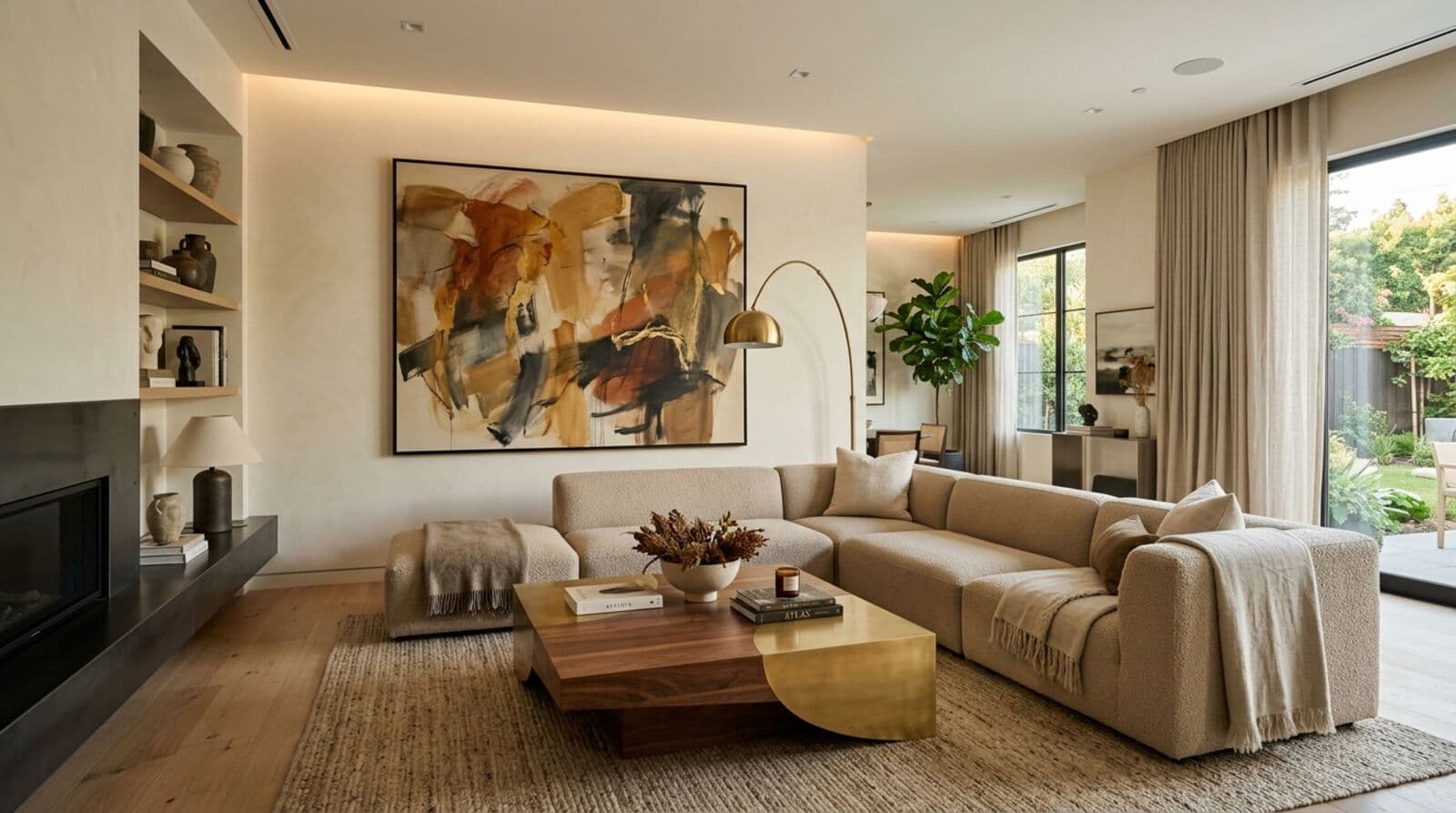
Somewhere along the way, modern living room design became synonymous with "beautiful room nobody wants to sit in." White everything, sharp-edged furniture, a single decorative object placed with museum-level precision. It photographs well. It functions terribly. The truth is that modern design was never supposed to be cold or uncomfortable — that's a misinterpretation that took hold through magazines and social media. Real modern design is about intentionality, clean proportions, and choosing quality over quantity. It should feel calm, not clinical. Let's talk about how to get there.
Modern Doesn't Mean Cold and Uncomfortable
The word "modern" in design refers to a movement that values simplicity, function, and the idea that less can be more — when the "less" is well-chosen. It doesn't mean stripping a room down to a sofa and a floor lamp and calling it done. A modern living room can have texture, warmth, color, and personality. It just achieves those things with fewer, better-chosen elements.
The cold, all-white modern living room you see in design publications is a styling choice, not a design requirement. Most people who live in those rooms have a closet full of blankets and pillows they pull out after the photographer leaves. The lived-in version of modern design includes throw blankets on the sofa, books on the coffee table, and art on the walls. It's edited, not empty.
If your modern living room feels cold, you're probably missing texture. A leather sofa needs a chunky knit throw. A marble coffee table needs a wooden tray. A smooth plaster wall needs a woven textile hanging. Contrast in texture is what makes modern rooms feel warm without adding clutter.
Furniture Arrangement for Conversation, Not Just TV
The default living room layout in American homes is everything facing the television. This makes sense if your living room's sole purpose is watching TV, but most people also use their living rooms for conversation, reading, hosting, and general living. Orienting everything toward a screen turns the room into a small theater.
A better approach: create a conversation zone. Position your main seating (sofa and chairs) to face each other, with the TV off to the side or on a wall that's visible from the sofa but not the focal point. In a modern living room, the focal point can be a fireplace, a large piece of art, a window with a view, or simply the center of the seating arrangement itself.
If the TV absolutely must be the focus, at least add two accent chairs angled toward the sofa at 45 degrees. This creates a U-shape that works for both watching and talking. Pull furniture away from the walls — even six inches makes a difference. Furniture pressed against walls makes rooms feel like waiting areas. Furniture floating in the room creates a sense of purpose and intimacy.
The Right Sectional for Your Room
Sectionals are the most popular modern living room furniture and also the most common source of proportion mistakes. The wrong sectional doesn't just look bad — it makes the entire room feel cramped or empty.
The rule of thumb: your sectional should take up no more than two-thirds of the room's longest wall. If your living room's longest wall is 15 feet, your sectional should be no longer than 10 feet. This leaves room for side tables, floor lamps, and visual breathing space.
Depth matters too. Standard sectional depth is 36-40 inches. Deep-seat sectionals run 42-46 inches and are more comfortable for lounging but eat significantly more floor space. In a room under 300 square feet, stick with standard depth. Above 300 square feet, deep-seat is an option if you prefer a lounging-oriented space.
The chaise should face into the room, not toward a wall. If your room has an open floor plan, the chaise end of the sectional naturally creates a boundary between the living area and adjacent space. And measure your doorways before ordering — more sectionals have been returned because they didn't fit through the door than for any other reason.
Lighting Layers: Ambient, Task, and Accent
Lighting is where modern living room design succeeds or fails, and most homes get it wrong by relying on a single overhead fixture. According to Architectural Digest, the key to a well-lit room is layering three types of light: ambient, task, and accent.
Ambient lighting provides overall illumination. In a modern living room, this is usually recessed cans or a statement pendant, ideally on a dimmer. The dimmer is critical — a living room needs bright light at noon and warm, low light at 8 PM, and a single brightness level can't serve both.
Task lighting is for reading, working, or any activity that needs focused light. Floor lamps next to seating or table lamps on side tables. In a modern room, arc floor lamps serve double duty as sculptural elements and reading lights.
Accent lighting is the difference between a room that looks flat and one that feels designed. LED strip lights behind a media console. A picture light above art. A candle cluster on the coffee table. These small light sources create depth and warmth, especially in the evening.
The most common mistake is having all lights on the same switch at the same brightness. Modern living rooms should have at least three separately controlled light sources. This lets you adjust the room's mood throughout the day without rearranging anything.
Color Palettes Beyond All-White
The all-white modern living room had its moment. It lasted about a decade, and now people are realizing that white walls, white sofa, white curtains, and white rug create a space that feels like a blank page — and one that shows every stain, scuff, and crumb.
Modern color palettes in 2026 have shifted toward warmth. Here are three that work:
- Warm neutrals: Cream walls, camel leather, warm oak wood, terracotta accents. This feels grounded and inviting without any bold colors - Soft greens: Sage or olive on an accent wall, natural wood furniture, cream textiles, brass hardware. Brings the outside in without going full botanical garden - Deep navy: Navy accent wall or large navy sofa, white and cream surroundings, brass or gold metallic accents. Dramatic without being dark — navy reads as sophisticated, not gloomy
The key is committing to a palette. Modern design doesn't work with too many colors competing. Two or three main tones plus one metallic accent is plenty. Everything in the room should connect to the palette, even if loosely. A single off-palette piece — that bright red vase someone gave you — will stick out in a modern room more than it would in a traditional one.
The Coffee Table Problem
Finding the right coffee table for a modern living room is harder than it should be. Too big and it dominates. Too small and it looks lost. Too tall and it blocks sightlines from the sofa. Too short and you're hunching to reach your drink.
The ideal coffee table is two-thirds the length of your sofa and about the same height as your sofa cushions (usually 16-18 inches). Round tables work better in rooms with angular furniture because they soften the geometry and eliminate corner-stubbing incidents. Rectangular tables work better in narrow rooms because they echo the room's proportions.
For storage in a modern living room, a coffee table with a lower shelf is more useful than one with drawers. The shelf holds books, magazines, or a basket — things that can look intentional. Drawers in coffee tables tend to become junk drawers within a month. If you need hidden storage, a storage ottoman that doubles as a coffee table is a more honest solution.
Material-wise, glass coffee tables make rooms feel bigger but show fingerprints constantly. Solid wood is warm and forgiving. Marble or stone is stunning but heavy and permanent-feeling. A mixed-material table — wood top with metal base, or stone top with wood legs — bridges the gap between warmth and modernity.
Built-in Storage vs Freestanding Furniture
Modern living rooms need storage, but they need it to be invisible or at least integrated. The mid-century media console has become standard for this reason — it hides components, provides surface area, and adds warmth through wood tones.
Built-in shelving and cabinets are the gold standard for modern storage. They make a room look finished, provide massive storage capacity, and can be designed to exactly fit your space. The downside is cost — custom built-ins typically start at $3,000-5,000 and go up from there. They also stay with the house, which is great for resale but less great if you're renting.
Freestanding furniture is more flexible and budget-friendly. A modern credenza, a simple bookshelf with a mix of closed and open storage, or a set of matching cabinets can accomplish most of what built-ins do. The trick is choosing pieces that look intentional and keeping them edited — a bookshelf that's 70% full looks curated, while one that's 100% full looks cluttered.
Customized renders start at $9.00 each. For modern living rooms specifically, storage should blend into the walls rather than stand out as furniture. Pieces that match or complement the wall color disappear visually, keeping the room feeling open and clean.
Previewing Your Modern Living Room Before You Commit
The biggest risk in designing a modern living room is scale. Because modern design uses fewer, larger pieces, each one matters more. A sofa that's six inches too long throws off the entire room. A coffee table that's the wrong height disrupts the visual plane. A rug that's too small makes everything float.
Before you order that $2,000 sectional or commit to a paint color, preview your modern living room design with AI. Upload a photo of your current space and test different layouts, color palettes, and furniture styles. See how a warm neutral palette feels versus your current white walls. Check whether that 100-inch sectional will overwhelm the room or fit perfectly.
This is especially valuable for modern living room design because the style depends so heavily on proportion and restraint. A maximalist room can absorb a mistake — one more pattern barely registers. A modern room has nowhere to hide. Every piece either contributes to the whole or detracts from it. Try it with your space before you commit, and check out our interior design ideas guide if you're still deciding on a style direction. The best modern rooms aren't the ones that follow the rules perfectly — they're the ones that feel both intentional and comfortable.
About the author
Noah James
Founder, DrivewAI
Noah James is the founder of DrivewAI, an AI home visualization platform that helps homeowners, contractors, and real estate agents preview renovations before committing. He built DrivewAI to close the gap between inspiration and execution in home improvement.
His writing focuses on practical renovation decision-making, material comparisons, and how AI visualization tools are changing the way people plan projects — from driveway replacements to full interior staging.
See your home transformed by AI
Upload a photo and get AI renderings across every style. Designs from $9 with a 24-hour refund guarantee.
Try DrivewAI Free