Fence Ideas: Materials, Costs, and Styles Compared
By Noah James
• 8 min read • Founder, DrivewAI
Picking Your Priority Before Picking Your Fence
Most people start shopping for fence ideas by browsing Pinterest. That's backwards. Before you care about aesthetics, you need to answer one question: what is this fence actually for?
Privacy fences block sightlines from neighbors and streets. They're typically 6 feet tall with no gaps between boards. Decorative fences define boundaries and add visual interest without necessarily blocking views — think picket fences, split rail, or ornamental iron. Security fences prioritize keeping things in (kids, dogs) or out (deer, trespassers) and focus on height, strength, and gate hardware.
Your priority shapes every decision that follows: material, height, style, spacing, and budget. A 3-foot decorative picket fence costs a fraction of a 6-foot solid privacy fence, and they serve completely different purposes. Start with function, then work toward form.
Wood Fencing: The Classic That Demands Attention
Wood remains the most popular fencing material in America, and for good reason — it's relatively affordable, highly customizable, and looks warm and natural. But it comes with a maintenance commitment that too many homeowners underestimate.
Cost: $15-$35 per linear foot installed. Pressure-treated pine sits at the low end. Cedar runs $20-$30. Redwood pushes toward $35 or higher. For a typical 150-linear-foot backyard fence, you're looking at $2,250-$5,250 installed.
The maintenance reality: Wood fences need staining or sealing every 2-3 years. Skip this step and you'll watch your investment warp, crack, and gray within five years. Budget $300-$600 every couple of years for stain and a weekend of work, or $500-$1,000 if you hire it out.
Best styles in wood: The classic dog-ear privacy fence is functional but forgettable. Board-on-board fencing (where boards overlap on alternating sides) looks significantly better and provides true privacy since there are no gaps even as wood shrinks. Horizontal slat fences — which we'll get to — have become the go-to for modern homes.
Cedar and redwood contain natural oils that resist rot and insects, which is why they cost more. Pressure-treated pine is chemically treated to resist decay but doesn't have the same warm color. Both work fine if maintained; the difference is aesthetics and how much staining you want to do.
Vinyl Fencing: The "Set It and Forget It" Option
Vinyl fencing is the choice for people who never want to stain, paint, or replace boards. It's essentially maintenance-free beyond occasional cleaning with a garden hose.
Cost: $20-$40 per linear foot installed. Basic white privacy panels are around $20-$25. Woodgrain-textured or colored vinyl runs $30-$40. That same 150-foot backyard fence costs $3,000-$6,000.
The honest pros: No painting, staining, or sealing ever. Won't rot, warp, or attract termites. Comes with long warranties (often lifetime limited). Cleans up with soap and water.
The honest cons: It looks like plastic because it is plastic. Higher-end vinyl with woodgrain textures helps, but close up, nobody's fooled. Vinyl becomes brittle in extreme cold — a hard impact in January can crack a panel. The color options are limited compared to painted wood. And if a panel does break, you're replacing the entire panel rather than swapping one board.
Vinyl works best for privacy fencing where you want clean lines and zero upkeep. It's less convincing for decorative applications where you want the warmth and character of real wood.
Aluminum and Ornamental Metal: Security and Elegance
Aluminum fencing mimics the look of wrought iron at a fraction of the weight and cost. It won't rust, doesn't need painting, and lasts essentially forever with minimal care.
Cost: $25-$50 per linear foot installed. Basic aluminum panels run $25-$35. Ornamental styles with decorative finials or scrollwork push toward $50. Steel fencing (true wrought iron style) can exceed $50-$75 per foot.
Aluminum is the best choice for pool enclosures (most building codes require a specific fence type around pools, and aluminum meets those codes). It's also excellent for front yards where you want to define the property line without blocking the view.
The limitation is obvious: aluminum offers zero privacy. You can see right through it. If blocking the neighbor's view is the goal, aluminum isn't your material. It's a security and decorative fence, not a privacy fence.
Steel fencing is heavier, stronger, and more expensive. It requires rust-prevention maintenance (powder coating helps enormously). Real wrought iron is beautiful, heavy, and costs more than most homeowners expect. For security applications where strength matters, steel is superior to aluminum. For everything else, aluminum gives you 90% of the look at half the cost and none of the rust.
Composite Fencing: The Premium Play
Composite fencing uses a blend of wood fibers and plastic polymers — essentially the same material as composite decking. It looks more like real wood than vinyl does, resists rot and insects like vinyl, and never needs staining.
Cost: $30-$60 per linear foot installed. This is the most expensive option for standard residential fencing. That 150-foot fence runs $4,500-$9,000.
Is it worth the premium? If you want the appearance of wood with vinyl-level maintenance, yes. Composite has the texture and warmth that vinyl lacks. It comes in convincing wood tones that hold up to close inspection. And unlike real wood, the color doesn't fade significantly over a decade.
The downsides: cost is the obvious one. Composite is also heavier than wood or vinyl, which means installation takes longer and posts need to be more robust. Color options, while good, are still limited compared to paintable wood. And composite is relatively new in the fencing market, so long-term performance data (20+ years) is limited compared to wood and vinyl.
The HOA Trap and Height Regulations
Here's where many fence projects go sideways: you pick the perfect fence, order materials, maybe even start digging post holes — and then your HOA sends a violation letter or your city inspector shows up.
Check your HOA restrictions first. Many homeowners associations regulate fence height, material, color, and style. Some ban certain materials entirely. Others require architectural review board approval before installation. A few particularly controlling HOAs dictate the exact shade of stain you can use. Read your covenants, conditions, and restrictions (CC&Rs) before you spend a dollar.
Check local building codes second. Most municipalities have height restrictions that vary by zone. Common rules include 4-foot maximum in front yards and 6-foot maximum in side and back yards. Some cities require a permit for any fence over 4 feet. Others require permits for all fences regardless of height.
The American Fence Association has resources on finding local regulations and certified installers. Your city's building department website usually lists fence-specific requirements. A 15-minute phone call to the building department can save you from a very expensive mistake.
Setback requirements are another gotcha. Many codes require fences to be set back 2-6 inches from the actual property line. Build on the property line and your neighbor might legally own half your fence — or you might be building on their property. Get a survey if there's any ambiguity.
Horizontal Slat Fences: The Trend That Earns Its Hype
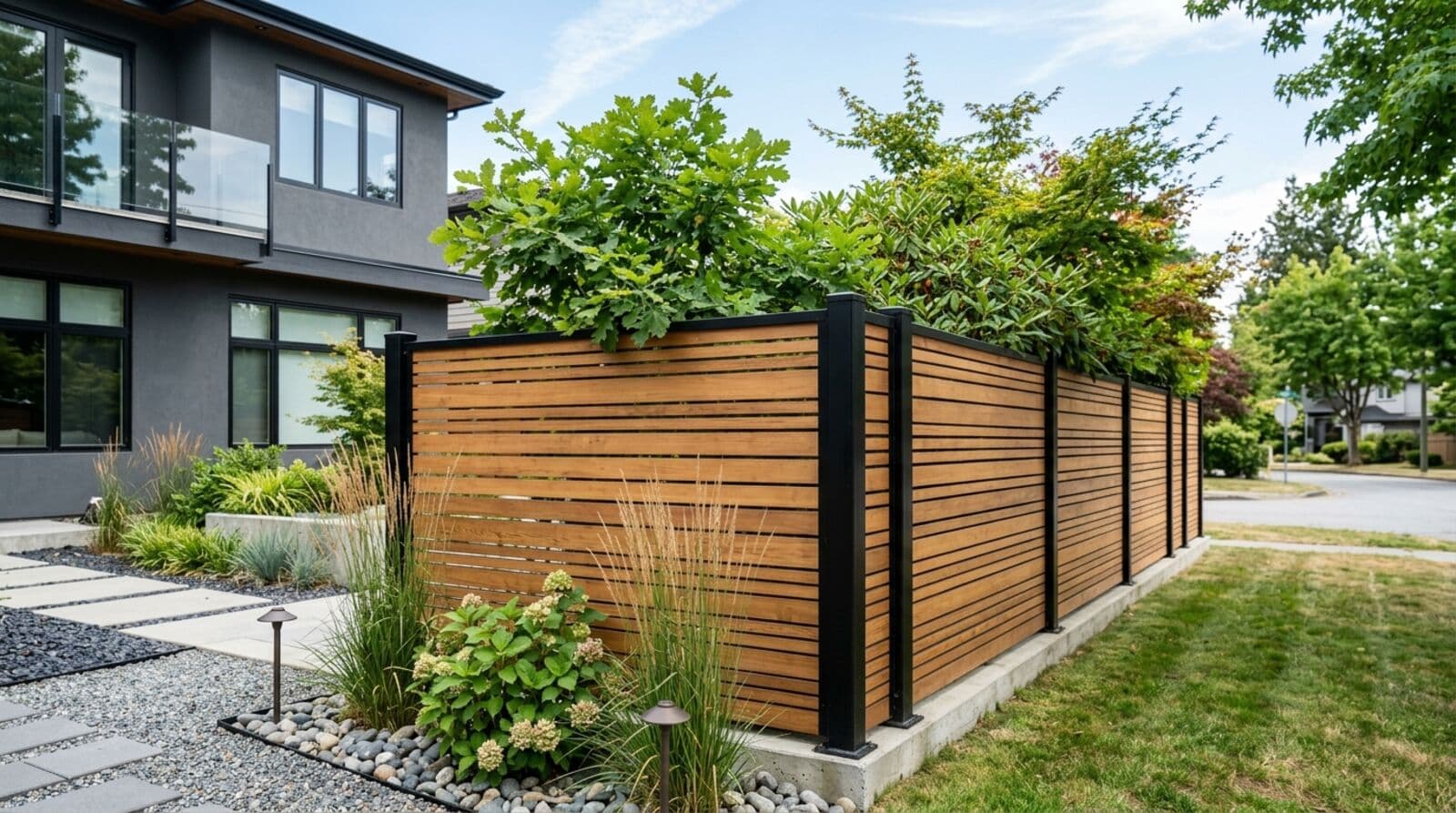
Not every design trend deserves attention, but horizontal slat fencing has earned its popularity. The look is clean, modern, and works with contemporary, mid-century, and even transitional home styles. It's one of the few fence ideas that genuinely elevates a property's appearance rather than just enclosing it.
The basic concept: Horizontal boards run parallel to the ground instead of vertically. Gaps between boards vary from zero (full privacy) to 1-2 inches (semi-private with airflow). Posts are set every 6-8 feet with boards spanning between them.
Materials that work for horizontal fences:
- Cedar is the most popular choice. Its natural grain looks exceptional in a horizontal orientation. Cost runs $25-$40 per linear foot installed. - Ipe (Brazilian hardwood) is the premium option. Incredibly dense, naturally rot-resistant, and turns a gorgeous silver-gray if left unstained. Costs $40-$60+ per foot. - Composite works well and eliminates maintenance. Runs $35-$55 per foot in horizontal configurations. - Metal slats (aluminum or steel) create an industrial-modern look. Expect $35-$50 per foot.
The structural consideration: Horizontal fences put different stresses on posts than vertical fences do. Boards can sag between posts if spans are too long. Keep post spacing at 6 feet maximum (not the 8 feet common with vertical fences). Use thicker boards — 1x6 minimum, and 5/4x6 is better. This isn't a place to cut corners or you'll have wavy boards within a year.
The DIY Fence Reality Check
YouTube makes fence building look like a pleasant weekend project. Two guys, a post hole digger, some quick cuts, and boom — beautiful fence by Sunday afternoon. Reality is different.
What DIY saves you: Labor is typically 40-60% of a fence installation cost. On a $5,000 fence, you might save $2,000-$3,000 by doing it yourself. That's real money.
What DIY costs you: Time (a 150-foot fence is a 3-4 weekend project for most homeowners, not one), potential mistakes (crooked posts are forever — or at least until you dig them out and start over), and tool costs. You'll need a post hole digger or auger ($50-$200 to rent), a level, a circular saw, and various other tools. If you hit rock or roots while digging post holes, a hand auger becomes a medieval torture device.
The posts are everything. If your posts are plumb, evenly spaced, and set at the right depth (generally 1/3 of the total post length underground, with concrete), the rest of the fence is straightforward. If your posts are off by even a half inch, every board will remind you. Set your corner and end posts first, run a string line between them, and set intermediate posts to the string. Take your time on this step.
A realistic DIY assessment: If you're handy, own basic tools, have helped with a fence before, and have a friend willing to work a few weekends, DIY fencing is doable. If you've never built anything more complex than an IKEA bookshelf, hire a professional for at least the post setting and do the board installation yourself.
Visualizing Your Fence Before You Build
A fence is one of the most visible changes you can make to your property, and mistakes are expensive to fix. The wrong style or height can make a yard feel like a prison compound. The wrong material can clash with your home's architecture. And once those posts are concreted in, moving them isn't a casual decision.
Try uploading a photo of your yard to DrivewAI's landscaping tool to preview different fence styles on your actual property. Customized renders start at $9.00 each. It's useful for comparing how a horizontal cedar fence looks versus a classic picket, or whether a 6-foot privacy fence overwhelms your lot.
Fencing is a significant investment that you'll look at every day for the next 15-20 years. Whether you go with budget-friendly pressure-treated pine or premium composite, the right fence adds privacy, security, and real curb appeal. The wrong one just adds regret.
For related outdoor project inspiration, check out our guides on low maintenance landscaping ideas and driveway redesign ideas to complete your property's transformation.
About the author
Noah James
Founder, DrivewAI
Noah James is the founder of DrivewAI, an AI home visualization platform that helps homeowners, contractors, and real estate agents preview renovations before committing. He built DrivewAI to close the gap between inspiration and execution in home improvement.
His writing focuses on practical renovation decision-making, material comparisons, and how AI visualization tools are changing the way people plan projects — from driveway replacements to full interior staging.
See your home transformed by AI
Upload a photo and get AI renderings across every style. Designs from $9 with a 24-hour refund guarantee.
Try DrivewAI Free