Circular Driveway Guide: Sizing, Costs, and Design Tips
By Noah James
• 8 min read • Founder, DrivewAI
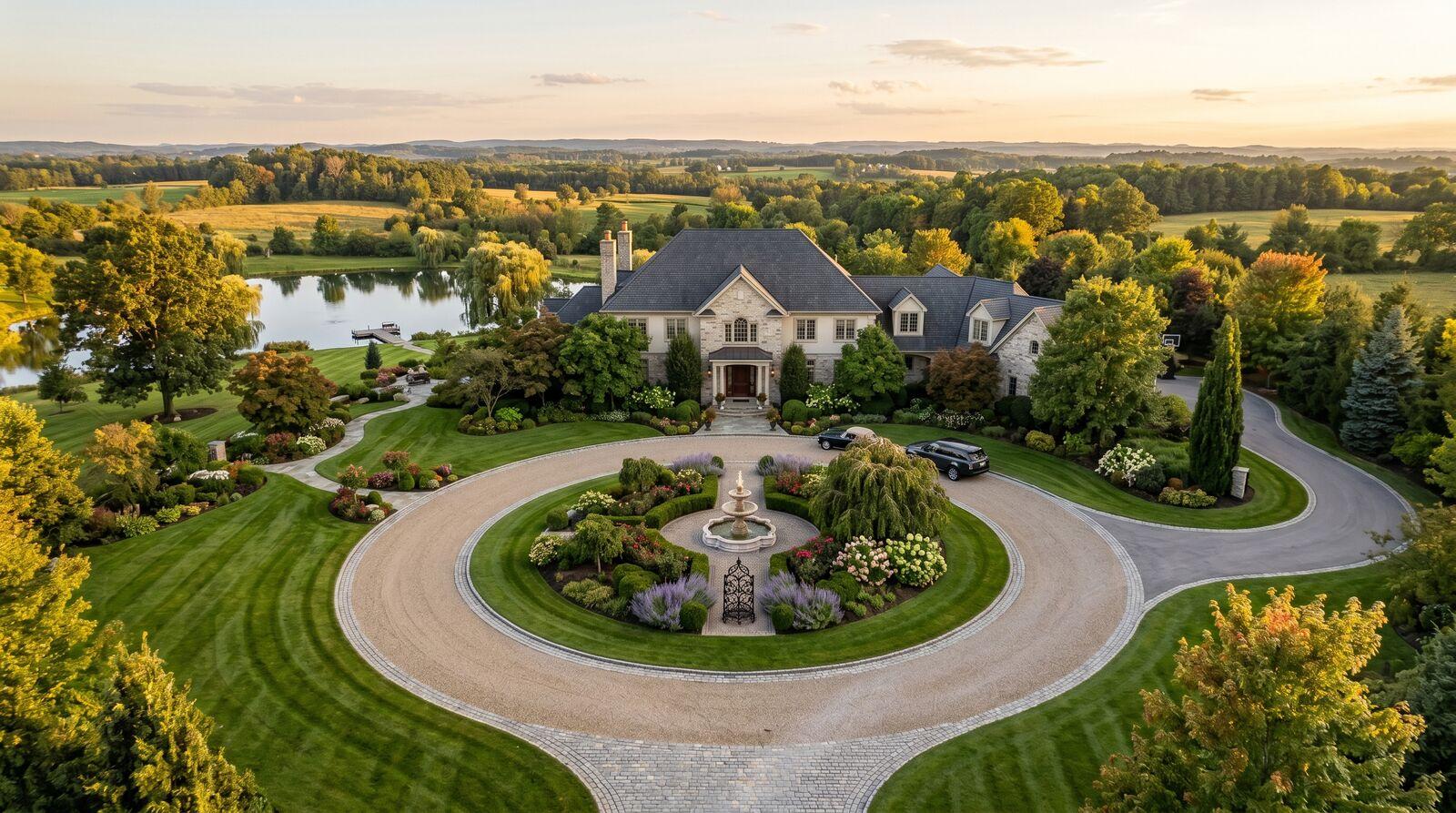
A circular driveway changes how your entire property functions. Instead of backing out into traffic every morning — that awkward reverse-and-pray maneuver — you pull forward in a smooth loop and merge naturally. It sounds like a small thing until you have done it a few hundred times. But circular driveways come with real constraints that most homeowners discover too late: lot width requirements, permitting headaches, costs that can easily double a standard straight driveway, and design decisions that are surprisingly hard to reverse. Here is what you actually need to know before committing.
Minimum Lot Size and Frontage Requirements
This is the deal-breaker for most people, so let us address it first. A functional circular driveway requires a minimum lot frontage of about 30 feet, and that is tight. Most installers and the American Society of Landscape Architects recommend at least 40 to 50 feet of frontage for a comfortable loop that does not feel cramped.
The math works like this. You need two curb cuts (entrance and exit), each about 10 to 12 feet wide. Between them, you need enough space that the loop feels natural rather than like a U-turn. The center island — the landscaped area inside the loop — needs to be at least 15 feet in diameter for a passenger car to navigate comfortably. For SUVs and trucks, bump that to 20 feet.
Your total driveway footprint for a modest circular design will be roughly 1,000 to 1,500 square feet. A larger loop with a generous center island can easily reach 2,000 to 2,500 square feet. Compare that to a standard straight two-car driveway at 500 to 700 square feet and you can see why costs multiply quickly.
Also check your local zoning code. Some municipalities restrict the number of curb cuts per lot or require minimum spacing between curb cuts. You may need a variance or special permit, which adds time and cost. Call your local planning department before you sketch anything on paper.
Design Dimensions That Work
Getting the proportions right is the difference between a circular driveway that feels elegant and one that feels like a parking lot. Here are the dimensions that experienced designers recommend.
Drive lane width should be 10 to 12 feet for one-way traffic flow. If you want two cars to pass each other within the loop, you need 18 to 20 feet, but this creates a much larger footprint and is rarely necessary for residential use.
Center island diameter of 15 to 20 feet works for most passenger vehicles. Delivery trucks and moving vans need more room. If you regularly receive large deliveries, consider 25 feet.
Turning radius is measured from the center of the island to the center of the drive lane. A minimum inner turning radius of 12 feet accommodates passenger cars. The outer turning radius will be 22 to 24 feet with a 10-foot-wide lane.
Entry and exit angle matters for safety. Both curb cuts should meet the street at close to 90 degrees to give drivers clear sightlines. Acute angles create blind spots and make merging dangerous, especially on busy streets.
Setback from the house — leave at least 5 to 8 feet between the nearest edge of the driveway and your front facade. This space prevents the driveway from dominating the front of the house and gives room for foundation plantings.
What a Circular Driveway Actually Costs
A circular driveway costs more than a straight driveway of the same material, both because the total area is larger and because curves require more skilled labor and material cutting. Here are realistic cost ranges by material.
Gravel is the most affordable option at $3 to $6 per square foot installed. For a 1,200-square-foot circular layout, expect $3,600 to $7,200. Gravel works surprisingly well for circular driveways in rural and suburban settings, and it handles curves naturally without any cutting. The downside is ongoing maintenance — you will need to rake and replenish gravel periodically, and snow plowing can displace material.
Asphalt runs $7 to $13 per square foot. A 1,200-square-foot loop costs $8,400 to $15,600. Asphalt handles curves well and provides a clean, dark surface. It needs sealing every two to three years.
Poured concrete costs $8 to $18 per square foot depending on finish. Budget $9,600 to $21,600 for a 1,200-square-foot layout. Curves require careful forming, and expansion joints need thoughtful placement to look right on a radius.
Pavers — either brick or concrete — cost $15 to $30 per square foot, putting a 1,200-square-foot circular driveway at $18,000 to $36,000. Pavers are the premium choice and they look exceptional on circular layouts. The natural joints between pavers handle curves gracefully, and fan patterns designed specifically for radius work are available.
Add $1,500 to $5,000 for center island landscaping, depending on how elaborate you want it. A simple grass island with a small tree is on the low end. A designed landscape with specimen plantings, lighting, and decorative stone pushes toward the high end.
The Traffic Flow Advantage
The practical argument for a circular driveway is simple: you never back into the street. This matters more than people realize. The National Highway Traffic Safety Administration data consistently shows that backing maneuvers are disproportionately involved in driveway-related accidents, particularly those involving children and pedestrians. A circular driveway eliminates backing entirely during normal daily use.
It also matters for convenience. If you live on a busy road, backing out during morning rush is stressful and sometimes genuinely dangerous. A circular driveway turns that into a calm, forward-driving exit every time.
Guest parking is the other advantage. A circular driveway provides natural overflow parking without cars blocking each other in. Guests can pull into the loop, park along the outer edge, and leave independently. No more orchestrating a multi-car shuffle when someone needs to leave a dinner party early.
When a Circular Driveway Adds Value vs Wastes Space
A circular driveway adds measurable property value when three conditions align: the lot is large enough that the driveway does not overwhelm the front yard, the home's architecture supports a formal or estate-style approach, and the street is busy enough that the traffic flow benefit is meaningful.
On a generous lot with a colonial, Mediterranean, or estate-style home set back from a moderately busy road, a well-designed circular driveway can add 5 to 10 percent to curb appeal value. Real estate agents consistently cite circular driveways as a feature that attracts buyers in the upper-mid price range and above.
A circular driveway wastes space — and can actually hurt value — when the lot is too small. If the loop eats up most of your front yard, the property looks like a parking turnaround rather than a home. The center island ends up too small to landscape meaningfully, and the whole thing feels forced. On lots under 60 feet wide, think very carefully before committing.
Suburban tract homes on quiet cul-de-sacs rarely benefit from circular driveways. If you are backing into a street with three cars per hour, the safety argument evaporates and you are just spending $15,000 to $35,000 on a feature that does not solve a real problem.
Permitting and Municipal Considerations
Circular driveways require two curb cuts, and most municipalities regulate curb cuts. You will likely need a driveway permit at minimum, and possibly a variance if your local code limits properties to one curb cut. Permit costs range from $50 to $500 depending on your municipality.
Stormwater management is increasingly a factor. A circular driveway adds significantly more impervious surface than a straight driveway, which means more stormwater runoff. Some jurisdictions now require stormwater mitigation plans for driveways above a certain square footage. Permeable pavers or a gravel loop can help address this requirement while potentially avoiding additional regulatory hurdles.
Utility easements along your frontage can also complicate things. If there is a utility easement in your front yard — common in many subdivisions — you may not be able to build a driveway across it or may need utility company approval.
The permitting process typically takes two to six weeks. Start early and do not sign a contract with an installer until you have permit approval in hand.
Center Island Design Ideas
The center island is the focal point of your circular driveway, so it deserves real thought. The most common mistake is planting a tree that grows too large and eventually heaves the driveway surface with its roots. Choose a small ornamental tree — Japanese maple, crape myrtle, or a columnar variety — that stays proportional to the island size and has a non-aggressive root system.
Low maintenance is key. You will be driving past this island multiple times daily but rarely stopping to tend it. Evergreen shrubs, ornamental grasses, and groundcovers that need minimal attention are smarter choices than perennial beds that demand weekly care.
Lighting the center island dramatically increases the visual impact at night. Two to four low-voltage uplights on the specimen tree and some path-level fixtures along the driveway edge transform the approach after dark.
Keep the island slightly raised — 4 to 6 inches above the driveway surface — with a clean edge. This prevents cars from cutting across it and gives the landscaping definition. A stone or brick edge that matches your driveway material ties the whole design together.
See Your Circular Driveway Before Breaking Ground
A circular driveway is a significant commitment — both financially and in terms of how it changes your property's appearance. Before you start the permitting process and contractor interviews, upload a photo of your current front yard to DrivewAI and preview what a circular layout would look like with different materials and landscaping. It is a lot cheaper to experiment digitally than to discover you prefer pavers over concrete after 40 yards of concrete have been poured. Check out our paver driveway guide and gravel driveway guide to compare material options, then try the visualizer to see how each one looks on your actual property.
About the author
Noah James
Founder, DrivewAI
Noah James is the founder of DrivewAI, an AI home visualization platform that helps homeowners, contractors, and real estate agents preview renovations before committing. He built DrivewAI to close the gap between inspiration and execution in home improvement.
His writing focuses on practical renovation decision-making, material comparisons, and how AI visualization tools are changing the way people plan projects — from driveway replacements to full interior staging.
See your home transformed by AI
Upload a photo and get AI renderings across every style. Designs from $9 with a 24-hour refund guarantee.
Try DrivewAI Free