Garage Door Ideas That Transform Your Curb Appeal
By Noah James
• 8 min read • Founder, DrivewAI
The Biggest Design Element You Have Been Ignoring
Here is a number that should change how you think about your home's front face: your garage door occupies roughly 30-40% of it. On a typical two-car garage home, the garage door is the single largest visual element facing the street. Bigger than the front door. Bigger than any window. Bigger than the porch. And despite that, most homeowners treat garage door ideas as an afterthought — pick the cheapest option, match it to the house color, and forget about it.
This is a massive missed opportunity. Replacing or updating a garage door is one of the highest-ROI home improvements you can make, consistently ranking in the top three in Remodeling Magazine's Cost vs. Value report. A garage door replacement recoups 90-100% of its cost at resale. That is better than a kitchen remodel, better than a bathroom renovation, and infinitely easier to execute. No permits, no plumbing, no living in a construction zone. A crew shows up, takes down the old door, installs the new one, and leaves. Four hours, transformation complete.
Garage Door Styles: Picking the Right One
Carriage house
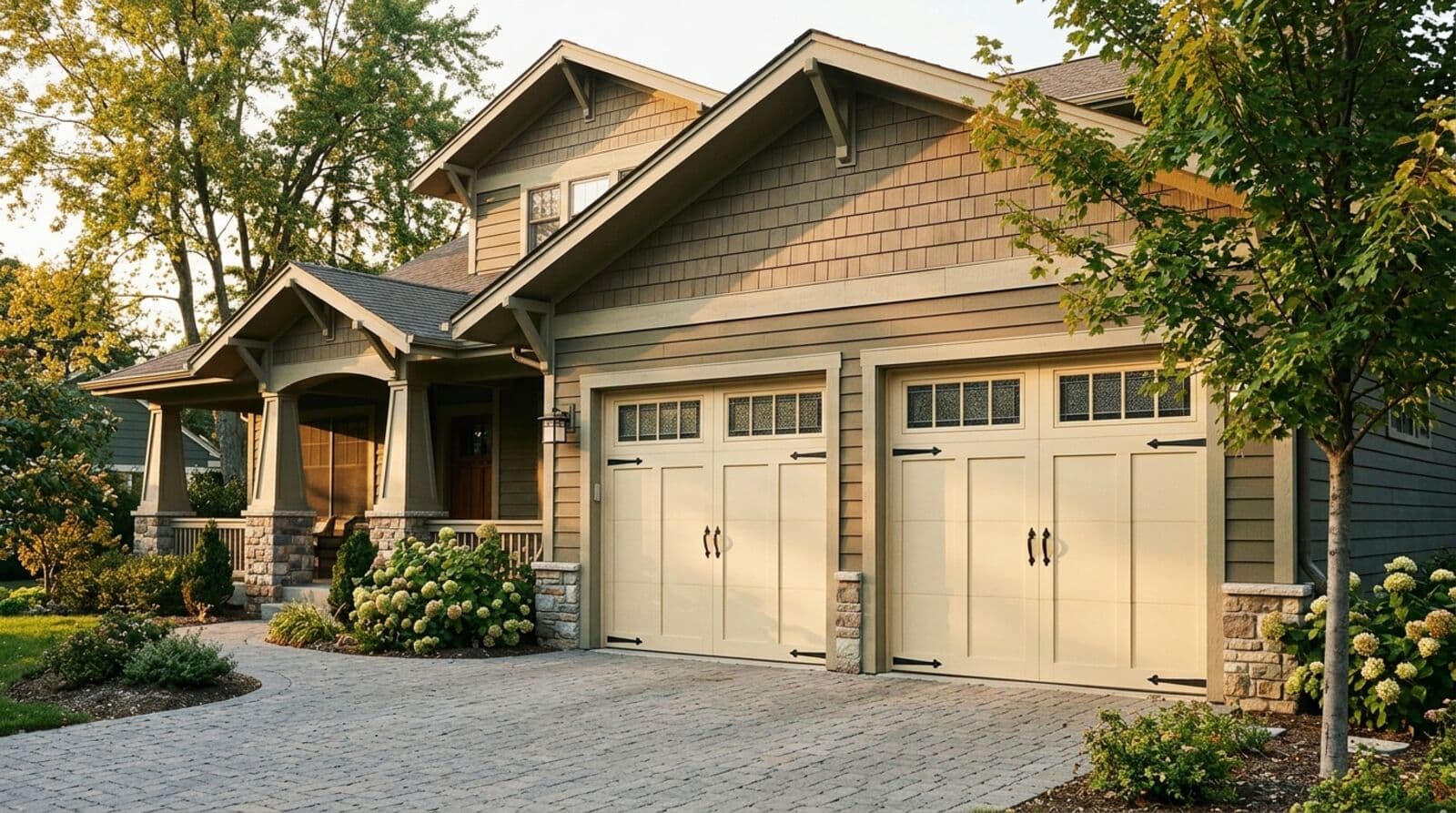
Carriage house doors are designed to look like old swing-out barn doors but operate as modern overhead doors. They feature decorative hardware (hinges and handles that are ornamental, not functional), crossbuck or panel designs, and often window inserts along the top row. Carriage house doors suit Craftsman, farmhouse, and traditional homes. They are the most popular upgrade style because they add character to even the plainest garage.
Modern flush
Flush doors are flat, smooth panels with clean lines. They come in aluminum, glass, steel, or wood. The glass-and-aluminum combination is the signature contemporary garage door — think frosted glass panels in a slim aluminum frame. These doors look stunning on modern and mid-century homes but fight with traditional architecture. If your house has shutters, dormer windows, and a Colonial front porch, a flush glass garage door will look like it was delivered to the wrong address.
Traditional raised panel
Raised panel doors are the default. Short rectangular panels arranged in rows. They are inoffensive and versatile, which is why every builder uses them. The problem is that they are also forgettable. If your home is traditional but you want the garage door to contribute to curb appeal rather than just exist, a carriage house style is the upgrade path. If your home is modern, flush panels are the move. Raised panel is the "I have not thought about this" option, and it shows.
Contemporary with windows
A middle ground between flush and traditional: clean panel lines with a row of windows. This style works across many home types because the windows add interest without committing to a full carriage house or full modern look. Window placement matters — a single row at the top is most common, but mid-door windows create a more distinctive look.
Material Breakdown: Steel, Wood, and Aluminum
Steel ($800-$2,500 per door)
Steel is the dominant garage door material and for good reason. It is durable, low-maintenance, insulative (when insulated cores are added), and available in every style. Modern steel doors can be textured to look like wood grain, which is convincing enough from 20 feet away. The range in price comes down to thickness (gauge), insulation, and finish quality. A basic single-layer steel door is around $800. A triple-layer insulated steel door with a premium finish runs $1,500-$2,500.
Go with at least a two-layer (steel + insulation) door. Single-layer steel doors dent easily, have no insulation value, and sound like a drum in the rain. The insulation upgrade costs $200-$400 more and is worth every dollar, especially if the garage is attached to the house.
Wood ($1,500-$5,000+ per door)
Wood garage doors are beautiful and high-maintenance. Cedar, redwood, and mahogany are the most common species. They need to be refinished every 2-3 years, and they are heavier than steel or aluminum, which means the opener and springs work harder. The visual payoff is real — nothing looks exactly like real wood, and up close, the warmth and texture are undeniable.
Wood makes sense on high-end homes where the garage door is a prominent architectural feature and the homeowner is willing to maintain it. For everyone else, steel doors with realistic wood-grain textures get 85% of the look with 5% of the upkeep.
Aluminum ($1,200-$3,000 per door)
Aluminum is lighter than steel, resistant to rust, and the material of choice for modern full-view (glass panel) doors. Powder-coated aluminum frames with frosted or tinted glass panels create the contemporary look that has become popular in architect-designed homes. Aluminum is less insulative than steel, so it is a better fit for mild climates or detached garages where energy loss is not a concern.
The Window Insert Trick: $200 That Transforms a Plain Door
If your existing garage door is structurally sound but aesthetically boring, window inserts are the single best upgrade for the money. Most raised panel and carriage house style doors have a top row of panels that can accept window inserts. These snap or screw into the existing panel cutouts.
Cost: $150-$300 for a full set (both sides of a two-car garage).
Window styles range from plain rectangular glass to arched, prairie-style, or decorative options. The general rule is to match the window style to your home. Colonial homes look best with rectangular divided-light inserts. Craftsman homes suit prairie-style or arched inserts. Modern homes want plain, unadorned glass.
The impact is disproportionate to the cost. Windows break up the blank expanse of a solid door and let light into the garage, which is a practical bonus if you use the garage as a workshop. If privacy is a concern, frosted or obscured glass inserts let in light without visibility.
This is the kind of upgrade that makes people ask "did you get a new garage door?" when all you did was spend $200 on window inserts and an hour with a drill.
Color Coordination: Making the Garage Door Belong
The default approach is painting the garage door to match the house body color, and for most homes, this is correct. Matching the body color lets the door recede into the facade, which works when you want the front door, landscaping, or architectural details to be the focal point.
But there are cases where contrast works better.
Accent color (matching trim or front door): On homes with a dark body color, a lighter garage door (matching the trim color) creates definition and prevents the garage from looking like a dark cave. On white or light homes, a darker garage door adds weight to the lower portion of the facade.
Stained wood or wood-grain finish: A wood-tone garage door on a painted house creates warmth and a natural accent. This works particularly well on modern farmhouse and contemporary homes where the rest of the palette is cool-toned.
Full contrast (black door on white house or vice versa): High-contrast garage doors make a statement. This is the approach in most modern farmhouse designs and it works because the limited color palette keeps it clean.
Colors to avoid: anything that does not appear elsewhere on the house. A standalone color on the garage door — one that does not connect to the trim, shutters, front door, or siding — looks arbitrary. The garage door should reference at least one other color on the home.
Smart Garage Door Openers and Technology
Smart garage openers have become genuinely practical additions, not just tech gimmicks.
Smart openers ($250-$400 installed) connect to Wi-Fi and let you open, close, and monitor the garage from your phone. The real value is the "did I close the garage?" peace of mind when you are already 10 minutes down the road. Most integrate with Alexa, Google Home, or Apple HomeKit.
Camera-equipped openers ($300-$500) add a video feed of the garage interior. Useful for monitoring deliveries left inside the garage (increasingly common with in-garage delivery services from Amazon and others).
Battery backup is an underrated feature. If the power goes out — which happens during exactly the kind of storms when you need to get your car out — battery backup keeps the door operational. Most smart openers include this, but verify before buying.
Quiet operation. Belt-drive openers are significantly quieter than chain-drive. If bedrooms are above or adjacent to the garage, the upgrade from chain to belt drive ($50-$100 more) is worth it for the household peace alone.
Common Garage Door Mistakes
Wrong scale. A single oversized door (16+ feet) on a modest home looks like a commercial loading dock. Two 8-foot doors or a 16-foot door with a center post creates better proportions on most residential facades.
Ignoring hardware. On carriage house doors, the decorative hardware (handles and hinges) is part of the design. Skipping the hardware to save $50 makes the door look unfinished. Conversely, adding decorative hardware to a flush modern door looks confused.
Mismatched style. The garage door style should relate to the house architecture. This is where people go wrong most often — a rustic carriage house door on a contemporary home, or a glass-panel modern door on a Colonial. The door does not have to match exactly, but it should feel like it belongs in the same architectural family.
Neglecting the surround. The trim around the garage door matters. Wide trim with a header detail frames the door and gives it importance. Minimal or no trim makes even a nice door look like an afterthought. On many homes, adding or upgrading the garage door trim is as impactful as the door itself.
Preview Your New Garage Door Before You Order
Garage doors are too expensive and too visible to get wrong. A $2,000 door that clashes with your home is worse than the builder-grade door it replaced, because now you have spent money to make things look worse.
Upload a photo of your home to DrivewAI and preview different garage door styles, materials, and colors on your actual house. DrivewAI plans start at just $9.00 — compare that to the cost of ordering the wrong garage door and paying for a second installation. Seeing your home with a carriage house door versus a flush modern door versus an updated version of your current style makes the decision obvious.
For a complete curb appeal overhaul, combine your garage door update with insights from our front door ideas guide and driveway redesign ideas. When the door, the driveway, and the garage all work together, the whole front face of your home levels up.
About the author
Noah James
Founder, DrivewAI
Noah James is the founder of DrivewAI, an AI home visualization platform that helps homeowners, contractors, and real estate agents preview renovations before committing. He built DrivewAI to close the gap between inspiration and execution in home improvement.
His writing focuses on practical renovation decision-making, material comparisons, and how AI visualization tools are changing the way people plan projects — from driveway replacements to full interior staging.
See your home transformed by AI
Upload a photo and get AI renderings across every style. Designs from $9 with a 24-hour refund guarantee.
Try DrivewAI Free