Bathroom Remodel Cost: Real Numbers by Scope
By Noah James
• 9 min read • Founder, DrivewAI
Why Bathroom Remodel Cost Estimates Are All Over the Map
Search for "bathroom remodel cost" and you will find numbers ranging from $3,000 to $80,000. That is not helpful. It is like saying a car costs somewhere between $5,000 and $200,000. Technically accurate, practically useless. The reason bathroom remodel cost varies so wildly is that "remodel" means completely different things to different people. Painting the vanity and swapping hardware is a remodel. Gutting the room, moving the plumbing, and installing a freestanding tub is also a remodel. These are not the same project, and they should not share a cost range.
This guide breaks down real costs by scope so you can figure out where your project actually falls and where your money will go. No vague averages. No misleading national medians that include both a powder room refresh in rural Mississippi and a master bath renovation in Manhattan.
Tier 1: Cosmetic Refresh ($2,000-$5,000)
A cosmetic refresh keeps the existing layout, plumbing, and surfaces in place. You are changing what you see without changing what is behind the walls.
What is included:
- Paint walls and ceiling ($200-$400) - Replace vanity light fixture ($100-$400) - Swap faucet ($150-$500) - New mirror ($100-$600) - Replace toilet seat, showerhead, towel bars, toilet paper holder ($100-$300) - Reglaze or paint the existing bathtub ($300-$600) - New vanity top without replacing the cabinet ($200-$800)
What it gets you: A bathroom that looks noticeably updated without construction. The room still has the same footprint, the same tile, and the same tub — but fresh fixtures and finishes make it feel 10 years newer.
Who this is for: Homeowners who need a visual update for resale prep or personal satisfaction but cannot justify tearing things apart. This is also the right scope for rental properties and investment homes where ROI matters more than personal taste.
The honest truth: A cosmetic refresh is limited by whatever you cannot change. If the tile is dated, the tub is stained, or the vanity is falling apart, paint and new fixtures can only do so much. This tier works best when the existing bones are decent and just need polishing.
Tier 2: Mid-Range Remodel ($10,000-$25,000)
The mid-range remodel replaces surfaces and fixtures while keeping the layout intact. Same plumbing locations, same footprint, new everything else.
What is included:
- Remove and replace tile (floor and tub/shower surround) — $3,000-$8,000 - New vanity with countertop and sink — $800-$3,000 - New toilet — $250-$800 - New tub or shower base (same location) — $500-$2,000 - New faucets, showerhead, shower valve — $500-$1,500 - Lighting and electrical updates — $500-$1,500 - Paint and finishing — $300-$600 - Labor for demolition and installation — $3,000-$7,000
What it gets you: A bathroom that feels entirely new. New tile, new vanity, new fixtures — the room is transformed. Because the plumbing stays in the same locations, you avoid the most expensive line items (more on that below).
Who this is for: Most homeowners doing a primary bathroom upgrade. This is the sweet spot where the result feels custom but the costs stay manageable. According to Remodeling Magazine's Cost vs. Value data, a mid-range bathroom remodel recoups roughly 60-70% of its cost at resale.
The honest truth: Tile is the biggest variable in this tier. Subway tile from a big box store installed in a simple pattern costs $8-$12 per square foot installed. Large-format porcelain in a complex pattern runs $15-$25 per square foot. Handmade zellige tile with a custom layout can hit $40+ per square foot. The tile choice alone can swing a mid-range remodel by $3,000-$5,000.
Tier 3: Luxury Gut Renovation ($30,000-$75,000)
A gut renovation strips the bathroom to the studs and rebuilds from scratch. Everything is new: layout, plumbing, electrical, walls, floors, fixtures, finishes.
What is included (in addition to mid-range items):
- Demolition to studs — $1,500-$3,000 - Plumbing relocation — $2,000-$8,000 - Electrical rewiring — $1,000-$3,000 - New subfloor and waterproofing — $1,000-$3,000 - Heated floors — $1,000-$2,500 - Freestanding tub — $1,000-$5,000 - Frameless glass shower enclosure — $1,500-$4,000 - Custom vanity — $2,000-$8,000 - Premium tile (walls, floor, shower niche) — $5,000-$15,000 - Upgraded ventilation — $500-$1,500 - Design fees — $1,000-$3,000
What it gets you: A bathroom designed from scratch to your specifications. Custom layout, premium materials, and details like heated floors and curbless showers.
Who this is for: Homeowners with the budget for a dream bathroom, typically in a primary suite. Also necessary when the existing bathroom has structural issues (water damage, mold, outdated plumbing) that require opening walls regardless.
The honest truth: Gut renovations regularly exceed initial estimates by 15-25%. The most common budget-busters are discoveries behind the walls — water damage, inadequate framing, outdated plumbing that does not meet code. Build a 20% contingency into any gut renovation budget.
What Actually Costs the Most
People assume the expensive part of a bathroom remodel is the fixtures — the tub, the vanity, the faucet. Those are significant, but they are not the budget killers. The two most expensive elements in most bathroom remodels are tile labor and plumbing changes.
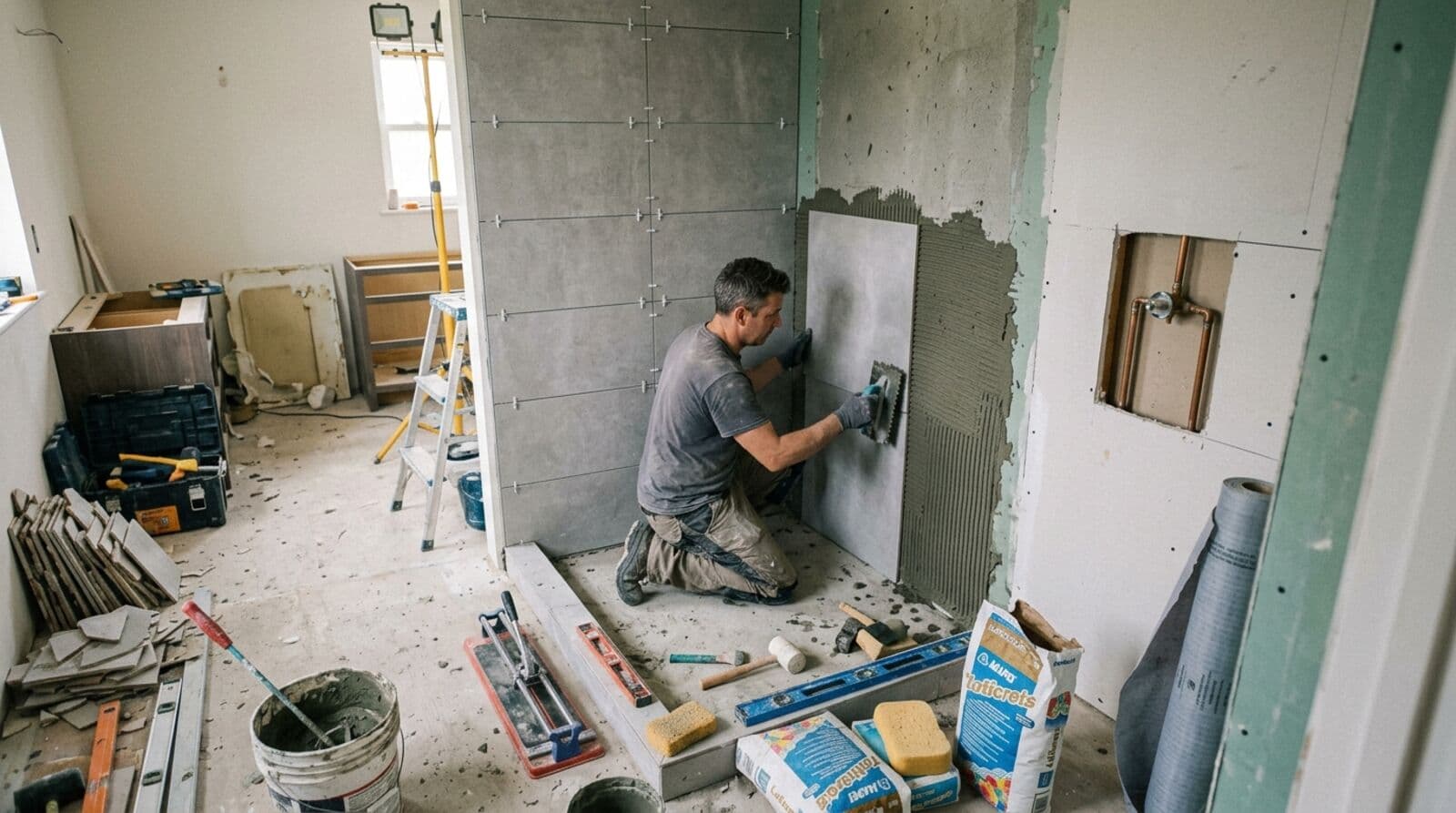
Tile labor is expensive because it is skilled, slow work. A tile installer might complete 30-50 square feet per day depending on the tile size, pattern, and layout complexity. A full bathroom with floor tile, shower surround tile, and a tile accent wall can take 3-5 days of installation alone, plus prep time. At $50-$100 per hour for a skilled tile setter, the labor often exceeds the material cost.
Plumbing relocation is the other hidden cost driver. Moving a shower valve to a new wall is not just about the pipe — it means opening the wall, possibly the floor, running new supply and drain lines, and then patching and finishing everything. Moving a toilet is even worse because the drain (the closet flange) is in the floor, which means cutting into the subfloor and potentially the floor joists.
The Layout Change Penalty
This deserves its own section because it catches people off guard. Moving plumbing fixtures — toilet, sink, shower — from one location to another adds $5,000-$15,000 to the project. That is not the cost of the new toilet or shower. That is just the cost of making the plumbing work in the new location.
Moving a toilet costs $3,000-$6,000 because it requires relocating the drain in the floor. If the bathroom is above a finished ceiling, the ceiling below needs to be opened and repaired too.
Moving a shower costs $2,000-$5,000 for supply and drain relocation plus waterproofing the new location.
Moving a vanity to a different wall costs $1,500-$4,000 for supply, drain, and vent relocation.
The takeaway: if you can keep the toilet, shower, and vanity in their current locations while upgrading everything else, you save thousands. The layout change penalty is the single biggest cost lever in a bathroom remodel. Designers and contractors know this. Homeowners often do not, which leads to sticker shock when the bid comes back.
Where to Save Without It Looking Cheap
There is an art to cutting bathroom remodel costs without the result screaming "budget." Here is where to save.
Keep the layout. Already covered, but it bears repeating. Same footprint, same plumbing locations. This is the biggest single savings.
Standard tile in a clean pattern. White subway tile in a brick pattern costs $8-$12 per square foot installed and looks timeless. It has been in style for over 100 years and is not going anywhere. The "basic" choice is often the enduring one.
Stock vanity with an upgraded top. A stock vanity from a big box store ($300-$800) with a quartz or marble countertop ($200-$600) looks nearly identical to a custom vanity costing three times as much. The vanity box is hidden behind doors — nobody sees the particleboard.
Splurge on fixtures, save on surfaces. A high-quality faucet ($250-$500) is used and noticed daily. Expensive floor tile is walked on and mostly covered by bath mats. Put the money where people interact with it.
Refinish instead of replace. Bathtub reglazing ($300-$600) is a fraction of the cost of a new tub ($500-$2,000) plus installation ($500-$1,000). If the tub is cast iron and in good structural shape, reglazing is the smart move.
Skip the heated floors in small bathrooms. In a 40-square-foot bathroom, heated floors add $1,000-$1,500 to the project. A $30 bath mat achieves roughly the same warm-feet result. Save heated floors for larger master bathrooms where the investment is proportional to the space.
Small Bathroom vs. Master Bath: The Cost Difference
Size affects cost, but not proportionally. A small bathroom (40-50 square feet) costs roughly 50-70% of a comparably scoped master bath (80-120 square feet). The reason it is not a straight per-square-foot calculation is that every bathroom needs at least one toilet, one sink, and one shower/tub — and the labor to install those is similar regardless of room size.
Powder room (half bath) remodel: $3,000-$10,000. No tub or shower means no tile surround, no waterproofing complexity, and no shower fixture costs. A powder room remodel is mostly vanity, toilet, mirror, and paint.
Small full bath: $8,000-$20,000. Tighter spaces actually cost more per square foot because the contractor is working in cramped conditions. Tiling a 3x3 shower stall takes as long as a 4x5 one because the setup, grouting, and finishing are the same.
Master bath: $15,000-$50,000+. Larger footprint means more tile, more countertop, and often a separate tub and shower. The fixtures tend to be higher-end because this is the homeowner's personal space. Double vanities, freestanding tubs, and frameless glass all add up.
Visualize Your Bathroom Remodel Before Demo Day
The most expensive bathroom mistake is hating the result. A $20,000 remodel that you regret — wrong tile color, wrong vanity style, wrong layout — is not just a financial loss. It is a daily reminder in the most personal room in your home.
Before committing to materials and design, upload a photo of your current bathroom to DrivewAI's staging tool and preview different design directions. DrivewAI plans start at just $9.00, and seeing your actual bathroom with different tile, vanity, and color schemes is the closest thing to a time machine for design decisions. It is dramatically cheaper than ordering tile samples, taping them to the wall, and still not being sure.
Pair your bathroom project with our guide to AI room redesign before buying furniture for tips on using visualization tools to plan interior changes across every room. And if your exterior needs attention too, our driveway redesign ideas cover the other side of the house.
About the author
Noah James
Founder, DrivewAI
Noah James is the founder of DrivewAI, an AI home visualization platform that helps homeowners, contractors, and real estate agents preview renovations before committing. He built DrivewAI to close the gap between inspiration and execution in home improvement.
His writing focuses on practical renovation decision-making, material comparisons, and how AI visualization tools are changing the way people plan projects — from driveway replacements to full interior staging.
See your home transformed by AI
Upload a photo and get AI renderings across every style. Designs from $9 with a 24-hour refund guarantee.
Try DrivewAI Free